Talks or tactics? Washington says progress. Tehran says retreat. The truth may decide the war.
A fragile diplomatic opening is emerging in the fourth week of the Iran war—but even that possibility is clouded by conflicting narratives and deep mistrust.
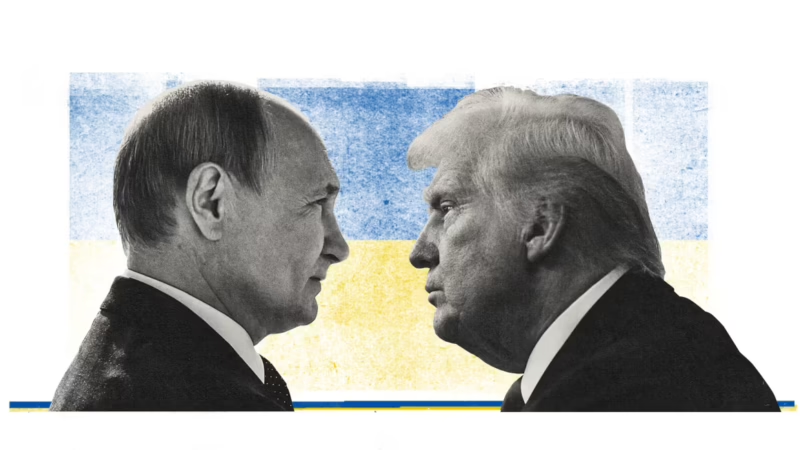
Israeli Prime Minister Benjamin Netanyahu said President Donald Trump now sees a potential path to a negotiated settlement, suggesting that recent military gains could be leveraged into a broader agreement with Tehran.
The comment followed what Trump described as “productive” conversations with Iranian representatives, prompting a five-day pause on planned U.S. strikes against Iran’s energy infrastructure.
The shift marks a notable turn in tone. After days of escalating threats—including warnings to “obliterate” Iranian power plants—Washington is now signaling that diplomacy may offer a way to achieve its objectives without further widening the conflict.
But the picture remains far from clear.
Trump insists that discussions are underway and progressing, even hinting at a possible “complete and total resolution” of hostilities. Yet Iranian officials are publicly rejecting that account.
A senior security figure in Tehran said no such talks are taking place, framing the U.S. pause not as a diplomatic breakthrough, but as a retreat driven by military pressure and market instability.
That divergence highlights a recurring feature of the conflict: parallel narratives aimed at shaping perception as much as reality.
For Netanyahu, the moment presents an opportunity. His statement suggests Israel is prepared to translate battlefield momentum into political outcomes—provided any agreement secures its core security interests.
At the same time, Israeli operations continue, indicating that military pressure remains part of the broader strategy.
For Trump, the stakes are both strategic and domestic. A negotiated outcome could stabilize energy markets, ease economic pressure at home, and offer a pathway to declare success. But it also risks appearing inconsistent after a series of escalating threats and rapid policy shifts.
The absence of direct contact with Iran’s new supreme leader, Mojtaba Khamenei, adds another layer of uncertainty. Without clear engagement at the highest level, it remains unclear whether any discussions—formal or indirect—can produce a binding agreement.
Meanwhile, regional dynamics continue to evolve. Gulf states remain wary of escalation, while global markets react sharply to each signal of either conflict or compromise. The five-day pause has temporarily eased tensions, but it has not resolved the underlying standoff over the Strait of Hormuz or the broader strategic rivalry.
The central question now is whether this moment represents a genuine opening—or a tactical pause in a conflict that is still expanding.
If talks materialize into concrete terms, the war could pivot toward de-escalation. If not, the competing narratives from Washington and Tehran may only deepen mistrust, setting the stage for renewed escalation once the temporary reprieve expires.
For now, diplomacy and confrontation are unfolding side by side.
And in that narrow space between them, the outcome of the war may ultimately be decided.