Analysis
Exile as a Temporary State: The Resilience of Burmese Writer Ma Thida
Exploring the Journey and Impact of Ma Thida’s Exile on Burmese Literature and Activism
By Kasim Abdulkadir:
Ma Thida, a prominent Burmese writer, physician, and activist, embodies the spirit of resilience and hope amid the challenges of political exile. Her story is a testament to the power of the written word and the unyielding human spirit in the face of repression. This article delves into Ma Thida’s journey, the significance of her work, and its broader impact on Burmese literature and activism.
The Journey of Ma Thida
Ma Thida’s journey is one of remarkable courage and perseverance. Born in Burma (Myanmar), she pursued a career in medicine while simultaneously nurturing her passion for writing. Her dual roles as a physician and writer provided her with unique insights into the human condition, which she eloquently expressed through her literary works.
However, Ma Thida’s outspoken criticism of the Burmese government led to her arrest in 1993. She was sentenced to 20 years in prison on charges of “endangering public peace, having contact with illegal organizations, and distributing unlawful literature.” Her imprisonment brought international attention to the human rights abuses in Burma, and she was eventually released in 1999 after serving almost six years.
Exile and Activism
Following her release, Ma Thida continued to face persecution, which led her to seek refuge abroad. Despite the physical displacement, she viewed exile as a “temporary state of mind,” focusing on the continuity of her activism and literary contributions rather than the constraints of her situation.
In exile, Ma Thida has become a prominent voice for freedom and democracy. She has participated in numerous international forums, advocating for human rights and shedding light on the plight of the Burmese people. Her work has not only highlighted the struggles within Burma but has also inspired global audiences to support the cause of freedom and justice.
Literary Contributions
Ma Thida’s literary works are deeply intertwined with her activism. Her writings, including novels, essays, and short stories, reflect the socio-political landscape of Burma and the resilience of its people. Through her storytelling, she has provided a voice to the voiceless, capturing the complexities of life under an oppressive regime.
Her notable works, such as “The Roadmap” and “Prisoner of Conscience: My Steps through Insein,” offer personal and poignant insights into the challenges faced by political prisoners and the broader fight for democracy. Her ability to convey profound messages through literature has made her a revered figure in both literary and activist circles.
Impact and Legacy
Ma Thida’s impact extends beyond her literary achievements. She has founded PEN Myanmar, an organization dedicated to promoting freedom of expression and supporting writers in Burma. Her efforts have helped create a platform for Burmese writers to share their stories and advocate for change.
Her resilience in the face of adversity serves as an inspiration to many, highlighting the importance of perseverance and hope. Ma Thida’s story is a powerful reminder that exile, while challenging, can also be a period of profound growth and influence.
Multiple Perspectives and Future Scenarios
The story of Ma Thida can be viewed through multiple lenses:
- Human Rights Advocacy: Ma Thida’s journey underscores the critical role of human rights advocacy in challenging oppressive regimes. Her work highlights the importance of international solidarity and support for political prisoners and activists.
- Literary Influence: As a writer, Ma Thida has significantly contributed to Burmese literature, using her platform to address pressing social and political issues. Her works offer valuable insights into the lived experiences of those under authoritarian rule.
- Cultural Resilience: Ma Thida’s story illustrates the resilience of cultural and intellectual pursuits even in the face of exile. Her continued contributions to literature and activism demonstrate that physical displacement does not equate to the silencing of one’s voice.
- Future Prospects: Looking ahead, Ma Thida’s work could inspire a new generation of writers and activists in Burma and beyond. Her efforts to promote freedom of expression and support for writers may pave the way for more robust and vibrant literary and activist communities.
Conclusion: A Beacon of Hope
Ma Thida‘s story is a powerful narrative of resilience and hope. Her ability to view exile as a temporary state of mind and continue her activism and literary work is a testament to her strength and determination. As she continues to inspire others, Ma Thida remains a beacon of hope for those fighting for freedom and justice in Burma and around the world. Through her words and actions, she has shown that even in the most challenging circumstances, the human spirit can persevere and thrive.
Analysis
After Iran, Is Turkey Next?
If Iran falls, who stands next in line? In Ankara, that question is no longer theoretical.
Ankara Fears Crushing Tehran Could Trigger a New Phase of Regional Power Struggles.
As the war between Israel, the United States and Iran deepens, officials in Turkey are asking a stark question: if Tehran is broken, what comes next — and who?
From the first days of the open strikes on Iran in late February, President Recep Tayyip Erdogan condemned the attacks as violations of international law and warned that the conflict risked spiraling into a regional catastrophe.
Foreign Minister Hakan Fidan reinforced that message, cautioning that escalation could destabilize energy markets and disrupt the Strait of Hormuz, a chokepoint critical to global oil flows — and to Turkey’s import-dependent economy.
But Ankara’s concerns run deeper than fuel prices.
Turkish officials argue that forcibly dismantling Iran would not bring stability. Instead, it could collapse one of the region’s major power centers, triggering internal fragmentation and unleashing a chain reaction from Iraq and Syria to the Caucasus and the Eastern Mediterranean.
For Turkey, which has absorbed the spillover of wars in Iraq and Syria for two decades — from refugee waves to cross-border militancy — the prospect of chaos inside Iran is viewed as an existential strategic risk.
The fear is not ideological alignment with Tehran. Turkey and Iran compete across multiple theaters, from Syria to the South Caucasus. Rather, Ankara sees the regional balance — tense and imperfect though it may be — as preferable to a vacuum.
There is another layer to Turkish anxiety: the belief that Israel’s campaign may not end with Iran. Israeli political figures have publicly identified Turkey as a growing regional rival.
In Ankara’s strategic calculus, if Iran is decisively weakened, attention could shift toward other independent regional actors — with Turkey foremost among them.
Recent incidents have reinforced that sense of proximity. Iranian missiles have reportedly entered Turkish airspace during regional exchanges, prompting diplomatic protests.
For Ankara, the war is no longer distant. It is edging toward its borders.
At the same time, Turkey faces domestic economic fragility. Rising energy costs, inflationary pressure and market volatility could compound existing challenges. A prolonged regional war would translate quickly into higher import bills, strained budgets and social tension.
Ankara’s response has therefore followed a dual track: vocal diplomatic opposition to escalation and quiet reinforcement of defensive preparedness. Erdogan has repeatedly called for a ceasefire and mediation, framing diplomacy as the last barrier before a broader conflagration.
In Turkish strategic thinking, the destruction of Iran would not conclude a conflict. It would reset the Middle East into a far more combustible phase — one in which alliances shift, power vacuums open and rivalries intensify.
For now, Turkey speaks the language of restraint. But behind that language lies a sober calculation: if the region’s fire is not contained, it will not stop at Iran’s borders.
Analysis
Gulf States Want Iran Weakened — But Fear the Fire
As Hormuz Disruption Deepens, Arab Gulf Leaders Urge Washington to Finish the Job While Avoiding Direct Entry Into War.
They didn’t ask for this war — but now Gulf leaders fear living with a half-finished one.
The Gulf Arab states did not press Washington to launch its war on Iran. But as missiles strike airports, oil terminals and commercial hubs from Doha to Abu Dhabi, many now fear something worse than escalation: an unfinished campaign.
According to regional sources and diplomats, leaders across the Gulf increasingly believe that if the United States and Israel halt operations before decisively degrading Iran’s military capacity, the region could face a permanent state of vulnerability.
Tehran’s ability to disrupt the Strait of Hormuz — the artery carrying roughly one-fifth of global oil — has transformed abstract security concerns into immediate economic threats.
Abdulaziz Sager of the Gulf Research Center described a turning point in sentiment. Gulf governments initially opposed war. But once Iranian missiles and drones struck their territory, the calculus shifted. For some policymakers, the question is no longer whether Iran should be constrained — but whether Washington will see the campaign through.
Yet the Gulf faces a strategic paradox.
While pressing the U.S. not to leave Iran militarily intact, most Gulf states are reluctant to join the fight directly. Collective action might dilute exposure; unilateral intervention would invite retaliation.
The six members of the Gulf Cooperation Council — Bahrain, Kuwait, Oman, Qatar, Saudi Arabia and the United Arab Emirates — have held limited consultations, but no unified military posture has emerged.
The United Arab Emirates has publicly emphasized restraint, stating it does not seek escalation. Saudi Arabia, long Tehran’s principal rival, has signaled red lines — particularly attacks on major oil infrastructure or desalination plants — but appears intent on calibrating any response.
The underlying fear is clear: a weakened but not neutralized Iran could periodically hold the Gulf’s energy lifeline hostage.
The 2019 strike on Saudi oil facilities at Abqaiq and Khurais demonstrated how vulnerable even sophisticated defenses can be. Today’s disruptions go further, shaking the region’s carefully cultivated image as a stable hub for trade, tourism and investment.
Washington, for its part, is urging broader support. President Donald Trump has called for international participation in securing Hormuz. But enthusiasm is limited. Many regional leaders worry that deeper alignment with a U.S.-led offensive would magnify the very risks they seek to contain.
Iran’s leverage lies not only in missiles but in geography. Control over maritime chokepoints grants outsized influence over global markets. Even sporadic disruption sends oil prices soaring and rattles economies far beyond the Gulf.
The Gulf’s dilemma is therefore existential and political at once. Neutralizing Iran decisively could restore deterrence — but risks widening war. Leaving Iran partially intact may preserve short-term calm — but at the cost of enduring insecurity.
For now, Gulf capitals appear to be walking a narrow path: urging Washington to degrade Tehran’s capabilities while avoiding a direct plunge into the conflict. Whether that balance can hold may determine not only the outcome of this war, but the strategic architecture of the Gulf for years to come.
Analysis
If Iran’s Missiles Are “Destroyed,” Why Are They Still Flying?
Despite Heavy U.S.–Israeli Strikes, Tehran Retains Enough Launch Capacity to Sustain a War of Attrition.
Air dominance doesn’t mean silence. Iran’s reduced barrages still carry strategic weight.
The White House has declared sweeping success. “Complete and total aerial dominance,” it said, claiming Iran’s ballistic missile capability is “functionally destroyed.” President Donald Trump added that drone manufacturing capacity has been decimated.
Yet missiles continue to fly.
In recent days, Qatar, Saudi Arabia, the United Arab Emirates and Israel have all reported interceptions. A missile strike in Abu Dhabi killed one person. Sirens have echoed across central Israel. Drone-related fires have disrupted areas near Dubai and Fujairah. If Iran’s launch systems are crippled, how is it still firing?
The answer lies in scale, strategy and survivability.
There is little doubt that Iran’s capabilities have been sharply reduced. U.S. officials say missile launches are down roughly 90 percent from the first days of the war, with drone attacks reduced by more than 80 percent. Israeli assessments indicate hundreds of launchers have been destroyed — possibly 290 out of an estimated 410 to 440.
But “functionally destroyed” does not mean eliminated.
Iran entered the war with one of the region’s largest missile inventories, estimated in the thousands. More importantly, it invested heavily over the years in dispersal. Launchers were decentralized. Mobile systems were embedded in civilian or non-traditional locations. Hidden stockpiles were prepared long before the conflict escalated.
Without ground forces inside Iran, fully neutralizing those assets is extraordinarily difficult — even with air superiority.
What has changed is tempo. Instead of mass volleys, Tehran is firing sporadically — one or two missiles, a handful of drones. Militarily, such attacks may be limited. Strategically, they are potent.
Iran appears to be shifting from shock-and-awe retaliation to calibrated attrition. The objective is not overwhelming destruction but sustained pressure. Each launch forces costly intercepts, keeps air defenses on high alert and injects uncertainty into regional markets.
This is classic asymmetric warfare.
Iran’s relatively inexpensive drones, such as loitering munitions derived from the Shahed model, can be produced quickly and launched without sophisticated fixed infrastructure. Even if most are intercepted, the occasional breakthrough is enough to rattle public confidence. As security analysts often note, it takes only one successful strike to shift perceptions.
Tehran’s broader calculation may be economic rather than purely military. The conflict has already pushed oil prices above $100 per barrel. Shipping traffic through the Strait of Hormuz remains constrained, affecting roughly 20 percent of global energy flows. Insurance premiums are rising. Markets are volatile.
If the war becomes a contest of endurance — missile stockpiles versus interceptor inventories, economic resilience versus disruption — Iran may believe time is not entirely on Washington’s side.
The United States and Israel have degraded Iran’s capacity significantly. But degradation is not elimination. As long as Tehran can sustain a credible threat, even at reduced intensity, it retains leverage.
In modern warfare, silence is rarely absolute. The question is not whether Iran can fire as many missiles as before. It is whether firing fewer, more strategically, achieves its aims.
Analysis
Iran’s Proxy Play Reaches the Atlantic
From Lebanon to Yemen — and now the Sahara? Washington fears Tehran’s shadow network is moving west.
U.S. Lawmakers Move to Label Polisario a Terror Group Amid Claims of IRGC and Hezbollah Support in Western Sahara.
For years, analysts tracked Iran’s expanding arc of influence across the Middle East — from Hezbollah in Lebanon to the Houthis in Yemen. Now, U.S. lawmakers warn that Tehran’s shadow war may be stretching beyond the Levant and Gulf, toward North Africa’s Atlantic coast.
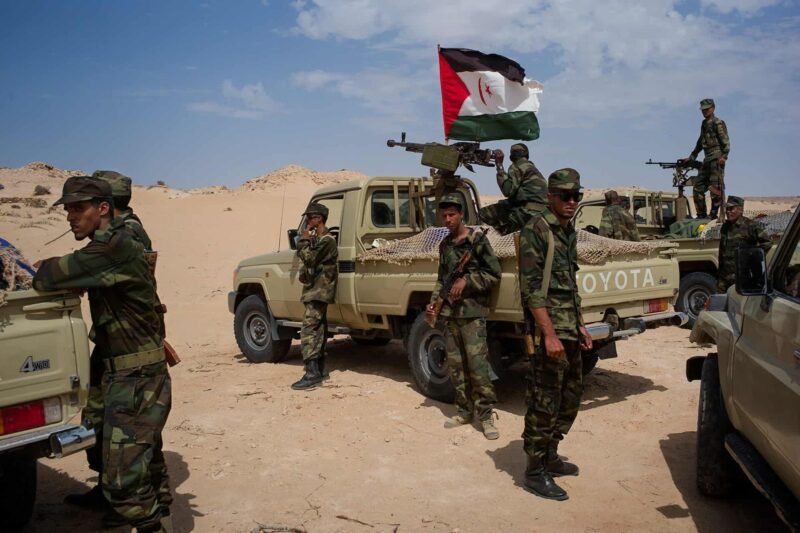
A legislative push in Congress, led by Ted Cruz, seeks to designate the Polisario Front as a foreign terrorist organization. Supporters argue that intelligence pointing to Iranian and Hezbollah involvement with the group has transformed a long-running territorial dispute in Western Sahara into a broader security concern.
The Polisario Front, which seeks independence for Western Sahara from Morocco, has historically framed itself as a nationalist movement with Marxist-Leninist roots.
But reports circulating in Western and regional security circles allege that elements of the Islamic Revolutionary Guard Corps and Hezbollah have provided training, drones, mortars and other advanced weaponry to Polisario fighters in camps near Tindouf, Algeria.
Morocco severed diplomatic ties with Tehran in 2018, citing what it described as Hezbollah-backed military training for Polisario cadres. Iran has denied destabilizing activities in North Africa, and Polisario officials reject accusations of foreign military alignment. Yet the claims have gained renewed traction amid broader tensions between Washington and Tehran.
The strategic implications, if substantiated, would be significant. Iran’s regional model has often relied on cultivating non-state armed groups capable of exerting pressure without direct state confrontation. Extending such a model into the Maghreb would mark a geographic expansion beyond its traditional Middle Eastern theaters.
Western Sahara itself sits near key maritime routes connecting the Atlantic and Mediterranean. Security analysts caution that militarization of the dispute could add volatility to an already fragile belt stretching from the Sahel to Libya.
The proposed U.S. legislation would require annual assessments of alleged military cooperation between Polisario, Iran and Hezbollah. Designation under existing counterterrorism authorities could trigger sanctions and financial restrictions aimed at curbing funding streams.
Yet the situation remains complex. Western Sahara’s status has been contested for decades, and regional rivalries — including tensions between Morocco and Algeria — shape the landscape. Labeling Polisario a terrorist organization could recalibrate diplomatic dynamics in North Africa as much as it constrains Tehran.
The broader question is whether this represents a durable strategic foothold for Iran or a limited convergence of interests in a localized conflict. What is clear is that the map of confrontation between Washington and Tehran no longer appears confined to the Gulf.
If the allegations prove accurate, the U.S.–Iran shadow war may be entering a new phase — one that reaches from the deserts of Western Sahara to the wider Atlantic horizon.
Analysis
Has Washington Lost Control of the Iran War?
Analysis
Oil Shock Could Cost Trump the White House
Wars aren’t lost only on battlefields. They’re lost at the gas pump — and voters are watching.
Rising Energy Prices and Public Backlash Over Iran War Threaten to Undermine President’s Political Standing.
President Donald Trump may believe the war with Iran can be managed militarily. Politically, it is a far riskier bet.
The administration has projected confidence since launching joint operations with Israel, framing the campaign as decisive and limited. Trump has argued that any spike in oil prices is temporary — a “small price to pay” for eliminating what he calls an Iranian nuclear threat.
Markets, at least initially, have not panicked. The S&P 500 remains near historic highs, and the United States is less dependent on imported crude than during the oil shocks of the 1970s.
But wars are not judged by stock indices alone. They are measured in household costs.
Oil prices are set globally. Even a country producing more of its own energy cannot fully insulate itself from a disruption in the Strait of Hormuz, through which roughly one-fifth of the world’s oil passes.
Gasoline prices have already climbed above $3.50 a gallon nationwide. Federal projections suggest retail fuel prices may not return to prewar levels until well into 2027.
That matters politically. Fuel costs ripple outward: trucking firms pass on higher diesel expenses; airlines adjust fares; farmers facing higher fertilizer and transport bills raise food prices. Inflation, which had begun stabilizing earlier this year, now faces renewed pressure.
Any delay in Federal Reserve rate cuts would further strain borrowers and investors alike.
The war’s unpopularity compounds the economic risks. Unlike previous military engagements that rallied public support in their early phases, polling indicates skepticism from the outset.
Americans appear wary of open-ended commitments, particularly those framed around regime change or “unconditional surrender” — goals that history suggests are far harder to achieve than to declare.
Trump’s team has attempted to blunt the economic fallout: proposing naval escorts for tankers, easing certain sanctions on Russian oil exports, and exploring expanded Venezuelan production. But stabilizing global energy markets typically requires either de-escalation or a decisive reduction in the adversary’s capacity to disrupt supply — outcomes that are neither swift nor guaranteed.
The deeper challenge lies in strategic clarity. Tactical success from the air does not automatically produce political victory on the ground. Iran’s Revolutionary Guards and allied networks retain the capacity to endure and retaliate asymmetrically.
Survival, for Tehran, can itself be framed as resistance.
For Trump, the dilemma is acute. Backing down from maximalist rhetoric risks appearing weak. Escalating further — potentially with ground forces — risks prolonging both the conflict and the economic pain.
American presidents are rarely undone solely by foreign adversaries. More often, it is domestic fatigue and economic strain that erode support.
If higher prices persist and the war drags on without a clear endpoint, the battlefield that matters most may not be in the Middle East at all — but in suburban swing districts and restless households weighing their costs.
Military campaigns can be declared “complete.” Voters’ verdicts are less easily controlled.
Analysis
How the Iran War Could Spiral
From Tactical Success to Strategic Uncertainty, the U.S.–Israel Campaign Risks Becoming More Complex and Costly.
Airstrikes may be working. Strategy may not be. Is the Iran war climbing an escalatory ladder with no clear exit?
The war against Iran is entering a dangerous phase — one where battlefield precision masks strategic ambiguity.
In military terms, the opening strikes by the United States and Israel achieved striking tactical results. Key Iranian leaders, including former Supreme Leader Ali Khamenei, were killed. Command structures were disrupted. Missile sites and drone facilities were degraded.
But tactical success does not automatically translate into strategic victory.
Iran’s regime remains intact. Its stockpile of highly enriched uranium is unsecured. And Tehran has pivoted to what analysts call “horizontal escalation” — widening the war’s geography and economic impact rather than confronting U.S. forces head-on.
By targeting Gulf states and threatening shipping through the Strait of Hormuz, Iran is attempting to shift the burden of the conflict. The aim is not to defeat American airpower, but to raise costs — politically and economically — for Washington and its regional partners.
Robert Pape, a historian who has studied the limits of air campaigns, describes this dynamic as an “escalation trap.” The first stage is tactical dominance. The second comes when battlefield success fails to produce political results, prompting the attacker to double down.
The third stage is the most perilous: riskier, more expansive options that may deepen the conflict without guaranteeing resolution.
By that measure, the war may already be edging from stage two toward stage three.
Israel has signaled readiness to expand operations in Lebanon against Hezbollah. U.S. officials continue to intensify strikes in Iran. President Donald Trump speaks simultaneously of victory and of unfinished business.
That rhetorical duality reflects a strategic dilemma. Iran does not need to win conventionally. It needs only to survive while imposing incremental costs — oil disruptions, maritime insecurity, asymmetric strikes. Even a reduced pace of missile and drone attacks can sustain pressure if shipping lanes remain under threat.
The risk extends beyond the Gulf. Analysts warn of incrementalism — the slow slide into deeper involvement. Special forces deployments, support for internal factions, or territorial footholds could trigger Iranian retaliation in unpredictable forms, from cyberattacks to strikes on soft targets.
At the same time, internal debates are shaping the trajectory: between U.S. defense professionals and political leadership, between Washington and Jerusalem, and within Iran’s own power centers, including the Islamic Revolutionary Guard Corps.
What makes the moment volatile is not only the military exchange, but the mismatch between short-term battlefield gains and long-term political objectives. Airpower can degrade capabilities. It rarely compels ideological surrender.
The escalatory ladder is steep. Each rung may appear manageable. But the higher it climbs, the harder it becomes to step down without appearing to lose.
The central question now is whether this war stabilizes through diplomacy or exhaustion — or whether the logic of escalation overtakes the logic of restraint.
History suggests that once leaders become confident in their ability to control escalation, that is often when control begins to slip.
Analysis
A War Trump Can’t Finish?
Why the Iran Conflict May Be Easier to Start Than to End — Even for a President Who Declares Victory.
Declaring “we won” is easy. Making Iran accept defeat is something else entirely.
President Donald Trump says the war with Iran is both a victory and “not finished yet.” It was a short “excursion,” he argues — but one that may require Tehran’s “unconditional surrender.” The contradiction captures a deeper problem: modern wars rarely end on command.
Military force can destroy infrastructure, eliminate leaders and degrade arsenals. It cannot easily manufacture political submission.
The White House appears caught in a familiar trap. History is crowded with examples of leaders who believed swift, surgical strikes would yield decisive political outcomes. The Soviet Union expected Afghanistan to fold quickly. The United States anticipated a rapid transformation of Iraq in 2003. Vladimir Putin assumed Ukraine would collapse within weeks. In each case, the initial shock did not translate into lasting political control.
Iran presents a similar dilemma.
The assassination of Supreme Leader Ali Khamenei was meant to decapitate the regime. Instead, hardliners consolidated power around his son, Mojtaba Khamenei — the very outcome Washington publicly opposed. The Islamic Revolutionary Guard Corps has framed the conflict not as a defeat, but as a call for endurance and revenge.
And endurance may be enough.
For Tehran, survival equals victory. The regime does not need to win militarily; it only needs to remain standing. It can absorb strikes, lose commanders, see launch sites destroyed — and still continue low-level retaliation. Missile salvos may shrink, drone attacks may thin out, but persistence alone keeps pressure on Washington.
The United States, by contrast, faces constraints. Sustained air campaigns deplete munitions stockpiles and strain budgets. Casualties erode public support. Oil prices climbing above $100 reverberate through global markets and domestic politics. As midterm elections approach, the appetite for a prolonged confrontation could narrow.
Airpower also has limits. It can weaken regimes. It has rarely forced ideological surrender. Over time, targets grow harder to isolate from civilian infrastructure, increasing the humanitarian and diplomatic costs of each strike.
Meanwhile, Tehran can escalate asymmetrically — through harassment in the Strait of Hormuz, cyber operations, or proxy attacks — without crossing thresholds that would justify full-scale American escalation. That calibrated resistance complicates any clean narrative of victory.
There is another strategic risk. Once a president repeatedly signals a desire to end a war, adversaries notice. If Iran believes Washington wants out, the incentive to simply endure grows stronger.
None of this means the conflict will spiral into a “forever war.” It is still in its early weeks. Quiet diplomacy or mutual exhaustion could produce a face-saving pause. Both sides might claim success. But the structural tensions would remain.
If the war winds down without decisive political change in Tehran, Iran’s leadership may emerge hardened rather than humbled — convinced that it survived the full force of American power. That perception alone could reshape its future strategy.
Starting a war is a presidential decision. Ending one is rarely within a single president’s control. Trump now confronts the oldest paradox in modern conflict: the easier it is to declare victory, the harder it is to secure it.
-
Terrorism2 months agoAmerica Pulls Back From Somalia but Doubles Down Next Door
-
Somaliland2 months agoF-35s Over Hargeisa: The Night Somaliland’s Sovereignty Went Supersonic
-
Somalia2 months agoAid Destroyed, Trust Shattered: Somalia Loses U.S. Support for Good
-
Terrorism2 months agoForeign ISIS Pipeline Exposed: Puntland Captures Dozens of Non-Somali Fighters
-
Somaliland2 months agoSomaliland at Davos: The Moment Somaliland Entered the World’s Inner Circle
-
Top stories2 months agoEuropean Troops Land in Greenland as US Pushes Takeover
-
Analysis1 month agoHow Chinese Speculators Set the Stage for the Gold and Silver Crash
-
Top stories2 months agoFrance Blocks EU Push to Let Ukraine Buy British Storm Shadow Missiles