Ethiopian Prime Minister Abiy Ahmed seals nuclear and defense deals with Vladimir Putin in Moscow, signaling a dramatic tilt toward Russia that could reshape Horn of Africa geopolitics.
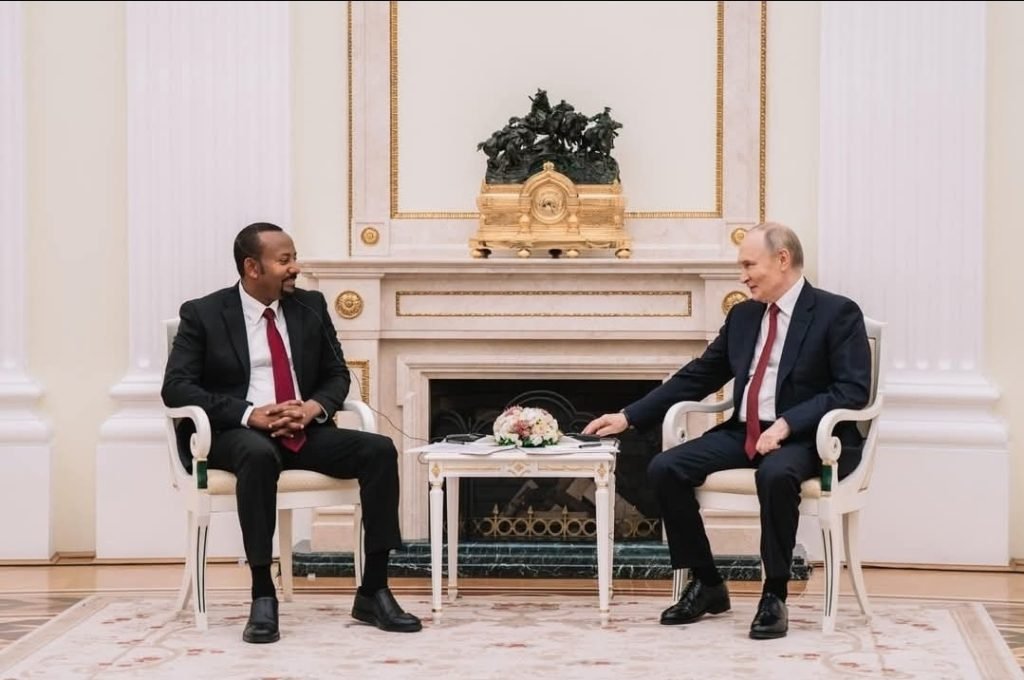
Ethiopian Prime Minister Abiy Ahmed’s Moscow visit has turned into a showcase of how far Ethiopia is willing to lean into Russia’s orbit at a moment when the Horn of Africa is already under immense strain. Meeting Vladimir Putin on the sidelines of World Atomic Week, Abiy hailed “comprehensive discussions” on energy, agriculture, healthcare, and defense, but the true headline is nuclear: Ethiopia and Russia will move forward with plans to jointly develop a nuclear power plant.
For Abiy, still balancing the scars of civil war and economic freefall, this is a gamble. Nuclear power offers the promise of cheap energy and industrial growth, but it also yokes Ethiopia’s future to Moscow’s strategic designs.
For Putin, it is a masterstroke — expanding Russia’s nuclear export model beyond the Middle East and into Africa’s second-most populous state, while deepening Moscow’s foothold at the Red Sea’s backdoor.
The implications are stark. Ethiopia’s neighbors, from Egypt to Sudan, already see Addis Ababa’s hydro-projects on the Nile as existential threats. A nuclear partnership with Russia — especially in tandem with budding defense cooperation — could sharpen those rivalries further.
Cairo in particular will read this as a hostile signal: an Ethiopia armed not only with a dam, but with Moscow’s reactors and military know-how.
Abiy’s move also speaks to shifting fault lines. The U.S. and Europe remain wary of his government after the Tigray war and human rights abuses.
China’s economic squeeze on Addis has grown heavier. That leaves Russia — isolated globally but eager for clients — as a willing partner. Nuclear power, agriculture deals, healthcare exchanges: all wrapped inside a defense umbrella that cements Russia’s relevance on the Horn.
The timing is no accident. With Ukraine grinding on, Putin wants to show that Moscow is not a pariah but a global convener — and Ethiopia gives him exactly that stage.
For Abiy, Moscow’s embrace is insurance: a signal to Western critics that Ethiopia has alternatives, even if those alternatives carry their own risks.
This nuclear handshake may be pitched as “clean energy for societal benefit,” but in reality, it’s a strategic pact with echoes that will ripple across the Horn, the Nile basin, and the Red Sea corridor.
Abiy is betting Ethiopia’s future on Putin’s promises. The question is whether that future will be one of power — or peril.