
AI Diplomacy
Experts Warn of China Backdoor as Trump Approves Massive AI Chip Sale to Saudi, UAE

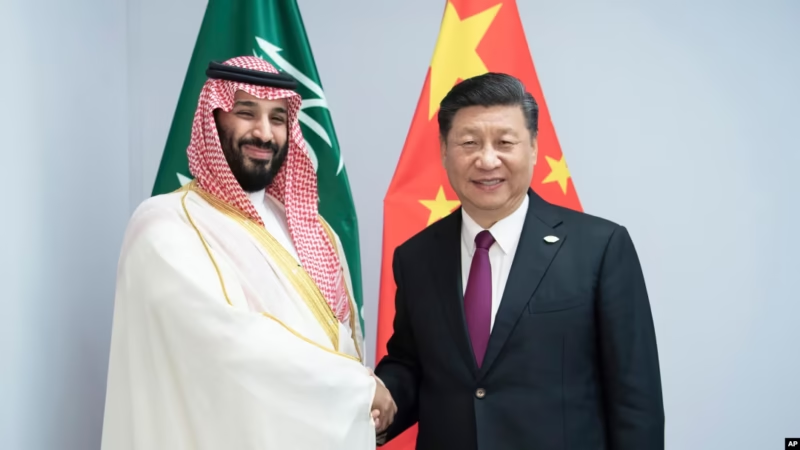
Trump approves sale of advanced U.S. AI chips to Saudi Arabia and UAE, reversing earlier export limits.
The Trump administration has authorized the sale of up to 70,000 of the world’s most advanced artificial intelligence chips to Saudi Arabia and the United Arab Emirates, a major policy shift that reverses export restrictions imposed during Trump’s previous term.
The approvals, confirmed during Saudi Crown Prince Mohammed bin Salman’s visit to Washington, clear the way for U.S. companies to provide Nvidia’s new Blackwell-series B300 processors and equivalent systems to Saudi Arabia’s national AI program, Humain, and the UAE’s influential tech conglomerate G42.
The Commerce Department said the decision includes “strict safeguards” to prevent the technology from reaching China, but national security officials warned that the size of the transfer and the Gulf states’ ongoing ties with Beijing pose “significant risk” of leakage.
The reversal marks a sharp departure from the 2023 export controls that barred advanced chip sales to 40 countries, including Saudi Arabia. Talks to loosen those restrictions reportedly accelerated following Trump’s high-profile trip to the Gulf in May.
Under the agreement, U.S. firms may sell up to 35,000 Nvidia GB300 servers to each country—a potential windfall for the American chip industry. Bank of America estimates that U.S. suppliers could reap $15 billion to $20 billion in revenue from Saudi purchases alone over several years.
Nvidia’s rival AMD has already signed multibillion-dollar deals with Humain, while tech giants such as Microsoft and Amazon had been waiting for export license approvals.
In return, Saudi Arabia and the UAE have pledged $2.4 trillion in investments in the United States. Both nations maintain deep commercial and security ties with China, raising concerns in Washington that Beijing could attempt to gain indirect access to U.S. chip technology.
G42, led by UAE national security adviser Sheikh Tahnoon bin Zayed, previously faced scrutiny over partnerships with Huawei and the Beijing Genomics Institute. The company claims it has “written off” all prior China-based investments.
U.S. officials say the new export approvals include unprecedented monitoring and compliance measures, with the Commerce Department’s Bureau of Industry and Security overseeing implementation. “These approvals will promote continued American AI dominance,” the agency said.
The move underscores a growing trend in U.S. diplomacy: the use of AI chips as strategic leverage, similar to the longstanding practice of offering defense contracts or commercial aircraft to build alliances. Recent examples include AI cooperation agreements with Armenia, Azerbaijan, and Kazakhstan after diplomatic breakthroughs brokered by the Trump administration.
The decision is also a major win for Nvidia CEO Jensen Huang, who has spent months urging the White House to ease export restrictions to maintain global market share. Huang has pledged $500 billion in U.S. AI infrastructure investment, aligning with Trump’s push for a manufacturing revival.
While 70,000 chips represent a substantial transfer to the Gulf, the figure is modest compared with the scale of private U.S. projects. Elon Musk’s xAI facility in Memphis, for instance, already operates more than 200,000 Nvidia processors.















Defense Secretary Hegseth Forces Out Army Chief

Bridges Fall, Missiles Rise—War Enters a More Destructive Phase

Iran Executes 18-Year-Old Protester


-
 US-Israel war on Iran1 month ago
UK Refuses Iran Strike Access, Trump Fires Back
-
 Russia-Ukraine War1 month ago
Europe’s Spies Challenge Trump’s Ukraine Peace Optimism
-

 Top stories1 month ago
War Expands Across Region as Iranian Militias Join Fight
-
 Top stories1 month ago
India Turns to Brazil in Strategic Minerals Push Against China
-
 US-Israel war on Iran1 month ago
Iran Pledges ‘Never, Ever’ to Hold Bomb-Grade Material
-

 US-Israel war on Iran1 month ago
Syria Under Fire on Two Fronts
-
 Russia-Ukraine War1 month ago
Estonia Warns NATO Would Strike Deep Inside Russia if Baltics Are Invaded
-

 Top stories3 weeks ago
Meloni Breaks Ranks: Italy Warns on Iran War