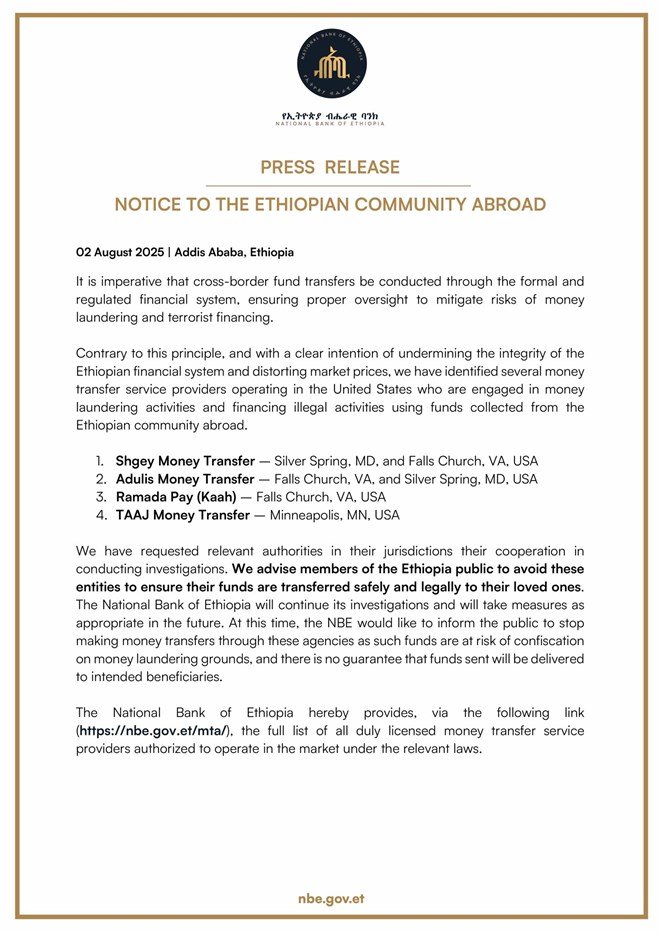
Ethiopia’s central bank has turned its sights on four Somali-owned money transfer firms operating in the U.S., accusing them of laundering money and funneling funds into illegal activities. In a statement released on August 2, the National Bank of Ethiopia (NBE) named Shgey Money Transfer, Adulis Money Transfer, Ramada Pay (Kaah), and TAAJ Money Transfer as the culprits allegedly undermining the country’s financial system and distorting market prices.
The NBE warned Ethiopians abroad to steer clear of these companies, urging them to use safer, legally compliant channels when sending money home. These firms, based across Maryland, Virginia, and Minnesota, serve large East African diaspora communities—particularly Ethiopians and Somalis—who have long depended on informal and semi-formal remittance methods to bypass the often fragile banking systems back home.
While Ethiopia didn’t explicitly call out Somalia, including Somali-run giants like Kaah and TAAJ in the crackdown has sent ripples through diaspora families. These companies act as crucial financial lifelines, channeling funds for essentials like school fees, food, and healthcare to remote areas in Ethiopia’s Somali Regional State, where formal banking barely reaches—only about 6% financial inclusion as of 2024. For many, these remittances aren’t just money transfers—they’re survival.
This latest move comes amid Ethiopia’s sweeping reforms to its foreign exchange system, backed by a $3.4 billion IMF program aimed at unifying exchange rates and cutting down on black market activities. Despite the efforts, the IMF recently flagged ongoing challenges: liquidity shortages, high transaction fees, and a stubborn 15% gap between official and black-market rates.
Still, remittances remain a financial pillar for Ethiopia. In 2023/24 alone, the Ethiopian diaspora pumped over $6 billion into the economy—around a third of the country’s official foreign currency inflows.
Unlike past quiet regulatory nudges, the NBE has gone public, releasing an updated list of more than 80 officially licensed money transfer agencies as of April 2025. This roster features big names like Western Union, MoneyGram, and World Remit, alongside regional players such as Equity Bank Kenya and LA Poste de Djibouti. Somali-targeted services like Iftin Express and Tawakal also appear, but notably absent are the firms now under scrutiny.
The NBE insists that sending money through formal, regulated channels is critical to preventing money laundering and terrorism financing. The bank pledges ongoing investigations and readiness to take further action.
This crackdown highlights the delicate balance Ethiopia faces: cracking down on illicit financial flows while ensuring vital remittance corridors to vulnerable populations remain open. It’s a tough line to walk, especially when many rely on these channels as their only financial connection to home. The coming months will reveal whether Ethiopia’s efforts will tighten financial controls without cutting off essential lifelines for its diaspora communities.