In a significant political development following Somaliland’s November 13 elections, the Electoral Commission has officially announced the three parties that will shape the nation’s political landscape for the next ten years: Waddani, Kulmiye, and the newly established Kaah party. This decision marks the culmination of a rigorous competition among political organizations vying for recognition as Somaliland’s national political parties.
Changing Dynamics in Somaliland Politics
The announcement signals a major shift in Somaliland’s political framework, with the long-standing UCID Party—a fixture in the nation’s politics for decades—failing to retain its position as a national party. This leaves Waddani and Kulmiye, the dominant forces of recent years, alongside Kaah, which has rapidly gained prominence under the leadership of Mohamud Hashi, a well-known politician with significant political and public influence.
The Three National Parties
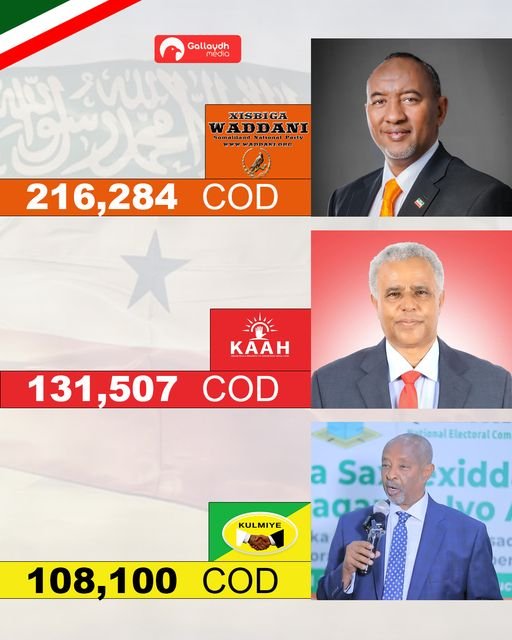
Waddani Party: Fresh from its resounding victory in the presidential election, Waddani continues to cement its role as a leading political force. Under the leadership of President-elect Abdirahman Mohamed Abdullahi Irro, the party has garnered widespread support, appealing particularly to the youth and those seeking political change.
Kulmiye Party: Despite losing the presidency, Kulmiye retains its status as a national political party, reflecting its enduring support base and significant role in Somaliland’s recent political history. Under the leadership of outgoing President Muse Bihi Abdi, the party remains a major player in shaping Somaliland’s future.
Kaah Party: The ascension of Kaah marks the emergence of a new political contender. Led by Mohamud Hashi, Kaah has quickly positioned itself as a formidable force, stepping into the space previously occupied by the UCID Party.
UCID’s Exit and Its Implications
The elimination of the UCID Party from Somaliland’s national political scene marks the end of an era. UCID, founded and led by Faisal Ali Warabe, has been a cornerstone of Somaliland politics for decades. However, its dwindling electoral performance and inability to secure enough support in this election have led to its exclusion from the next decade’s political framework.
With Waddani, Kulmiye, and Kaah now set to dominate Somaliland’s political affairs, the nation faces a period of renewed political competition and potential realignment. The establishment of these three parties reflects the evolving preferences of Somaliland’s electorate and sets the stage for vibrant debates over the next decade.
For Waddani and President-elect Abdirahman Irro, the immediate focus will be on governance and delivering on campaign promises. Meanwhile, Kulmiye and Kaah will work to redefine their strategies to maintain relevance and influence in the changing political climate.
The next decade promises to be pivotal for Somaliland’s democracy, as these three parties lead the nation into a future filled with both opportunities and challenges.