Somaliland Seeks U.S. and Israeli Air-Defence Support, WARYATV Sources Say
WARYATV sources say Somaliland has approached Washington and Israel about air defence—but no agreement has been publicly confirmed.
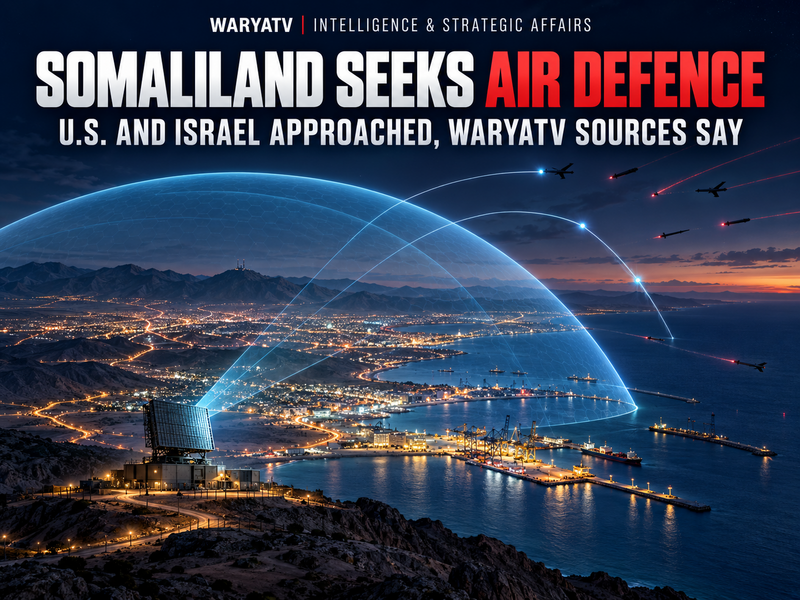
Somaliland has asked the United States and Israel for assistance in acquiring an air-defence capability as Hargeisa reassesses threats emerging from Yemen, Iran-aligned forces and Turkey’s expanding military operations in Somalia, sources familiar with the discussions told WARYATV.
The exact systems requested, the level at which the discussions occurred and whether either government has agreed to provide equipment remain unclear. No formal agreement has been publicly announced.
Israeli request gains public corroboration
WARYATV’s reporting concerning Israel is consistent with public comments attributed to Mohamed Osman Fadal, a senior foreign-affairs adviser to Somaliland President Abdirahman Mohamed Abdillahi.
“We need air defence systems,” Fadal reportedly said when discussing Turkish drones and combat aircraft operating from Somalia. He also called for Israeli support against the security imbalance created by Ankara’s military partnership with Mogadishu.
Somaliland Defence Minister Mohamed Yusuf Ali confirmed in June that Israel was training Somaliland police and military personnel. He denied that Israel had established a base or that negotiations for one were under way.
WARYATV sources say Somaliland has also approached Washington. That part of the report has not been publicly confirmed by the United States or Somaliland’s government.
Three threats shape Hargeisa’s calculations
The first concern is the escalating conflict across the Gulf of Aden. The Houthis have demonstrated the ability to conduct long-range missile and drone attacks and previously warned against countries facilitating operations targeting Iran or its allies. There is not yet public evidence of an imminent Houthi or Iranian strike against Somaliland. reuters.com
The second concern is Turkey’s growing combat role in Somalia. Open-source conflict monitoring indicates that Turkish strikes increased during 2026, primarily against Al-Shabaab. Somali political actors have also accused Turkey of striking federal-government opponents, although several such allegations remain disputed.
The third issue is Berbera’s rising strategic profile. Closer cooperation with Israel, the UAE and the United States could strengthen Somaliland’s security while simultaneously making military, port and airport infrastructure more visible to hostile actors.
Mogadishu raises the stakes
Somali President Hassan Sheikh Mohamud told Al Jazeera that his government would not accept an Israeli presence in Somaliland “under any circumstances.” He claimed Israel planned to establish a naval base in Berbera and use its airport.
Somaliland and Israeli officials have previously denied that a base agreement exists. Mohamud provided no publicly disclosed evidence for the alleged plan.
WARYATV Assessment
Somaliland has a legitimate reason to study air defence. Geography places Berbera, Hargeisa and critical infrastructure within a region increasingly shaped by drones, missiles and foreign military competition.
But air defence cannot be reduced to purchasing interceptors. Somaliland would need radar coverage, trained personnel, secure communications, maintenance, identification procedures and rules preventing civilian aircraft from being misidentified.
Hargeisa must also avoid turning defensive cooperation into an undeclared foreign basing arrangement. Any agreement should receive legal review and parliamentary oversight, with non-sensitive obligations disclosed publicly.
The strategic objective should be protecting Somaliland’s population and infrastructure—not importing the Middle East’s rivalries onto Somaliland territory.