Analysis
How Iran’s History Explains Its Present Crisis
Why Iran’s Grand Strategy May Be Reaching Its Limits.
Iran’s war isn’t just about today. It’s the result of a century-old struggle between power, religion, and ambition.
The current war surrounding Iran cannot be understood through missiles and alliances alone. Its deeper logic lies in a long-running tension that has shaped the country for more than a century: the uneasy fusion of religious authority and modern state power.
This tension first surfaced in modern form during the Constitutional Revolution of the early 20th century. Faced with a weakening Qajar state, Iran attempted to build a hybrid system—one that blended elected institutions with clerical influence. But the experiment never resolved a fundamental question: were religious authorities partners in governance, or its ultimate arbiters? That ambiguity proved fatal.
The system fractured from within, opening the door for Reza Shah, who imposed order through centralized, coercive modernization.
Yet that model, imposed from above, lacked deep institutional roots. Unlike Turkey’s structured transformation, Iran’s modernization remained tethered to individual authority. When external forces removed Reza Shah during World War II, the old dilemma returned under his son, Mohammad Reza Pahlavi: how to modernize a state without alienating a deeply embedded religious network.
The crisis sharpened in 1953, when Prime Minister Mohammad Mosaddegh sought to redefine Iran through economic sovereignty and oil nationalization. His failure is often attributed to foreign intervention, but internal fractures were equally decisive. Religious figures, excluded from power, turned against him.
The result was a restoration of monarchy—and a lesson that would echo through decades: no political project in Iran could succeed while sidelining the clerical establishment.
That lesson culminated in the 1979 revolution. What followed was not simply a return to tradition, but a new synthesis—Velayat-e Faqih—that fused religious legitimacy with a powerful security and political apparatus. It was a system designed to avoid past failures by embedding ideology within the machinery of the state.
Domestically, it proved resilient.
Externally, it sought validation through expansion.
Over time, Iran extended its influence across Iraq, Syria, Lebanon, and Yemen, building networks of allied groups that mirrored elements of its own system. This was not merely opportunistic policy. It reflected a broader strategic vision: that regional influence could reinforce domestic legitimacy and security.
But expansion carries risks. History offers repeated examples—imperial Japan, the Soviet Union—where outward reach ultimately strained internal capacity. Iran now appears to be confronting a similar dilemma. Economic pressure, international isolation, and sustained regional conflict have begun to test the limits of that model.
The war unfolding today is therefore more than a military confrontation. It is a stress test of the system’s founding logic: whether a state can indefinitely combine ideological mission with geopolitical expansion without overextending itself.
What may emerge is not collapse, but recalibration.
Iran has repeatedly adapted across its history, reshaping its political structures in response to internal and external pressures.
The current moment presents a familiar choice in a new context: whether to continue pursuing a broad, outward-looking strategy, or to consolidate around the logic of a modern nation-state with defined interests and limits.
That decision will shape not only Iran’s future, but its role in a changing international order.
Because while power endures, history suggests something else does not: empires, once stretched beyond their limits, rarely return in the form they imagined.
Analysis
Ukraine Urges Strikes on Russian Drone Sites
The Iran war is no longer regional. Ukraine now wants strikes inside Russia. Here’s why.
The war surrounding Iran is beginning to reshape conflicts far beyond the Middle East, with Ukraine now urging a dramatic expansion of the battlefield—into Russia itself.
At a United Nations session, Ukraine’s ambassador Andriy Melnyk argued that Russian drone production facilities should be considered “legitimate targets,” citing Moscow’s growing military cooperation with Tehran. According to Ukrainian officials, Russia has supplied Iran with modernized versions of the Shahed drones—systems originally developed by Iran and widely used by Russian forces in Ukraine since 2022.
The message was clear: the wars are no longer separate.
Melnyk framed the Iran conflict as directly intertwined with Russia’s invasion of Ukraine, describing Moscow as a key enabler of Tehran’s military capabilities. By providing technology, production licenses, and reportedly even attack helicopters, Russia has, in Kyiv’s view, become an active participant in a broader network of conflict stretching from Eastern Europe to the Gulf.
That framing carries significant implications.
If accepted by Western partners, it could justify expanded military support to Ukraine—not only for defensive operations, but for deeper strikes into Russian territory targeting drone factories and supply chains.
Kyiv has already conducted limited strikes on such facilities, but officials argue that more advanced long-range weapons would increase their effectiveness.
The argument is strategic as much as tactical. By disrupting Russia’s drone production, Ukraine believes it can simultaneously weaken Moscow’s war effort at home and reduce the flow of technology that could empower Iran in the Middle East.
There is also an economic dimension.
Rising oil prices, driven in part by instability in the Strait of Hormuz, are providing Russia with a financial boost, offsetting some of the economic strain caused by sanctions. Ukrainian officials warn that the Iran war risks becoming a “lifeline” for Moscow, strengthening its ability to sustain operations in Ukraine.
This convergence of interests is reshaping how the conflict is perceived.
What once appeared as distinct regional crises—Ukraine on one side, the Middle East on the other—is increasingly viewed as a connected strategic environment. Military technologies, economic shocks, and geopolitical alliances are linking these theaters in ways that complicate efforts to contain escalation.
Melnyk’s call for strikes inside Russia reflects that shift. It suggests that Ukraine sees the Iran war not just as a distant conflict, but as part of a broader struggle that directly affects its own security.
Whether Western governments accept that argument remains uncertain. Expanding the scope of military operations into Russian territory carries obvious risks, including further escalation between NATO and Moscow.
But the fact that such proposals are now being openly discussed at the United Nations underscores how quickly the boundaries of the conflict are changing.
The Iran war is no longer confined to the Middle East. It is feeding into a wider geopolitical contest—one where actions in one region are increasingly shaping outcomes in another.
And as those connections deepen, the line between regional war and global confrontation continues to blur.
Analysis
The Only Force That Can Break Iran’s Regime
Missiles can shake Iran. Only its own elites can bring it down. Here’s why.
For all the firepower unleashed in the current war, the survival of Iran’s regime will not be decided in the skies. It will be decided inside the regime itself.
History offers a consistent lesson: authoritarian systems rarely collapse because of external pressure alone. They fall when the inner circle—military commanders, political elites, economic power brokers—begins to fracture.
In Iran’s case, that inner circle is anchored by the Islamic Revolutionary Guard Corps (IRGC), clerical leadership, and a network of state-linked economic interests. As long as that coalition holds, the system is likely to endure.
Military escalation can still matter—but its impact is indirect. Strikes on infrastructure, command centers, or strategic assets create what analysts call an “informational shock.” They expose vulnerabilities, challenge deterrence, and can trigger public unrest. Yet such shocks, on their own, rarely produce regime collapse.
In fact, they often do the opposite.
External attacks tend to generate a rally-around-the-flag effect, reinforcing national unity and strengthening the regime’s claim to legitimacy.
Iran’s leadership has long prepared for this dynamic, framing conflict as resistance against foreign aggression. In the short term, that narrative can stabilize rather than weaken the system.
The turning point comes only if that informational shock evolves into something deeper: an “incentive shock.” This is the moment when elites begin to question whether staying loyal still guarantees their survival.
Three pathways could push Iran toward that threshold.
The first is fragmentation within the coercive apparatus. If divisions emerge between the IRGC and the regular military—or within the Guard itself—enforcement capacity weakens. Without a unified security structure, regimes struggle to maintain control.
The second is economic breakdown. Prolonged war can strain state finances, erode patronage networks, and make loyalty more costly. When elites are no longer confident that the system can sustain them, their calculations begin to shift.
The third is strategic isolation. If Iran’s regional influence diminishes and external support from partners like Russia or China weakens, the perception of long-term viability may erode. Elites do not need certainty of collapse—only doubt about the future.
Even then, collapse is not guaranteed.
Iran’s system has structural advantages that raise the threshold for breakdown. Its dual power structure—combining religious authority with a powerful security apparatus—creates overlapping networks of control. The IRGC is not just a military force; it is deeply embedded in the economy and political system, increasing the cost of defection. The Basij and other internal security forces reinforce that architecture.
Comparative cases underscore this resilience. Syria’s regime survived years of conflict because its core elites remained cohesive. By contrast, Tunisia and Egypt unraveled quickly when military leaders withdrew support. Iran, for now, resembles the former more than the latter.
This leaves three plausible trajectories.
The most likely is resilience: the regime absorbs military pressure, maintains elite cohesion, and survives. A second scenario involves prolonged instability—economic strain, limited fractures, but no decisive break. The least likely, though not impossible, is a full collapse triggered by cascading elite defections.
The critical variable is not the intensity of the war, nor the scale of public protest. It is whether those at the center of power begin to believe that the system can no longer protect them.
Until that shift occurs, bombs may shake Iran—but they will not break it.
Analysis
How Trump’s Power Plant Threat Could Redefine the Iran War
Countdown to Catastrophe: Inside the 48-Hour Threat That Could Ignite a Regional Collapse.
This isn’t just a military threat. It’s a warning aimed at the survival systems of an entire region.
The most dangerous moment in the U.S.-Iran war has not arrived through missiles or troop movements, but through a deadline.
By issuing a 48-hour ultimatum tied to the reopening of the Strait of Hormuz—and threatening to “obliterate” Iran’s power plants—Washington has shifted the conflict into a far more perilous domain: the targeting of civilian infrastructure that underpins daily life.
This is not a marginal escalation. It is a strategic transformation.
Power plants are not simply industrial facilities; they are the backbone of a modern state. In Iran, a nation of more than 80 million people, the electrical grid sustains hospitals, water systems, food distribution, and communications.
To strike at that system is not just to degrade capacity—it is to risk cascading humanitarian consequences. The language of “obliteration” suggests not limited disruption, but systemic collapse, what humanitarian law experts describe as “reverberating effects” that extend far beyond the initial target.
Iran’s response has mirrored that logic with precision. By signaling potential attacks on desalination plants and critical infrastructure in Gulf states, Tehran has effectively drawn a line of equivalence: if energy systems are targeted in Iran, water systems—equally essential for survival—may be targeted elsewhere.
The implications are stark. In parts of the Gulf, desalination provides the majority of freshwater. Disruptions would not merely inconvenience populations; they would threaten the basic viability of daily life in some of the world’s most water-scarce environments.
What is emerging is a form of strategic symmetry built around civilian vulnerability. Electricity in Iran. Water in the Gulf. Each side now holds the other’s essential systems at risk.
This dynamic creates what analysts describe as a “credibility trap” for Washington. The ultimatum leaves little room for ambiguity.
If the United States follows through, it risks triggering a chain reaction: a sharp spike in global energy prices, widespread humanitarian fallout, and the potential involvement of other major powers with direct economic stakes in the region.
If it does not follow through, the consequences are different but no less significant. A missed deadline could weaken the perceived credibility of U.S. threats, signaling to adversaries that red lines are negotiable. In a geopolitical environment already shaped by competition with China and Russia, such signals carry weight far beyond the Middle East.
The timing deepens the dilemma. The ultimatum came shortly after indications that Washington might seek to de-escalate.
The abrupt shift from restraint to maximal threat has reinforced concerns about strategic coherence—whether the war is being guided by a defined objective or by reactive escalation.
As the deadline approaches, the question is no longer limited to whether the Strait of Hormuz will reopen. It is whether the conflict has crossed into a phase where the infrastructure that sustains civilian life becomes a central battleground.
If that threshold is breached, the consequences will extend well beyond Iran or the Gulf. It would mark a turning point in how modern wars are fought—and how far states are willing to go when conventional pressure fails.
In that sense, the 48-hour ultimatum is more than a tactical move. It is a test of limits—military, political, and moral—in a conflict that is rapidly redefining them.
Analysis
Is America’s Iran War Tearing NATO Apart?
This isn’t just a war with Iran. It may be the moment NATO starts to break from within.
The war unfolding around Iran is no longer just a Middle Eastern conflict. It has become a defining stress test for NATO—and for the broader idea of Western unity in an increasingly unstable world.
At the heart of the tension is a growing divide between Washington and its European allies. For decades, the transatlantic alliance rested on a simple understanding: the United States would lead, and Europe would align, even amid disagreements.
That assumption is now under visible strain. Major European powers—including Germany, France, the United Kingdom, and Spain—have declined direct involvement in the U.S.-Israeli campaign against Iran, signaling a shift that goes beyond tactical hesitation.
Their message is clear: this is not their war.
What makes this moment different is not just disagreement over strategy, but a deeper unease about how decisions are being made.
European officials have indicated that they were neither fully consulted nor presented with a coherent endgame. In alliance politics, that matters. When a leading power initiates a high-risk conflict and then seeks support after the fact, the structure begins to resemble hierarchy rather than partnership.
That perception carries consequences. If allies believe they are being asked to absorb risks without influence, they are more likely to distance themselves—not out of defiance, but self-preservation.
The economic dimension reinforces that caution. The Strait of Hormuz, now under heightened tension, is a critical artery for global energy flows. Any sustained disruption reverberates far beyond the Gulf. Even countries less directly dependent on Middle Eastern oil remain exposed through global pricing, shipping costs, and supply chains.
Europe, still recovering from previous energy shocks, faces renewed vulnerability. Higher oil and gas prices ripple through industrial production, transportation, and agriculture. Fertilizer costs rise, food systems tighten, and manufacturing competitiveness erodes.
These pressures arrive at a moment when European governments are already trying to expand defense production and sustain support for Ukraine—objectives that rely heavily on stable energy inputs.
In that sense, the Iran conflict intersects directly with Europe’s own strategic priorities. A prolonged energy shock does not just strain economies; it can weaken the very industrial base required for military readiness.
Türkiye, positioned at the crossroads of energy transit and regional trade, faces its own exposure. Heavy reliance on imported gas and its role as a processing and export hub mean that disruptions in the Gulf can quickly translate into domestic and regional economic stress.
Against this backdrop, the political language from Europe has shifted. What once might have been quiet diplomatic friction is now more openly expressed as distance and caution.
European leaders have described the escalation as destabilizing and, in some cases, legally questionable. They have explored maritime security roles, but on terms distinct from Washington’s broader military objectives.
The result is an alliance under pressure—not collapsing, but no longer moving in lockstep.
President Donald Trump’s rhetoric has further complicated the picture. His criticism of NATO partners and suggestions that the United States can act alone have reinforced doubts about long-term cohesion. Alliances depend not only on shared interests but also on trust. When that trust erodes, even powerful structures begin to loosen.
What is emerging is a more fragmented strategic landscape. The United States retains unmatched military power, but its ability to organize collective action appears less certain. European states, in turn, are beginning to hedge—seeking flexibility rather than automatic alignment.
This does not mean NATO is about to disappear. But it does suggest a transition. The alliance is being forced to adapt to a world in which unity can no longer be assumed, and where major decisions carry global consequences that allies are less willing to bear without a voice.
The war with Iran, in that sense, is not only about military outcomes or regional balance. It is about whether the Atlantic alliance can still function as a coherent political project—or whether it is entering a period of gradual, uneasy redefinition.
And if the latter proves true, the implications will extend far beyond this conflict, reshaping the architecture of global power in the years ahead.
Analysis
Inside the IRGC’s Quiet Rebuild of Hezbollah
Analysis
Not a Shortage of Oil — A Shortage of Safe Passage
Middle East Conflict Forces OPEC+ and Asian Importers to Rethink Energy Security as Hormuz Risk Surges.
The world isn’t running out of oil. It’s running out of certainty.
The Middle East crisis has done more than rattle oil markets. It is quietly rewriting the doctrine of global energy security.
Missile and drone strikes across Gulf energy hubs have pushed the Strait of Hormuz — the transit point for roughly 21% of global petroleum liquids — from theoretical risk to active fault line.
Tankers are hesitating. Insurance premiums are climbing. Shipping queues are growing. The chokepoint is no longer background anxiety; it is the story.
Brent crude briefly surged above $119 a barrel before easing, while Middle East physical benchmarks spiked far higher, signaling a tightening that futures markets alone cannot explain.
The shock is less about destroyed production than about disrupted movement. Ports, airspace, insurance markets and tanker logistics have all become embedded in a conflict zone.
On paper, the world still has oil. Forecasts project mid-decade supply surpluses, with rising output from the United States, Brazil and Canada. But paper balances do not move cargo.
Around one-fifth of global oil and LNG still flows through Hormuz. Even partial disruption strands millions of barrels per day, overwhelming alternative pipeline routes from Saudi Arabia and the UAE.
This gap between spreadsheet surplus and deliverable supply has introduced a durable war premium. Freight costs are rising. Replacement barrels are more expensive. European diesel and jet fuel benchmarks have jumped. Markets are recalibrating around access risk, not just production capacity.
That shift is also transforming OPEC+. The group is no longer acting merely as a price manager. With most spare capacity concentrated in Saudi Arabia and the UAE, it now plays a quasi-stabilizing role in a corridor-constrained market.
Recent modest output adjustments were less about adding barrels and more about signaling control.
Yet spare capacity cannot escort tankers or neutralize naval threats. Maritime security has become as critical as upstream investment. European powers have hesitated to engage militarily, even as Washington offers escorts.
Asian importers, heavily exposed to Gulf crude, are quietly reassessing diversification strategies, insurance frameworks and emergency reserves.
The crisis underscores a structural reality: energy security is no longer defined only by how much oil exists underground. It hinges on whether it can travel safely through increasingly militarized sea lanes.
The emerging doctrine is stark. Control over shipping corridors, insurance credibility and geopolitical deterrence now matters as much as control over oil fields themselves. In this new order, the scarcest commodity is not crude — it is assured access.
Analysis
Who Is Winning the Middle East War?
Winning the War — Or Just Surviving It?
Iran Has Been Pounded Militarily, but Geography, Time and Economic Leverage Complicate the Scorecard
The opening phase of the U.S.-Israeli campaign against Iran has been, by most measurable standards, a tactical success. Air superiority was established quickly.
Thousands of strikes degraded missile launchers, command centers and elements of Iran’s military infrastructure. Iranian leadership networks have been disrupted.
On paper, Washington and Jerusalem appear firmly in control.
But wars are not decided on paper.
More than 13,000 strikes in two weeks represent extraordinary operational intensity. Yet Iran has not collapsed, nor has it conceded.
President Donald Trump has insisted that the campaign is succeeding, even as U.S. forces rush additional assets into the region — redeploying air defenses, repositioning naval forces and urging reluctant partners to assist in protecting shipping lanes.
That posture does not signal defeat. But neither does it suggest a clean, predictable path to victory.
Iran, unable to match Western airpower, has chosen a different logic. Rather than seeking decisive battlefield gains, it has aimed to raise the cost of the war. Energy facilities, commercial hubs and maritime chokepoints have become pressure points.
The Strait of Hormuz — through which roughly a fifth of global oil flows — remains the most powerful lever in Tehran’s hands.
Modern interstate conflict rarely hinges on frontlines alone. It turns on endurance. On supply chains. On public tolerance for prolonged disruption.
Israel has absorbed strikes but remains heavily defended and socially hardened. Gulf states, particularly the UAE, have faced repeated targeting. Energy markets have reacted sharply. Tanker traffic has slowed. Interceptor stockpiles are being consumed.
The burden of constant air and maritime defense is immense — financially, logistically and politically.
Strategy, at its core, is the alignment of ends and means. By that measure, Iran’s approach is not irrational. It cannot win a symmetric war. So it plays asymmetrically. It stretches geography to its advantage. It prolongs the timeline. It relies on a higher tolerance for economic pain and domestic hardship than its adversaries may be able to sustain.
The next phase will test both sides differently. Israel will likely intensify efforts to dismantle Iran’s coercive institutions, including the Revolutionary Guards and the Basij militia. The United States will prioritize restoring maritime flow and reassuring regional partners. Iran may escalate selectively, potentially deploying capabilities — such as cruise missiles — that it has so far used sparingly.
So who is winning?
Militarily, the U.S. and Israel hold the upper hand. Strategically, the answer is murkier. If victory means degrading Iran’s infrastructure, that goal is advancing. If it means stabilizing the region and ending the conflict on favorable terms, the outcome remains uncertain.
Wars are rarely decided by who strikes hardest. More often, they are decided by who can endure longer.
Analysis
Why Is Finland Eyeing the Iran War?
Finland has no direct stake in Hormuz. So why is its president talking about joining the fight?
President Alexander Stubb Signals Openness to Backing U.S. Operations — With Ukraine in Mind.
Finland’s president, Alexander Stubb, has emerged as one of the few European leaders openly suggesting that the European Union should consider supporting U.S. efforts in the Strait of Hormuz. His reasoning has less to do with Iran than with Ukraine.
While most major EU powers — including France, Germany and Italy — have stressed restraint and declined to commit forces to the Gulf, Stubb has said countries with “the capacity and the will” should help Washington secure maritime trade routes.
In London, he went further, reacting positively to the idea that European naval support in the Gulf could be leveraged to extract stronger U.S. backing for Kyiv in its war with Russia.
At the heart of Stubb’s calculus is concern that the U.S.-Israeli war with Iran is diverting American military resources and political attention away from Ukraine. Rising oil prices, driven in part by instability in the Strait of Hormuz, also benefit Russia by boosting energy revenues. From Helsinki’s perspective, anything that weakens Western focus on Ukraine strengthens Moscow’s hand.
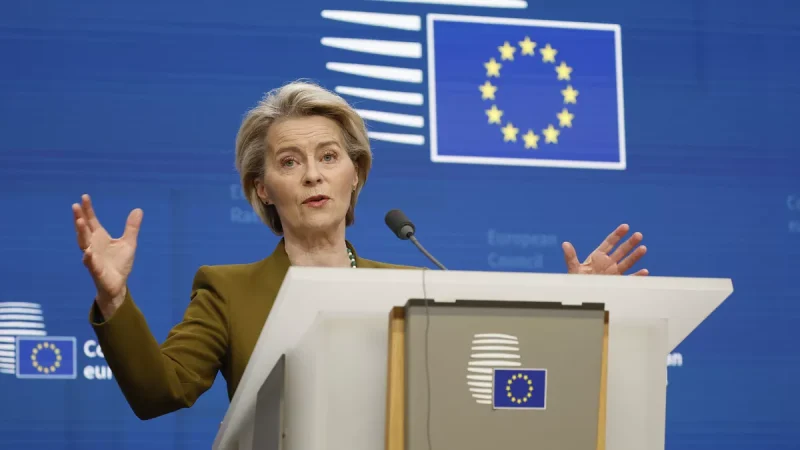
The proposal has met skepticism inside Europe. German Defense Minister Boris Pistorius publicly questioned what a handful of European frigates could accomplish that the U.S. Navy cannot. European Commission President Ursula von der Leyen has said there is “no appetite” in Brussels to widen EU naval operations beyond existing missions.
Finland’s own naval capabilities are limited: a small fleet of missile boats and minesweepers, designed primarily for Baltic Sea defense. The Baltic states that have echoed Stubb’s posture — Estonia and Lithuania — field similarly modest forces. Any deployment would be symbolic rather than decisive.
Still, symbolism may be the point. For Stubb and like-minded leaders, visible alignment with Washington in one theater could help maintain U.S. engagement in another. The risk, critics argue, is entanglement in a conflict far from Europe’s core security interests.
Public support within the EU for involvement in the Iran conflict remains weak. Larger military powers such as France and Poland have ruled out participation in combat operations, though some have left open the possibility of maritime escort missions once hostilities subside.
For now, Stubb represents a small but vocal bloc that sees strategic linkage between the Gulf and Eastern Europe. Whether that linkage persuades Washington — or alienates other European partners — remains to be seen.
-
Terrorism2 months agoAmerica Pulls Back From Somalia but Doubles Down Next Door
-
Analysis2 months agoHow Chinese Speculators Set the Stage for the Gold and Silver Crash
-
Top stories2 months agoRubio Signals Preemptive Military Option as U.S. Tightens Pressure on Iran
-
Top stories2 months agoFrance Blocks EU Push to Let Ukraine Buy British Storm Shadow Missiles
-
Russia-Ukraine War1 month agoRussian General Boasted of Torture and Killing of Ukrainian Prisoners
-
US-Israel war on Iran1 month agoUK Refuses Iran Strike Access, Trump Fires Back
-
Russia-Ukraine War1 month agoEurope’s Spies Challenge Trump’s Ukraine Peace Optimism
-
Analysis2 months agoIran Warns, Qatar Mediates, Washington Deploys: A Crisis Managed in Public and Private