Countdown to Catastrophe: Inside the 48-Hour Threat That Could Ignite a Regional Collapse.
This isn’t just a military threat. It’s a warning aimed at the survival systems of an entire region.
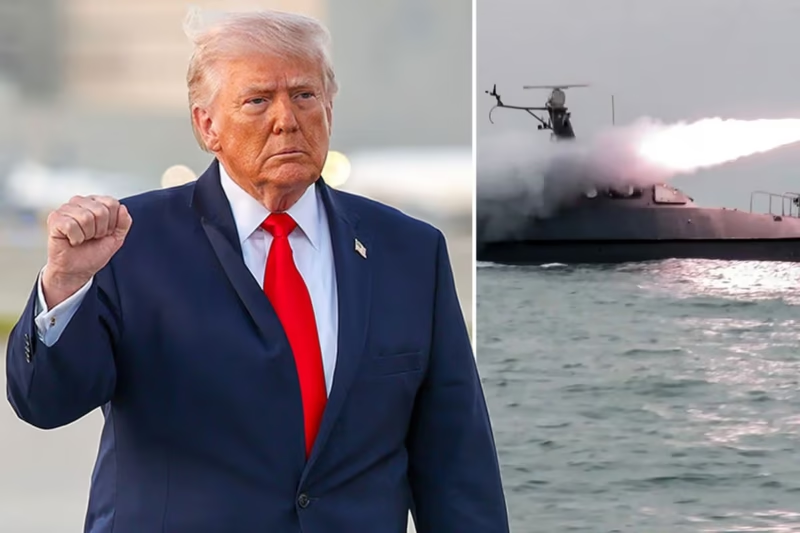
The most dangerous moment in the U.S.-Iran war has not arrived through missiles or troop movements, but through a deadline.
By issuing a 48-hour ultimatum tied to the reopening of the Strait of Hormuz—and threatening to “obliterate” Iran’s power plants—Washington has shifted the conflict into a far more perilous domain: the targeting of civilian infrastructure that underpins daily life.
This is not a marginal escalation. It is a strategic transformation.
Power plants are not simply industrial facilities; they are the backbone of a modern state. In Iran, a nation of more than 80 million people, the electrical grid sustains hospitals, water systems, food distribution, and communications.
To strike at that system is not just to degrade capacity—it is to risk cascading humanitarian consequences. The language of “obliteration” suggests not limited disruption, but systemic collapse, what humanitarian law experts describe as “reverberating effects” that extend far beyond the initial target.
Iran’s response has mirrored that logic with precision. By signaling potential attacks on desalination plants and critical infrastructure in Gulf states, Tehran has effectively drawn a line of equivalence: if energy systems are targeted in Iran, water systems—equally essential for survival—may be targeted elsewhere.
The implications are stark. In parts of the Gulf, desalination provides the majority of freshwater. Disruptions would not merely inconvenience populations; they would threaten the basic viability of daily life in some of the world’s most water-scarce environments.
What is emerging is a form of strategic symmetry built around civilian vulnerability. Electricity in Iran. Water in the Gulf. Each side now holds the other’s essential systems at risk.
This dynamic creates what analysts describe as a “credibility trap” for Washington. The ultimatum leaves little room for ambiguity.
If the United States follows through, it risks triggering a chain reaction: a sharp spike in global energy prices, widespread humanitarian fallout, and the potential involvement of other major powers with direct economic stakes in the region.
If it does not follow through, the consequences are different but no less significant. A missed deadline could weaken the perceived credibility of U.S. threats, signaling to adversaries that red lines are negotiable. In a geopolitical environment already shaped by competition with China and Russia, such signals carry weight far beyond the Middle East.
The timing deepens the dilemma. The ultimatum came shortly after indications that Washington might seek to de-escalate.
The abrupt shift from restraint to maximal threat has reinforced concerns about strategic coherence—whether the war is being guided by a defined objective or by reactive escalation.
As the deadline approaches, the question is no longer limited to whether the Strait of Hormuz will reopen. It is whether the conflict has crossed into a phase where the infrastructure that sustains civilian life becomes a central battleground.
If that threshold is breached, the consequences will extend well beyond Iran or the Gulf. It would mark a turning point in how modern wars are fought—and how far states are willing to go when conventional pressure fails.
In that sense, the 48-hour ultimatum is more than a tactical move. It is a test of limits—military, political, and moral—in a conflict that is rapidly redefining them.