Airports are no longer safe. The war is now targeting the systems that keep the sky alive.
A coordinated drone attack has struck Kuwait International Airport, damaging its radar systems and exposing a new vulnerability at the heart of Gulf infrastructure.
According to Kuwait’s Civil Aviation Authority, the strike caused “significant technical damage” to critical radar equipment used for air traffic control. While no casualties were reported, the impact is far from minor.
Radar systems are the backbone of aviation safety—responsible for tracking aircraft, coordinating landings, and preventing mid-air collisions.
Their disruption sends an unmistakable signal: the battlefield is expanding beyond military targets into civilian systems that sustain everyday life.
Authorities have not identified the source of the drones or explained how they penetrated restricted airspace. An investigation is underway, while emergency efforts are focused on restoring full operational capacity and ensuring the safety of flights.
But the strategic implications are already clear.
This attack fits a broader pattern emerging across the region—where drones are increasingly used not just to inflict damage, but to undermine confidence in state control.
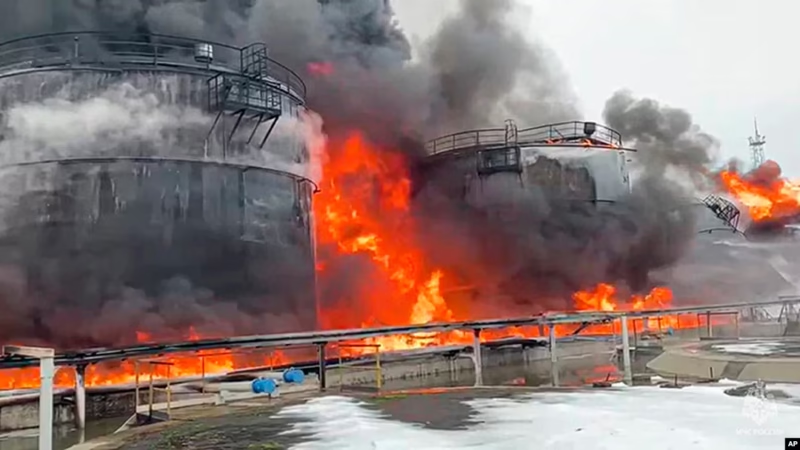
Airports, like oil facilities and ports, represent high-value targets not because of their immediate destruction, but because of the cascading disruption they can cause.
In the Gulf, where economies depend heavily on connectivity, logistics, and global movement, even temporary paralysis can carry outsized consequences.
The timing is critical. The strike comes as the wider conflict involving Iran continues to spill across borders, with missile and drone attacks already reported against multiple Gulf states. Civilian infrastructure—once considered off-limits—is increasingly part of the equation.
This reflects a shift in the nature of warfare.
Rather than decisive battlefield victories, the goal is pressure: degrade systems, create uncertainty, and stretch defenses across multiple fronts. Drones, inexpensive and hard to detect, are ideally suited for this kind of strategy.
For Gulf states, the challenge is immediate and complex. Air defense systems must now protect not only military installations, but also civilian nodes that are far more numerous and harder to secure.
The question is no longer whether such attacks will continue—but how far they will go.
If critical infrastructure becomes a sustained target, the region faces a new phase of conflict—one defined not by frontlines, but by the fragility of the systems that keep modern states functioning.