Connect with us

Top stories

Ethiopia Declares Sea Access a Non-Negotiable National Priority, FM Says

Published

on

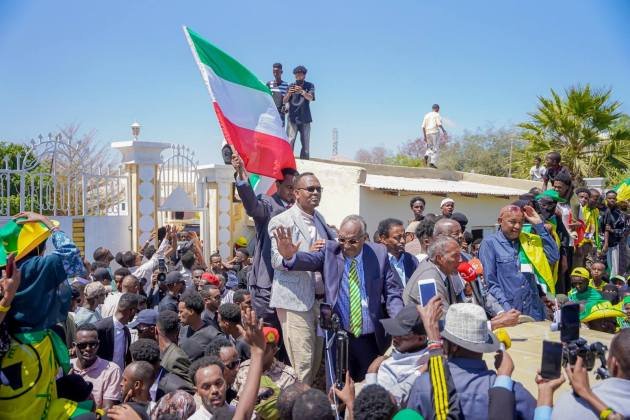
Ethiopia has elevated access to the sea from a policy objective to a national doctrine.

Speaking before the House of People’s Representatives on Monday, Foreign Affairs Minister Gedion Timothewos declared that Ethiopia’s quest for sea access is a strategic priority that transcends politics, governments, and generations.

Responding to lawmakers, Gedion said Addis Ababa has already succeeded in placing its case firmly on the international agenda, arguing that Ethiopia’s demand is legitimate, unavoidable, and rooted in long-term national survival, not short-term diplomacy.

“We have moved beyond simply explaining why Ethiopia needs sea access,” the minister said. “We are now actively pursuing ways to secure it.”

Gedion acknowledged the intense geopolitical competition in the Horn of Africa, where global and regional powers are racing to protect their interests. He said Ethiopia is navigating this landscape deliberately, aligning its diplomacy strictly with national interests.

Advertisement

The foreign minister stressed that improving relations with neighboring countries is central to the strategy, pointing to regional infrastructure projects — including electricity exports, railways, and cross-border development — as tools to create a favorable environment for achieving sea access.

Most notably, Gedion framed the issue not as a partisan debate, but as a generational obligation.

“This is not the agenda of one government,” he told parliament. “It is the agenda of Ethiopia.”

The message was unmistakable: landlocked status is no longer acceptable to Africa’s second-most populous nation — and Ethiopia is preparing, diplomatically and strategically, for a future in which access to the sea is treated as a right, not a favor.


Advertisement

Top stories

Trump Threatens Canada With 100% Tariff

Published

on

Donald Trump is no longer merely weaponizing tariffs. He is redefining them as instruments of geopolitical discipline.

On Saturday, the U.S. president escalated his economic pressure campaign by threatening Canada with a 100 percent tariff on all imports should Ottawa pursue a trade deal with China. The message, delivered in Trump’s familiar blunt style, was less about commerce and more about allegiance. In Trump’s worldview, economic neutrality no longer exists: trade choices are political choices.

The warning to Prime Minister Mark Carney framed Canada not as a sovereign trading partner but as a potential “drop-off port” for Chinese goods seeking access to American markets. It is a sharp reminder that Trump’s second-term foreign policy is not about multilateral balance but about bilateral obedience.

This threat fits neatly into a broader pattern. Only days earlier, Trump reversed tariff threats against European states after extracting what he called a “framework” agreement over Greenland — a strategic Arctic territory he continues to view as essential to U.S. military and resource dominance. Trump has turned tariffs into a coercive lever: lift them when partners comply, double them when they defy.

Yet the Canada warning is more significant than a simple trade dispute. It signals that Washington is no longer merely countering Beijing through tariffs on Chinese goods, but through indirect pressure on countries that might integrate economically with China. In effect, Trump is constructing a global economic perimeter around U.S. interests — one enforced not by treaties but by punishment.

Advertisement

At the same time, Trump is projecting raw power through control of energy flows. In the same weekend, he declared that the United States had seized Venezuelan oil from intercepted tankers and would refine it domestically. “We take the oil,” he said — a phrase that strips away diplomatic euphemism and replaces it with imperial clarity.

The oil seizures are part of a sweeping effort to dominate Venezuela’s energy sector after Trump’s dramatic capture of President Nicolás Maduro earlier this month. The campaign is not simply about regime change; it is about converting geopolitical victories into physical resource control. For Trump, energy is not just economic capital — it is strategic leverage.

Together, these moves reflect a coherent doctrine: economic force replaces diplomatic patience. Tariffs replace negotiations. Seizures replace sanctions. And compliance replaces consensus.

For Canada, the dilemma is acute. Aligning with China risks punitive isolation from its largest market. Rejecting China tightens dependence on a U.S. administration that increasingly demands loyalty over partnership.

Trump is not merely reshaping trade. He is reprogramming the rules of power in a world where economic decisions now carry the weight of military alliances.

Advertisement

The question is no longer whether countries can trade with China — but whether they are willing to pay the political price Washington now attaches to that choice.

Continue Reading

Top stories

Trump’s Defense Strategy Shakes the Global Order

Published

on

Trump’s New Defense Doctrine Tells Allies to Fend for Themselves — and Redraws America’s Global Role.

The Trump administration’s newly released National Defense Strategy is not merely a military document. It is a declaration that the post–World War II security architecture, long anchored in American leadership and alliance management, is being fundamentally rewritten.

For decades, U.S. defense strategy rested on a simple bargain: Washington guaranteed security, and allies aligned with its global priorities. Trump’s doctrine flips that logic. Allies, from Europe to East Asia, are now being told bluntly to carry their own weight — or risk finding themselves strategically expendable.

The document’s language is unusually political for a Pentagon blueprint. It scolds partners for relying on what it calls “subsidized defense,” framing U.S. protection less as leadership than as an unfair burden. In its place, Trump reasserts a narrower vision: dominance in the Western Hemisphere and a direct focus on concrete American interests rather than abstract global stewardship.

This pivot is most visible in how geography now outranks ideology. Greenland and the Panama Canal — once peripheral in strategic debates — suddenly emerge as priority terrain. The message is unmistakable: access, control, and proximity matter more than alliance sentiment or diplomatic tradition.

Advertisement

Even in Asia, where China once loomed as America’s “pacing challenge,” the tone has shifted. Beijing is no longer framed as an existential adversary but as a power to be deterred, not defeated. There is no mention of Taiwan — a striking omission that signals how carefully Washington now calibrates its commitments. Instead of confrontation, Trump’s strategy emphasizes “stable peace” and military-to-military communication, quietly lowering the ideological temperature while narrowing U.S. obligations.

Nowhere is the shock greater than in Europe. NATO is no longer portrayed as a security dependency but as a capable bloc expected to defend itself against Russia largely on its own. While Washington will remain “key,” it is now “calibrating” its presence — diplomatic code for a partial retreat. For a continent still grappling with war on its eastern flank, that recalibration carries existential weight.

This doctrine does not mark isolationism, but it does announce a new transactional realism. U.S. protection is no longer automatic; it is conditional, strategic, and interest-driven.

For allies, the implications are stark. The era of unquestioned American security guarantees is ending. What replaces it is a world where sovereignty must be matched by self-defense — or surrendered to geopolitical irrelevance.

Trump’s defense strategy is not just about military posture. It is about redefining power itself: less about who follows America, and more about who no longer can afford to.

Advertisement
Continue Reading

Top stories

Massive Winter Storm Set to Impact Over 200 Million Americans This Weekend

Published

on

More than 200 million people across the United States are in the path of a powerful winter storm expected to bring widespread snow, ice, and brutal cold across a 2,000-mile stretch of the country through the weekend, forecasters said.

The storm, which could affect nearly two-thirds of the U.S., is projected to be the most severe winter weather event in at least five years.

Freezing rain, snow and rain began sweeping across the Southern Plains on Friday and are forecast to move into the Mississippi and Tennessee Valleys on Saturday, before reaching the Northeast and Mid-Atlantic by Sunday into Monday.

Meteorologists warned the system will be slow-moving, allowing snow and ice to accumulate for prolonged periods. Winter weather alerts are in effect across 35 states, impacting at least 185 million people. Seventeen states and Washington, D.C., have declared states of emergency, and nine states have activated National Guard units.

Extreme cold is compounding the danger. Temperatures plunged to 21 degrees below zero in parts of Minnesota on Friday, with wind chills even colder. Record-low temperatures are expected across portions of the Southern Plains and Mid-Atlantic, as the polar vortex dips southward.

Advertisement

Heavy snow is forecast across a wide band of the country, with up to a foot expected in parts of the Texas Panhandle and Ozarks. The central Appalachians and parts of the Northeast could receive as much as two feet, forecasters said. New York City may see between 6 and 12 inches of snow.

Ice accumulation poses a major threat in the South, with up to one inch of ice possible in parts of northeastern Texas, northern Mississippi and southwestern Tennessee, increasing the risk of power outages as frozen rain weighs down power lines.

Travel disruptions are already mounting. Major U.S. airlines have issued travel waivers and hundreds of flights have been canceled, particularly at airports in Dallas-Fort Worth, Oklahoma City, Little Rock, Memphis, Nashville and Atlanta. An estimated 2,400 flights nationwide were canceled on Saturday alone.

Road conditions are expected to deteriorate rapidly, especially along major interstates including I-10, I-20, I-35, I-40 and I-55. Authorities urged people to avoid unnecessary travel and to carry winter emergency kits if driving is unavoidable.

Cities and states are preparing for the storm’s impact. New York City has deployed more than 2,000 sanitation workers and 700 salt spreaders, while Texas officials said the power grid is fully prepared to handle the surge in demand.

Advertisement

Emergency departments across the country are also bracing for a rise in cold-related injuries, including frostbite and hypothermia, particularly among vulnerable populations.

Meteorologists said forecast confidence has increased as the storm nears, though winter weather remains difficult to predict due to the fine balance between temperature and precipitation type.

The storm is expected to linger into early next week, with lingering ice and snow likely to persist well after precipitation ends.

Continue Reading

Top stories

Trump Launches Gaza Board of Peace in Davos

Published

on

DAVOS, Switzerland — U.S. President Donald Trump on Thursday formally launched the Gaza Board of Peace (BoP), signing its official charter during a high-profile ceremony at the World Economic Forum in Davos, marking one of the most ambitious foreign policy initiatives of his second term.

“Once this board is completely formed, we can do pretty much whatever we want to do,” Trump declared, adding that the body would operate in coordination with the United Nations while addressing not only Gaza but broader global challenges.

Trump, who will chair the Board, has invited dozens of world leaders to join the initiative, positioning it as a new diplomatic platform designed to stabilize post-war Gaza and reshape international conflict resolution. Although Trump insisted the BoP would not replace the UN, the initiative introduces a parallel structure that could significantly alter the architecture of global diplomacy.

The Board’s creation has been endorsed by a United Nations Security Council resolution as part of Trump’s Gaza peace framework. However, UN spokesperson Rolando Gomez clarified that UN engagement with the BoP would remain limited strictly to the Gaza context.

So far, around 35 countries have committed to joining, including Saudi Arabia, the United Arab Emirates, Egypt, Turkey, and Belarus. Notably absent, however, are most of the permanent members of the UN Security Council. Russia said it is “studying” the proposal, France has declined to join, Britain has opted out for now, and China has yet to announce a position.

Advertisement

Trump has proposed that permanent members contribute $1 billion each to help fund the initiative — a condition that has prompted caution and resistance among several traditional U.S. allies.

Despite that hesitation, Israel and Hungary — both close Trump allies — have confirmed their participation, lending the Board political weight despite its unconventional structure.

Momentum for the BoP continued to build across Europe. Albania’s parliament approved joining the Board on Thursday, with Prime Minister Edi Rama calling it “an act of goodwill” and “a special honor” that would secure Albania a place in high-level global diplomacy. Kosovo has also joined, while Bulgaria’s outgoing government has signed on, pending parliamentary ratification next week.

Veteran diplomat and former UN Middle East envoy Nikolay Mladenov has been appointed High Representative for Gaza under the Board’s framework.

With only Hungary and Bulgaria representing the European Union so far, Trump’s initiative highlights growing fractures between Washington and parts of Europe over how global governance should evolve in a post-Gaza order.

Advertisement

Whether the Gaza Board of Peace becomes a durable new pillar of international diplomacy or remains a Trump-era experiment now hinges on how many major powers ultimately choose to step inside its framework.

Continue Reading

Top stories

Trump Retreats on Greenland Tariffs After Davos Power Play

Published

on

Donald Trump arrived in Davos threatening a transatlantic rupture. He left suggesting an Arctic settlement.

In a dramatic reversal that stunned both allies and markets, the U.S. president stepped back from his threat to impose sweeping tariffs on European exports over Greenland, signaling that a “framework for a deal” had been reached following talks with NATO Secretary General Mark Rutte.

Only days earlier, Trump had rattled NATO by tying punitive trade measures to his push for U.S. control over Greenland — a move that risked triggering the deepest crisis in Western unity since the Iraq War. But in the Swiss Alps, Trump recalibrated, declaring that force was off the table and that a long-term security and minerals agreement was now within reach.

“It’s a deal that’s forever,” Trump declared, framing the shift not as retreat, but as strategic victory.

At its core, the pivot reflects a familiar Trump doctrine: escalate publicly, negotiate privately, then declare success. The tariffs — never formally enacted — functioned less as economic policy than as leverage. Their withdrawal suggests that Washington extracted enough concessions behind closed doors to justify stepping back without losing face.

Advertisement

What exactly has been agreed remains opaque. Rutte was careful to say that Greenland’s sovereignty was not discussed, underscoring Denmark’s red line. Copenhagen swiftly reiterated that any outcome must respect the territorial integrity of the Danish kingdom and the Greenlandic people’s right to self-determination.

Yet the contours of a deal are visible.

Trump’s language focused not on ownership, but access: missile defense infrastructure under his “Golden Dome” concept, privileged U.S. entry to Arctic minerals, and a coordinated Western posture to block Chinese and Russian expansion in the region. This suggests a shift from territorial ambition to strategic integration — turning Greenland into a fortified pillar of NATO’s Arctic architecture without formally redrawing borders.

For Europe, the retreat offers relief, but not reassurance.

European diplomats privately acknowledge that Trump’s tone has softened — but the underlying message remains: U.S. commitment to alliances is now transactional, not automatic. Even as Trump pulled back from tariffs, he used his Davos platform to scold allies on trade, defense spending, energy policy, and immigration — signaling that pressure, not partnership, is his default mode of engagement.

Advertisement

Markets, however, welcomed the détente. Wall Street surged after Trump ruled out force and paused the tariff threat, reversing days of volatility sparked by fears of a new trade war. The message to investors was clear: Arctic rivalry will be managed, not militarized — for now.

Still, the episode leaves deeper questions.

Trump’s Greenland gambit was never just about geography. It was about legacy, leverage, and redefining American primacy in a world where China and Russia are contesting every frontier — from the South China Sea to the Arctic Circle.

By forcing NATO and Denmark into negotiations under public pressure, Trump demonstrated that even core alliance norms are now subject to renegotiation. That precedent, not the tariffs themselves, may prove the most consequential outcome of the Davos confrontation.

As negotiations move into private channels involving Vice President JD Vance, Secretary of State Marco Rubio, and envoy Steve Witkoff, the real test will be whether this “deal framework” stabilizes Arctic governance — or simply postpones the next flashpoint.

Advertisement

For now, Trump has defused a crisis of his own making — and recast it as a triumph of American dealmaking.

In the new geopolitics of the Arctic, escalation is no longer a failure. It is a bargaining tool.

And Greenland, once a remote outpost, is now firmly on the world’s strategic map.

Continue Reading

Comment

Trump Put Somalia on Trial at Davos

Published

on

Trump Uses Davos to Spotlight Somalia, Immigration, and the Collapse of Mogadishu’s Image on the Global Stage.

In Davos, where the world’s elite typically trade in coded language about “collective action” and “shared responsibility,” Donald Trump chose confrontation over consensus.

Standing before political leaders, corporate titans, and global media at the World Economic Forum, the U.S. president delivered a blunt and unmistakable message: America will no longer absorb the political and institutional failures of other states through unchecked migration and welfare dependency. And in doing so, Trump placed Somalia — specifically its image, governance failures, and diaspora-linked scandals — squarely on the world stage.

At the center of his remarks was the sprawling Minnesota fraud case involving dozens of Somali residents accused of siphoning tens of millions of dollars from public nutrition programs. For Trump, the scandal was not an isolated criminal episode but evidence of a deeper failure — both in U.S. immigration screening and in the exporting of dysfunction from fragile states into Western institutions.

Trump framed the issue not in legal technicalities but in strategic terms: the United States, he argued, cannot function as a financial safety net for the governance failures of other nations. In his telling, welfare abuse is not merely criminal misconduct — it is a national security vulnerability.

Advertisement

The White House quickly reinforced that framing. In a statement following the speech, the administration argued that immigration must be tied to contribution, assimilation, and respect for the host nation’s laws, not merely humanitarian sentiment. In effect, Trump used Davos to internationalize what has long been a domestic debate — linking migration policy directly to state failure abroad.

What made the moment particularly striking was its venue. Davos is traditionally a sanctuary for diplomatic restraint and multilateral language. Trump transformed it into a platform for unilateral clarity, redefining what “dialogue” looks like under his presidency: not consensus-seeking, but agenda-setting.

Critics dismissed the remarks as inflammatory. Yet the policy sequence surrounding the speech tells a different story. The Davos intervention coincided with tangible shifts in U.S. immigration strategy:

A freeze on visa processing from dozens of countries deemed high-risk under “public charge” standards
Expanded DHS enforcement operations across multiple U.S. cities
A recalibration of immigration preference toward applicants with high economic or cultural alignment

This was not rhetorical theater. It was strategic signaling.

Advertisement

Beyond domestic politics, Trump’s Davos remarks also reshaped international perception. By associating Somalia’s global image with fraud, instability, and institutional failure, he inadvertently accelerated the collapse of Mogadishu-centric legitimacy on the world stage. In doing so, he exposed a diplomatic vacuum — one that stable, democratic actors in the Horn of Africa are now positioned to fill.

In global politics, reputation is currency. Trump effectively devalued Somalia’s brand in a room where reputations determine access, partnerships, and capital flows.

And here lies the deeper geopolitical consequence.

As the United States hardens its stance against exporting instability through migration, it simultaneously creates space for alternative African narratives — those rooted in governance, security, and economic discipline rather than perpetual crisis diplomacy. The era in which “Somalia” functioned as the default Horn of Africa identity in Western policymaking is visibly eroding.

Trump’s Davos moment, then, was not merely an attack on a community or a scandal. It was a recalibration of how failed states are treated in global forums — no longer as passive victims, but as accountable political entities whose internal failures carry international consequences.

Advertisement

Whether one agrees with his tone or not, the message delivered in Davos was unmistakable:
The age of moral abstraction in migration policy is ending.
The age of transactional sovereignty has begun.

And Somalia — or more precisely, the political model represented by Mogadishu — found itself publicly weighed, measured, and found wanting on the world’s most elite stage.

Continue Reading

Top stories

India and UAE Sign $3 Billion LNG Deal

Published

on

India and the United Arab Emirates have just redefined the strategic geometry between South Asia and the Gulf — and they did it in two hours.

During a lightning visit by UAE President Sheikh Mohammed bin Zayed to New Delhi, both sides signed a $3 billion liquefied natural gas deal that elevates India to the UAE’s largest LNG customer and anchors Abu Dhabi as a central pillar in India’s long-term energy security. ADNOC Gas will supply 0.5 million metric tons of LNG annually to Hindustan Petroleum for a decade, pushing the total value of Emirati energy contracts with India beyond $20 billion.

But the energy deal is only half the story.

More significant is what came alongside it: a formal commitment to build a strategic defence partnership and a pledge to double bilateral trade to $200 billion within six years. In practical terms, this signals a shift from transactional cooperation to structural alignment — energy, security, trade, and geopolitics now fused into a single corridor.

The timing matters.

Advertisement

India’s move comes as Pakistan has already locked in a mutual defence pact with Saudi Arabia and is pursuing a trilateral framework with Turkey. In response, New Delhi is not chasing alliances out of ideology — it is constructing partnerships around resilience: diversified energy supply, maritime security, arms cooperation, and supply chain insulation.

For the UAE, this is about strategic diversification. As Abu Dhabi recalibrates its regional posture — diverging from Saudi Arabia in Yemen, clashing on oil output, and navigating multipolar pressures — India offers something rare: scale without volatility, growth without ideological entanglement.

What makes this pact particularly notable is what it avoids.

Despite defence integration, Indian officials were explicit: this partnership does not pull India into Gulf conflicts. Instead, it positions New Delhi as a stabilizing external power — economically embedded, militarily interoperable, but politically independent.

In today’s fractured global system, that model is increasingly valuable.

Advertisement

This deal also strengthens the emerging Indo-Arab axis that stretches from the Gulf to the Indian Ocean — one that bypasses traditional Western security architecture while remaining compatible with it. It is a quiet but decisive move toward strategic autonomy for both sides.

Energy is the entry point. Defence is the multiplier. Trade is the anchor.

Together, they form a new corridor of influence — one that will shape how power flows between Asia and the Middle East in the decade ahead.

Continue Reading

Top stories

Iranian Interior Ministry Official Defects, Begs Trump to Strike Regime

Published

on

Iran Interior Ministry Official Defects, Urges Trump to Act Amid Brutal Crackdown.

An official from Iran’s Interior Ministry has defected from the Islamic Republic’s government and joined ongoing anti-regime protests, publicly appealing to U.S. President Donald Trump to take decisive action against Tehran as demonstrations and state violence escalate across the country, according to a report by Iran International.

The official — whose identity is being withheld for security reasons — said his decision to defect was inspired by calls from opposition figures, notably exiled Crown Prince Reza Pahlavi. He told the broadcaster that he witnessed what he described as the Islamic Republic’s deliberate and ruthless use of live ammunition against unarmed protesters, saying security forces had little regard for civilian life.

“Iran’s security apparatus is ruthless and will do anything,” the official said, describing a situation he characterized as resembling de facto martial law in several provinces, with traffic restrictions, armed patrols, and attempts to suppress all public gatherings. He also warned that Iranians’ patience was wearing thin amid intensified crackdowns.

In a direct appeal to Trump, the defector stated that many Iranians are “waiting for Trump,” and warned that if U.S. leadership fails to act, a “widespread hatred” toward the U.S. could emerge among the Iranian public. He expressed belief that Trump might eventually intervene but stressed protesters’ expectations were growing amid the regime’s use of lethal force.

The defection and public appeal come amid some of the most violent unrest Iran has seen in years. Protests that began in late December 2025 over economic hardship have expanded into broader anti-government demonstrations, prompting a severe crackdown by security forces and a near-nationwide internet shutdown. Rights groups estimate thousands of deaths and tens of thousands of arrests as authorities attempt to suppress dissent.

Advertisement

President Trump has repeatedly said the U.S. is considering strong measures against Tehran. In mid-January, he tweeted that “help is on the way,” a phrase widely interpreted as a promise of potential intervention, although he later canceled planned strikes and said he would “watch what the process is” regarding military options.

International concern has also grown: the United Nations Human Rights Council is planning an emergency session to address alleged rights violations against protesters, and several Western governments have condemned Iran’s use of force.

The unfolding crisis — now involving defections from within the regime’s own ministries — highlights both the depth of internal dissent and the intense pressure Iran faces domestically and internationally as calls for political change continue to grow.

Continue Reading

Most Viewed

error: Content is protected !!