Somalia’s Self-Inflicted Wounds: The Role of Clanism, Corruption, and Conflict in State Collapse.
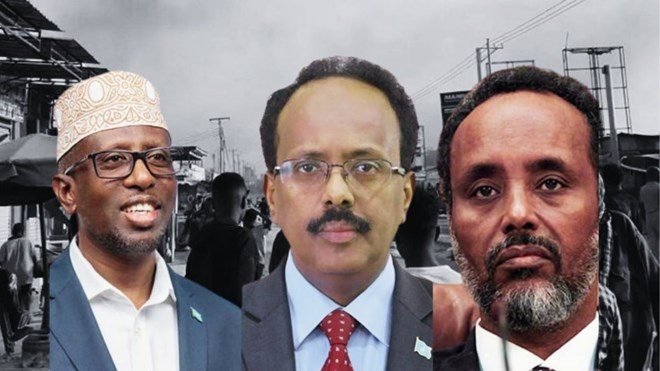
When three former Somali presidents—Abdiqasim Salad Hassan, Sharif Sheikh Ahmed, and Mohamed Abdullahi Farmaajo—jointly accuse the sitting government of violating the constitution to seize public land, it’s more than a political quarrel.
It’s a warning light on the dashboard of a state that never repaired its foundations after the Djibouti Peace Process of 2008.
Their statement, issued after deadly clashes around Mogadishu’s Horseed Stadium, is unusually specific: they cite constitutional guarantees on environment, property and land management, and the legal plumbing that should govern any transfer or sale—procurement oversight, publication in the Official Gazette, transparent accounting to the treasury. In plain terms: follow the law, resettle displaced families, stop treating public assets as private spoils.
Parliamentarians have echoed the concern. Humanitarian groups warn of mass evictions and a swelling tide of internally displaced families. The pattern is familiar and corrosive: contested land, opaque deals, force before process.
But to understand why these fires keep flaring, look past the parcels to the politics. Somalia’s operating system—the 4.5 power-sharing formula—was built to avoid zero-sum clan conflict. Over time it calcified into what many Somali analysts describe as a duopoly at the top, shrinking competition to two poles and inviting everyone else to bargain for access.
That is not a moral indictment; it is a structural one. When leadership is negotiated first by lineage and only later by program, cabinets become arithmetic problems, and public goods become afterthoughts.
Layer that structure onto today’s security map and you get the explosive mix we see now. Critics of President Hassan Sheikh Mohamud argue that the national army is too often redirected into political contests with federal member states instead of a sustained, professional campaign against Al-Shabaab. They point to repeated confrontations with Puntland and Jubaland—both led by Darood-heavy coalitions—as attempts to tilt the federal balance by coercion rather than consensus.
Whether you share that judgment or not, the perception matters: if federal authority is seen as a partisan cudgel, it deepens the very divides the federation was meant to manage.
The same logic applies beyond the federal map. In Somaliland, Hargeisa’s officials and civil leaders read recent political overtures toward local notables in Awdal as an effort to open a new front of pressure after the Lasanod rupture—another round of proxy politics in a region that needs the opposite. Mogadishu rejects that narrative; yet the fear is real, and fear has consequences. Dialogue with Somaliland since 2012 has been intermittent but essential; instrumentalizing local grievances for leverage would make a negotiated future harder, not easier.
Follow the money and the stakes climb again. Somali commentators worry that the presidency is courting foreign backers who oppose recognition for Somaliland—seeking budgetary oxygen and diplomatic backing while tightening the center’s grip. That may look like tactical statecraft in the short run. In the long run, it risks turning internal reconciliation into a subcontract of outside agendas. No one wins that auction except the auctioneers.
Strip away the slogans and the core problem is brittle legitimacy. When citizens watch evictions enforced before court orders, or see former militants recycled into senior office without accountable vetting, they conclude—rationally—that rules are flexible for the connected and rigid for the weak. When federal troops are more visible in political standoffs than in steady, disciplined operations against jihadists, the public draws its own line between priority and performance. And when the national story is framed as Hawiye versus Darood, every decision is read as sectarian even if it isn’t, because the scoreboard is already lit.
Why would any leader lean into that framing? Two uncharitable explanations circulate in Mogadishu’s tea houses. The first is hardball consolidation: narrow the base to the clan network most likely to defend the palace, sideline rival power centers in Puntland and Jubaland, and press the advantage while donors remain focused on budget lines, not benchmarks. The second is darker: secure enough friends and funds abroad to guarantee a soft landing if the center cannot hold—Turkey is the country most often mentioned in these whispers—while leaving an impossible inheritance to the next government. The president and his allies reject both claims. Yet in politics, unanswered suspicion behaves like fact.
There is a worst-case trajectory, and we should say it aloud to make it avoidable. If the army is politicized, if courts are sidelined by force, if land becomes the coin of coalition-maintenance and federalism the arena for settling lineage scores, Al-Shabaab’s narrative writes itself: a corrupt elite versus authentic faith and order. Afghanistan did not “fall” in a day; it hollowed out. Somalis deserve better than a Kabul-2021 replay in Mogadishu.
Somalia does not lack peace agreements. It lacks the habits and institutions that make agreements real across clan lines and across election cycles. Keep swapping the furniture at the top, and the house will keep shaking. Fix the beams—land governance, rule of law, professional security, de-sectarian politics—and it can stand. The choice is not Hawiye or Darood; it is statehood or the slow-motion surrender that extremists crave.