International Concerns Escalate as Armed Factions Mobilize in Tripoli Over Control of Libya’s Central Bank
The United Nations has issued a stark warning about the worsening situation in Libya, where recent mobilizations of armed factions and threats of force have intensified fears for civilian safety. On Thursday, the UN’s Libya mission highlighted mounting concerns over the deteriorating political and military climate in the country, driven by a deepening conflict over control of the Central Bank of Libya (CBL).
Stephanie Koury, the mission’s deputy head, delivered a sobering assessment to the U.N. Security Council on Monday, revealing that the security situation in Libya has rapidly declined over the past two months. Koury emphasized the unacceptable nature of military displays and confrontations within densely populated areas, which jeopardize the lives of ordinary Libyans.
The unrest erupted following political efforts to oust Sadiq al-Kabir, the head of the CBL. Rival factions, each backing different candidates for the central bank’s leadership, have mobilized their forces, exacerbating the crisis. On Friday, Mohammed al-Shokri, the proposed successor to Kabir, declared that he would only accept the position if endorsed by both of Libya’s rival legislative bodies—a move underscoring the deep-seated divisions within the country.
Libya’s struggle for stability traces back to the 2011 NATO-backed uprising that toppled Muammar Gaddafi. The country has been plagued by fragmentation since 2014, splitting between warring eastern and western factions. The conflict has drawn in foreign powers, including Russia and Turkey, each supporting different sides. Although a cease-fire was established in 2020, efforts to resolve Libya’s political crisis and establish a unified government have faltered, leaving the nation in a state of persistent conflict.
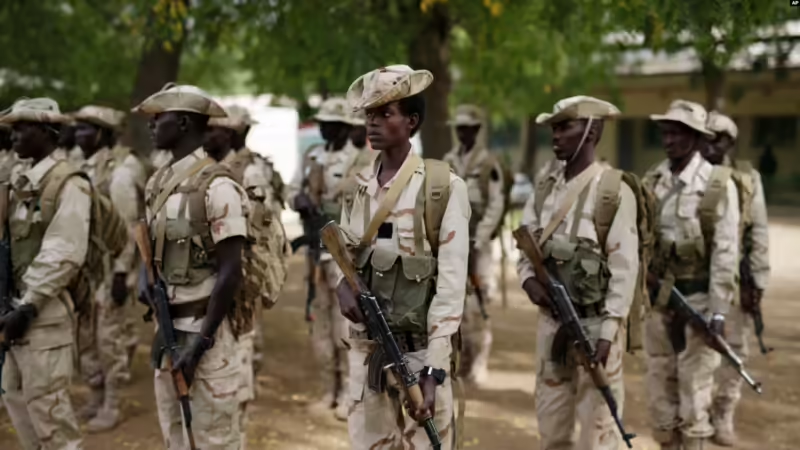
The current unrest reflects the broader instability that has plagued Libya for years. Eastern Libya is controlled by Khalifa Haftar’s Libyan National Army (LNA), while Tripoli and the northwest, where the internationally recognized Government of National Unity (GNU) is based, are home to various rival armed groups. Recent mobilizations by these factions, coupled with the LNA’s expansion into southwest Libya, have stoked fears of a renewed east-west conflict.
The political landscape is equally fraught. The eastern-based House of Representatives has intensified efforts to unseat the GNU and the Presidency Council, while the High State Council faces a deadlock following a contentious leadership vote. The conflict over the central bank’s control has further escalated tensions, especially after the Presidency Council’s attempt to replace Kabir and his board was met with strong resistance from the parliament.
As Libya’s political and security crisis deepens, the UN’s warnings highlight the urgent need for international intervention and a coordinated effort to restore stability and protect civilians in this war-torn nation.