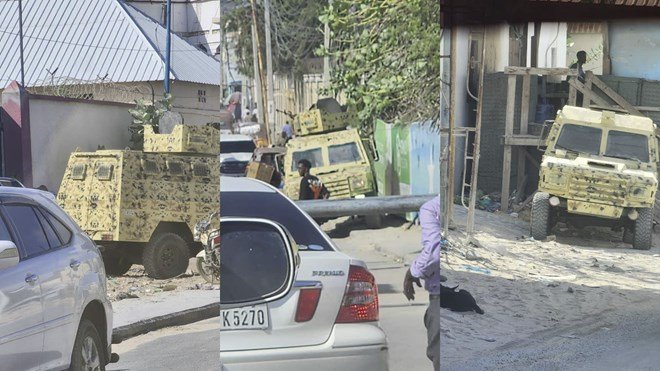
Mogadishu awoke Thursday to the sight of armored personnel carriers blocking key intersections and troops patrolling roads leading to the residences of prominent opposition leaders. The deployment followed deadly clashes a day earlier at Warta Nabadda police station, where government forces and opposition-linked militias exchanged fire in one of the capital’s most serious political flare-ups this year.
Opposition figures accused the government of using the mobilization to intimidate rivals and to disrupt alleged arms smuggling into the city. Photos circulated online showed armored vehicles stationed near Aden Adde International Airport, fueling speculation that the government is preparing for more confrontations.
The heightened security presence comes as opposition parties have called for protests this weekend against what they describe as illegal land seizures by senior officials. Residents expressed unease that demonstrations could spiral into violence if security forces clash with opposition supporters.
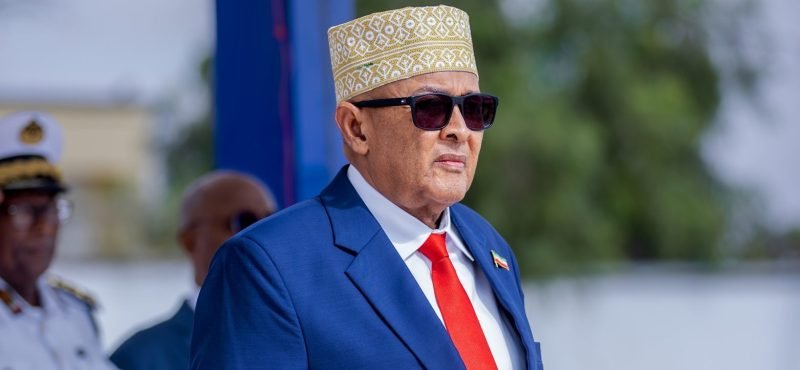
Sheikh Adan Mohamed Nur Madobe, the parliamentary speaker who is serving as acting president while President Hassan Sheikh Mohamud attends the UN General Assembly in New York, toured the police station Thursday and delivered a stark warning. He condemned the gun battles as “deeply regrettable” but praised government forces for limiting casualties.
In remarks that underscored the fragility of Somalia’s political order, he accused opposition leaders of pushing the country toward instability.
“The bullets I saw at the station were even heavier than those used in the civil war,” Madobe said. “It is shameful for this country to be dragged once again into chaos and disorder.”
Prime Minister Hamse Abdi Barre on Wednesday described the incident as a “failed coup attempt,” rhetoric that signals Mogadishu’s leadership intends to treat the clashes as a direct challenge to state authority rather than an isolated skirmish.
Madobe also confirmed that several officers had been arrested for allegedly beating civilians at Mogadishu’s Sinay market, promising accountability as part of an effort to calm public outrage. But he urged opposition politicians to avoid mobilizing the public for confrontation, warning that further escalation could destabilize the capital.
“What you are pursuing is not in the public interest,” he said. “Do not let what happened yesterday be repeated.”
The confrontation marks another dangerous turn in Somalia’s long struggle to balance fragile institutions with deeply polarized politics.
With armored convoys now stationed outside opposition homes, the capital faces a tense weekend that could determine whether the unrest fizzles—or ignites into a wider confrontation.