
Somalia
Somali police seize 48 sacks of narcotics at Mogadishu airport


Somali police at Aden Adde International Airport in Mogadishu have seized a large shipment of narcotics. The operation, which took place on Saturday, uncovered 48 sacks of drugs, totaling 2,496 packages.
Details of the Seizure
According to a statement from the Office of the Attorney General, the confiscated haul included 48 bags, each containing 52 packages, along with six cartons of paper wrapped with the drugs. Authorities have stated that investigations are underway to identify and bring those responsible to justice. The Attorney General’s Office warned that drug trafficking poses a significant threat to the security and well-being of the Somali community and that offenders will face strict legal consequences.
This seizure follows a similar incident one month prior at the same airport, where security agencies confiscated 189 packages of illegal drugs.
No arrests have been made in connection with that earlier case.


















Somali Future Council Cites Constitutional Deadlines as Parliament and Presidency Near Mandate Expiry.
April 14. May 15. Two dates that could define Somalia’s next chapter.
Somalia’s opposition-aligned Somali Future Council on Monday warned federal leaders against delaying national elections, citing looming constitutional deadlines and the risk of renewed political turmoil.
In a statement, the council said the current Federal Parliament’s term under the 2012 provisional constitution ends on April 14, 2026, while President Hassan Sheikh Mohamud’s mandate expires on May 15, 2026. It urged authorities to hold elections on time to preserve constitutional order and prevent disputes.
“Somalia must avoid actions that could lead to electoral delays or political disputes,” the council said, calling on federal institutions, political actors and other stakeholders to respect the constitution and uphold the governance framework.
The warning comes amid heightened political debate following the president’s recent signing of a revised federal constitution into law after parliamentary approval. The amendments set five-year terms for federal institutions, replacing the four-year limit established under the 2012 provisional charter.
Government officials have described the constitutional changes as part of a long-delayed reform process aimed at clarifying institutional mandates and strengthening governance. Opposition figures, including members of the Somali Future Council, argue that the amendments were adopted without sufficient national consensus and could affect the electoral timetable.
The council referenced the 2021 political crisis, when a dispute over a proposed term extension led to armed tensions in Mogadishu and deepened divisions between federal authorities and opposition groups. It warned against repeating what it described as “past mistakes” that undermined stability.
The statement also urged federal member states to conduct their own elections in line with constitutional principles and the federal framework, saying this would reinforce cooperation and trust between different levels of government.
With key mandates nearing expiration, Somalia faces a narrow political window. Whether leaders can navigate constitutional reform while maintaining broad consensus may determine whether the country moves toward orderly elections — or another period of uncertainty.
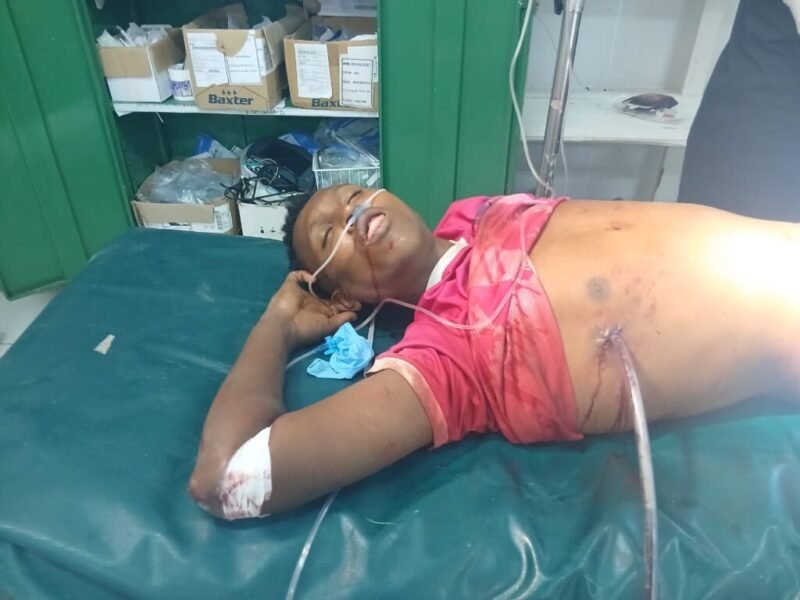
Protests over alleged land seizures turn violent in Mogadishu — gunfire leaves at least 10 wounded as tensions rise during Ramadan.
At least 10 people were injured after Somali security forces opened fire on protesters in Mogadishu’s Heliwaa and Yaaqshiid districts, according to witnesses and medical sources.
Residents had gathered to protest what they described as land grabbing by government officials, alleging that armed personnel were deployed to clear and demolish homes in parts of the two districts. Demonstrators reportedly blocked roads and threw stones at security forces before live ammunition was used.
Witnesses said a joint force of military and police officers fired directly into crowds after confrontations escalated. The confirmed number of injured stands at 10, though locals believe the toll could be higher.
One hospital in Mogadishu that received several of the wounded said some patients suffered gunshot wounds at close range. Medical staff indicated that multiple young men were admitted with serious injuries requiring urgent care.
Images circulated by local media showed civilians receiving treatment in emergency wards, highlighting the severity of the clashes. Independent verification of the total number of casualties remains ongoing.
The incident comes at a particularly sensitive time, as Somalia observes the holy month of Ramadan. Communities in Mogadishu are already grappling with economic hardship and prolonged drought, which have deepened vulnerability in urban neighborhoods.
Authorities have not yet issued a detailed public statement addressing the allegations of excessive force or clarifying the legal basis for the reported demolitions.
The confrontation underscores growing tensions in parts of the capital over land disputes — a long-standing and politically charged issue in Somalia’s rapidly expanding urban areas. As investigations continue, calls are mounting for accountability and restraint to prevent further escalation.
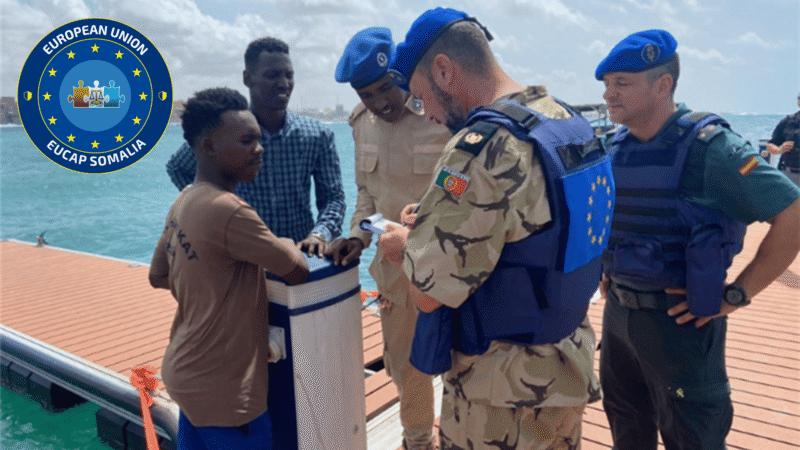
A fake email. A diverted bank transfer. Nearly €70,000 stolen from an EU mission in Somalia — now a prison sentence follows.
A Spanish citizen has been sentenced to three years in prison for impersonating a service provider to the European Union Capacity Building Mission in Somalia in order to fraudulently obtain funds, following an investigation by the European Public Prosecutor’s Office (EPPO) in Madrid.
The case involved funds allocated to EUCAP Somalia, a mission tasked with supporting the Federal Somali Police Force and strengthening maritime security and law enforcement capabilities in Somalia.
According to prosecutors, on December 27, 2022, the defendant sent an email to the EU mission posing as a legitimate supplier of medical and laboratory equipment. In the message, he requested that the next scheduled payment be transferred to a different bank account — one under his control.
Authorities said he had obtained key operational details from an unidentified third party, enabling him to execute the fraud. On January 9, 2023, €69,751.40 was transferred into the account he controlled.
In addition to the three-year prison sentence, Criminal Chamber Two of Spain’s Audiencia Nacional imposed a fine calculated at €10 per day for 10 months. The court also ordered the defendant to reimburse the full amount unlawfully obtained.
The verdict, issued on February 9, 2026, marks the first conviction handed down by a Criminal Chamber of the Audiencia Nacional following an EPPO investigation in Madrid. The ruling remains subject to appeal.
The EPPO is the European Union’s independent prosecution office, responsible for investigating and prosecuting crimes affecting the EU’s financial interests.
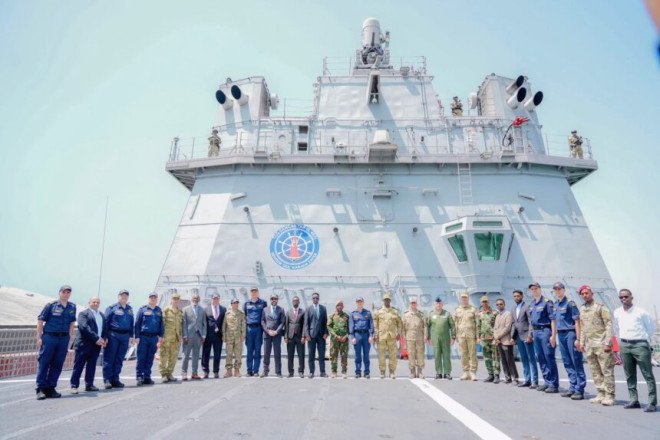
Ankara says “stability.” Somaliland sees risk. The Horn of Africa is entering a new strategic chapter — and the stakes are rising fast.
When Turkish warships docked in Mogadishu, alongside reports of F-16 fighter jet deliveries and offshore drilling plans, the signal was unmistakable: Ankara is deepening its footprint in Somalia. For Somaliland — whose collective memory still carries the trauma of the 1988 bombardment of Hargeisa by the regime of Siad Barre — the optics alone are unsettling. Military expansion in Mogadishu is rarely viewed as defensive. It is viewed through history.
Yet a sober assessment of the Turkey–Somalia defense and economic framework suggests a more complex reality. Turkey is unlikely to launch — or support — an offensive campaign against Somaliland. The strategic costs would be immense.
As a key member of NATO, Ankara positions itself as a regional stabilizer, not a proxy combatant in Somalia’s internal territorial disputes. An unprovoked escalation against a relatively stable and democratic territory with informal ties to the United Kingdom, the UAE and Ethiopia would undermine Turkey’s diplomatic standing at a time when it seeks influence across Africa and the Red Sea corridor.
Economics also act as a restraint. Turkey’s maritime doctrine — often described as the “Blue Homeland” — prioritizes sea lanes, energy access and trade routes. A regional war would jeopardize precisely the offshore prospects and shipping stability Ankara hopes to cultivate. Investors do not drill in active conflict zones.
Ethiopia further complicates any military calculus. Somaliland’s memorandum of understanding with Ethiopia creates a deterrent layer Ankara cannot ignore. Turkey maintains significant economic and defense ties with Addis Ababa; it is unlikely to risk indirect confrontation over Mogadishu’s maximalist claims.
Still, the danger lies less in intent than in imbalance. Advanced aircraft in a fragile security environment introduce new variables. Even if initially deployed against Al-Shabaab, the capability itself alters regional power equations. History in Somalia has shown how quickly state assets can be redirected.
Maritime cooperation carries similar risks. If Turkish-trained Somali naval units patrol waters claimed by Somaliland — particularly near the vital Berbera corridor — even minor incidents could escalate into diplomatic crises.
The most combustible element may be energy exploration. Should Turkish drilling vessels operate in offshore blocks Somaliland considers within its jurisdiction, a commercial venture could morph into a sovereignty dispute with international implications.
Turkey is not preparing an invasion. It is consolidating influence — military, economic and maritime — in a strategically vital region. For Somaliland, the challenge is not alarmism but strategy: direct engagement with Ankara, stronger regional integration with Ethiopia, and early internationalization of maritime boundary concerns.
In the Horn of Africa, power shifts rarely announce themselves loudly. They unfold quietly — until they don’t.

A passenger aircraft operated by Starsky Airline crashed on Tuesday at Aden Adde International Airport shortly after takeoff, but all passengers and crew survived, Somali aviation officials said.
The plane was en route to Galkayo when it suffered a technical malfunction immediately after departure, forcing the pilot to attempt an emergency return to Mogadishu.
The Somali Civil Aviation Authority confirmed that everyone on board was safely evacuated and that there were no fatalities.
“The pilot tried to land the aircraft back in Mogadishu, but after touchdown he was unable to maintain control,” said Ahmed Moalim Hassan, director general of the authority. “The aircraft overshot the runway and came close to the shoreline. There were no casualties.”
Initial reports indicated around 50 passengers were on board. Emergency teams responded quickly and evacuated all occupants.
Aviation officials said an investigation is under way to determine the exact cause of the crash.
The incident adds to concerns about aviation safety at Aden Adde Airport. In April last year, a UN-chartered aircraft made a belly landing at the same airport after its landing gear failed to deploy.
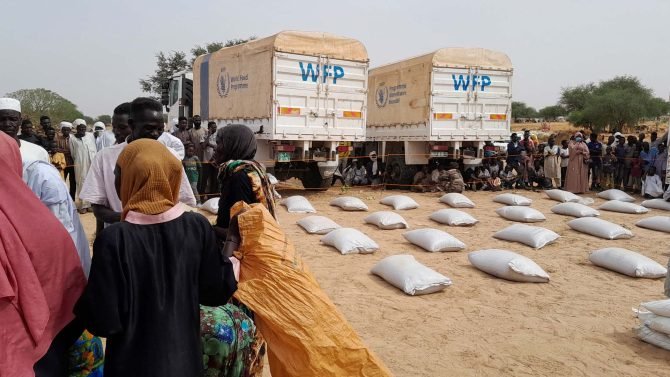
United States to Permanently End Aid to Somalia After Government Destroys U.S.-Donated Food.
The collapse of Somalia’s aid relationship with the United States is no longer hypothetical — it is now policy.
Washington is moving to permanently end U.S. assistance to the Somali Federal Government after authorities in Mogadishu demolished a World Food Programme (WFP) emergency warehouse containing 76 metric tons of U.S.-donated food, a decision approved at the highest levels of government. According to a U.S. diplomatic cable, the destruction likely rendered the food unusable and directly violated donor agreements and UN diplomatic protocols.
This was not a technical mishap. It was a sovereign decision taken without coordination with the United States, the WFP, or other international donors — and it has triggered consequences Somalia can no longer deflect or delay.
The State Department has already paused all assistance benefiting the Somali Federal Government, making clear that accountability and compensation were prerequisites for any resumption. According to senior U.S. officials, that resumption is now off the table entirely, with all U.S. aid expected to end permanently by May.
The implications are severe. U.S. assistance has been a financial and operational backbone for Somalia’s government — from food security and humanitarian relief to institutional support and logistics. Losing it permanently signals not just donor fatigue, but a complete breakdown in trust.
Equally damaging is the international signal. The United Nations World Food Programme has formally classified the demolition as a breach of UN diplomatic protocols, placing Somalia in direct violation of the norms that underpin humanitarian access worldwide. This risks contagion: other donors may follow Washington’s lead rather than assume similar political or reputational exposure.
At a moment when Mogadishu is already diplomatically isolated, struggling with internal legitimacy, and dependent on external support, this decision reinforces a growing perception among partners that the federal leadership is unpredictable, unaccountable, and hostile even to lifesaving aid.
This is no longer about food destroyed at a port. It is about a government that has crossed a red line with its most critical donor — and is now learning that international patience has limits.

Jealousy in Villa Somalia: Hassan Sheikh’s War Against Somaliland’s Democracy.
Somalia’s President Hassan Sheikh Mohamud has become a prisoner of his own jealousy. Two years into his second term, he has turned Villa Somalia into a war room not against al-Shabaab, famine, or corruption — but against Somaliland’s democracy.
It is the bitter irony of Mogadishu politics: Somaliland has what Hassan Sheikh craves but cannot build. Elections, functioning institutions, stability — the very pillars of a state. And each time Hargeisa strengthens its democracy, Hassan Sheikh’s insecurity deepens. Instead of fixing Somalia’s crumbling foundations, he wastes his energy trying to sabotage Somaliland’s international rise.
Diplomats whisper of a leader consumed by comparison. When Somaliland engages Ethiopia, he panics. When Congress debates travel advisories, he rages. When Somaliland’s army parades discipline, he lashes out with propaganda. It is envy in plain sight.
Meanwhile, Somalia under Hassan Sheikh has become what critics call “Somalia, Inc.” — a company run on begging contracts and aid trips. He has circled the globe signing pledges with Qatar, Turkey, and Egypt, but what has it delivered? More debt, more dependency, and more humiliation. He acts like a traveling salesman while Mogadishu rots under insecurity and corruption.
And yet, he keeps returning to his favorite target: Somaliland. His strategy is one of projection — blame Somaliland, block Somaliland, bury Somaliland. But the more he tries, the more the world notices Hargeisa’s difference. Somaliland is not perfect, but next to Mogadishu’s chaos, it shines.
This obsession is Hassan Sheikh’s fatal flaw. It exposes his weakness, isolates his diplomacy, and leaves Somalia unprepared for the storms ahead. Ethiopia is openly discussing Red Sea access. Egypt and Eritrea are arming Somalia’s fragile government. Al-Shabaab still controls swathes of land. Yet Villa Somalia’s energy is wasted on fighting a neighbor that long ago outpaced it.
The humiliation runs deeper. By attacking Somaliland, Hassan Sheikh admits — without saying it — that Somaliland is real. If it were not, why fear it? Why obsess over it? Why chase every foreign leader to block recognition? His jealousy has become Mogadishu’s foreign policy, and it is destroying him.
And here is the grim prediction: the president after him will be worse. If Somalia survives Hassan Sheikh’s term, it will inherit a broken state, an isolated diplomacy, and an army of resentments. Somaliland, meanwhile, will march on.
Whistleblower reveals President and Speaker approved secret deal granting Turkey control over 90% of Somalia’s oil and gas — triggering calls of betrayal and neo-colonialism.

“90% Giveaway”: Somalia’s Oil Surrender to Turkey Sparks Outrage in Parliament
A Somali MP has exposed explosive claims implicating the President and Speaker in a secret oil deal with Turkey that hands 90% of Somalia’s hydrocarbon wealth to Ankara. National sovereignty and political accountability now hang in the balance.
The Federal Parliament of Somalia has been rocked by an explosive declaration from MP Dr. Abdillahi Hashi Abib, who publicly accused President Hassan Sheikh Mohamud and Speaker Sheikh Adan Madobe of surrendering 90% of Somalia’s oil and gas wealth to Turkey in a secretive deal that he claims undermines the very sovereignty of the nation.
Standing before the House of the People, Dr. Hashi, a respected member of the Foreign Affairs Committee, revealed that a whistleblower from inside Villa Somalia had furnished him with credible documentation showing both the President and Speaker gave their approval to a deeply controversial hydrocarbons agreement that grants Turkey the lion’s share of Somalia’s natural resources — leaving the Somali people with only a token 10%.
He further disclosed that the President is reported to have defended the lopsided agreement as being “in the best interest of the nation,” a justification that Dr. Hashi forcefully condemned as “a veiled act of neo-colonialism.”
But the accusations don’t stop there. Dr. Hashi warned that in the coming days, he will release notarized documents showing that Ziraat Bank of Turkey violated Somali banking laws, operating under the radar with what appears to be unauthorized coordination with the Central Bank of Somalia.
The implications are staggering. If substantiated, this agreement not only strips Somalia of control over its future economic engine but also potentially violates constitutional procedures, sovereignty norms, and economic governance principles.
Dr. Hashi’s rallying cry was blunt:
“Have the President and the Speaker fulfilled their solemn constitutional oaths to safeguard the interests and sovereignty of the Federal Republic of Somalia?”
Public outrage is mounting. Many in Mogadishu and the wider Somali diaspora are now calling for an emergency parliamentary investigation. Critics are framing the deal as an act of economic treason—a continuation of foreign domination disguised as partnership.
With his final words, Dr. Hashi warned:
“Stay vigilant. The truth will be revealed.”
The Somali public is waiting — and the storm is just beginning.
Oil, Betrayal & Invasion: Somalia’s Secret Coup in Lasanod Unmasked
Turkey’s Somali Oil Grab: A Strategic Coup or Neocolonial Exploitation?
How Turkey’s Strategy in Africa Capitalizes on Anti-Western and Anti-China Sentiments
Turkey to Deploy Frigates to Guard Energy Exploration Ship in Somalia
Somalia and Turkey Have Signed Intelligence-sharing Agreement

How the UAE Became the Frontline of a War It Tried to Avoid

The Hormuz Paradox: Globalization’s Artery as its Executioner

Oil Shock Deepens as Iran War Disrupts Global Supply


-

 TECH3 weeks ago
China Bets on an AI-Powered Military Future
-
 US-Israel war on Iran2 weeks ago
Waves of Mystery Drones Breach U.S. Nuclear Base Airspace
-
 Terrorism7 days ago
Egypt Uncovers Alleged Plan to Down Presidential Plane
-
 US-Israel war on Iran2 weeks ago
Saudi Arabia Warns of Military Action After Iranian Missile Strike
-
 US-Israel war on Iran2 weeks ago
Former CIA Chief Blames White House for Escalating Iran War Crisis
-
 Top stories1 week ago
Saudi Arabia Deepens Defense Ties with Ukraine
-
 US-Israel war on Iran2 weeks ago
Iran’s Guard Leadership Hit Hard in Escalating Strikes
-
 Analysis2 weeks ago
Inside the IRGC’s Quiet Rebuild of Hezbollah