A Harder Iran May Emerge From War—Weaker Militarily, Stronger Internally.
In Tehran, power is shifting quietly.
Airstrikes have hit infrastructure, commanders have been killed, and military capabilities have been degraded. Yet inside the system, something else is taking place: not collapse, but consolidation. What is emerging is a more centralized, security-driven order—one increasingly defined by the dominance of the Islamic Revolutionary Guard Corps.
This transformation reflects a familiar pattern in wartime regimes.
By the third layer of this conflict, external pressure is not loosening control—it is tightening it. As political space narrows, authority migrates toward institutions built for survival: intelligence services, paramilitary networks, and internal security organs. In Iran, that shift has been underway for years. The war is accelerating it.
There are two competing realities.
On one hand, Iran’s conventional and nuclear capabilities have been significantly weakened by sustained strikes. On the other, the internal balance of power is tilting toward more hardline actors—those least inclined toward compromise and most invested in coercion.
That contradiction matters.
Historically, weakening a state’s external capabilities does not necessarily moderate its behavior. In some cases, it produces the opposite effect: a system that compensates for strategic losses with increased repression and asymmetric leverage.
The Strait of Hormuz is central to that leverage.
By restricting access to one of the world’s most critical energy routes, Iran has demonstrated that it retains the capacity to shape global markets even as its military assets are degraded. The blockade transforms geography into influence—allowing Tehran to project power without direct confrontation.
There are also internal dynamics at play.
The loss of senior figures has created openings within the hierarchy. Promotions are increasingly driven by loyalty rather than expertise, reinforcing a system that prioritizes control over competence. Decision-making may become less coordinated, but more uncompromising.
At the same time, public pressure inside Iran is rising—driven by economic strain, disruption, and uncertainty. Yet these pressures do not necessarily translate into reform. For a system oriented around survival, internal dissent often leads to tighter control, not political change.
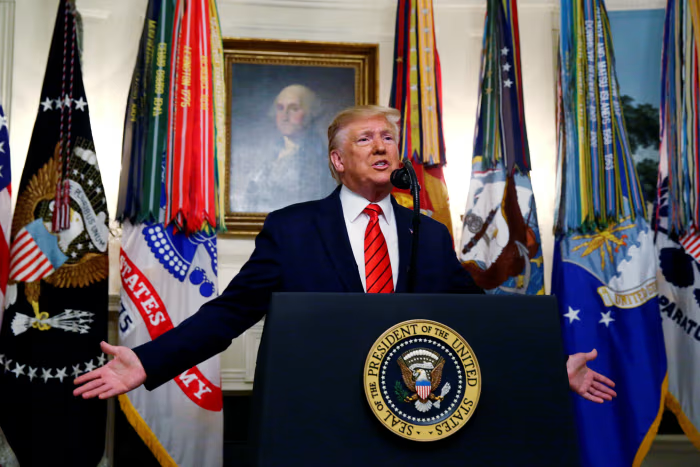
The United States, under Donald Trump, has framed the campaign as a decisive effort to eliminate threats. But the strategic question is no longer limited to battlefield outcomes.
It is about what comes after.
There are competing interpretations of the trajectory. Some argue that sustained pressure could eventually force concessions or weaken the regime’s grip. Others warn that the current path risks producing a more rigid, militarized state—less capable in conventional terms, but more willing to use disruptive tools.
That second scenario carries broader implications.
A state that is weaker but more ideologically hardened, and still able to influence global energy flows, may prove harder to contain. Its incentives shift—from projecting stability to managing crisis as a form of leverage.
The debate over ceasefire reflects this tension.
In Western frameworks, a ceasefire implies de-escalation and a path toward resolution. In Tehran’s evolving system, pauses may function differently—tactical adjustments within a longer cycle of confrontation.
That divergence complicates diplomacy.
What is unfolding is not simply the degradation of a regime, but its reconfiguration.
And in that reconfiguration lies the central risk: that the war produces not a more compliant Iran, but a more controlled, more insular, and potentially more unpredictable one.
Because in conflicts like this, weakening a state is not the same as reshaping it.
And the difference can define the next phase of instability.