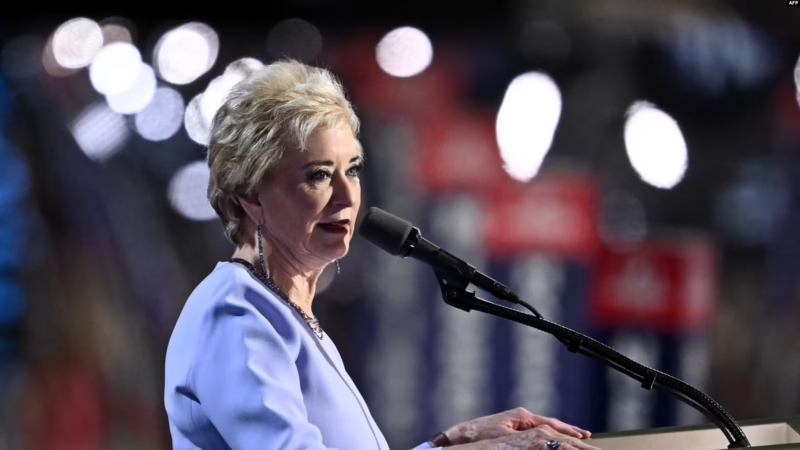
Namibia may witness a historic moment as Vice President Netumbo Nandi-Ndaitwah stands on the brink of becoming the country’s first female president in Wednesday’s presidential elections. If victorious, her leadership would mark a significant milestone in the nation’s democratic journey, with broader implications for women’s representation across Africa.
At least 1.4 million voters, nearly half the population, are registered to cast their ballots in an election that also determines control of the National Assembly. Nandi-Ndaitwah’s party, the South West Africa People’s Organization (SWAPO), has been the dominant political force since Namibia gained independence from South African apartheid rule in 1990.
Challenges Facing SWAPO’s Legacy
While SWAPO retains a historical advantage due to its role in Namibia’s liberation, the party’s grip on power has weakened in recent years. In 2019, SWAPO lost its two-thirds parliamentary majority for the first time since 1994. The loss has been attributed to widespread discontent fueled by allegations of corruption and the “Fishrot” scandal, which implicated senior government officials in misappropriating funds from Namibia’s lucrative fishing industry.
Political analyst Henning Melber has warned that SWAPO must adapt to shifting voter demographics. Younger Namibians, or “born-frees”—those born after independence—are less swayed by the party’s liberation legacy and more concerned with governance and economic performance.
“The erosion of legitimacy as a former liberation movement is a challenge SWAPO must address if it hopes to maintain influence,” Melber noted.
Nandi-Ndaitwah’s Promises and Critics
At 72 years old, Nandi-Ndaitwah has campaigned on addressing Namibia’s pressing socioeconomic issues, including high youth unemployment, currently estimated at 20%, and economic stagnation exacerbated by global downturns. She has pledged to create 500,000 jobs over the next five years, backed by a $4.7 billion investment plan—an ambitious promise her critics argue lacks feasibility given Namibia’s modest economic resources.
She has also emphasized policies that support gender equality, including reproductive rights, equal pay, and improved healthcare access. If elected, Nandi-Ndaitwah would join the ranks of Africa’s trailblazing female leaders, such as Ellen Johnson Sirleaf of Liberia and Joyce Banda of Malawi.
Opposition Challenges
SWAPO faces formidable opposition from parties like the Independent Patriots for Change (IPC), led by former dentist Panduleni Itula, and the Affirmative Repositioning Party, spearheaded by university professor Job Amupanda. Both parties have tapped into growing discontent among Namibia’s youth and urban populations, presenting themselves as alternatives to SWAPO’s long-standing dominance.
Shifting Political Tides in Southern Africa
Namibia’s elections occur amid broader political upheaval in southern Africa. South Africa’s African National Congress (ANC) recently lost its parliamentary majority for the first time in 30 years, while Botswana’s ruling party was ousted after nearly six decades in power. Even in Mauritius, known for its political stability, opposition parties achieved a landslide victory.
Disputed results in Mozambique have led to deadly protests, with at least 30 fatalities reported as opposition groups challenge the ruling Frelimo party’s victory.
A Landmark Moment for Namibia?
Should Nandi-Ndaitwah secure the presidency, her leadership would symbolize progress in a region where women’s political representation remains limited. Political science lecturer Erika Thomas highlighted the importance of Nandi-Ndaitwah fostering transparency and inclusivity if elected.
“She must prioritize policies that empower women and increase their participation in political structures,” Thomas emphasized.
As Namibians head to the polls, the outcome will not only determine the country’s leadership but could also signal a turning point in its political and social trajectory. The election’s result may serve as a reflection of Namibia’s readiness to embrace change amid the challenges of governance, economic reform, and inclusivity.