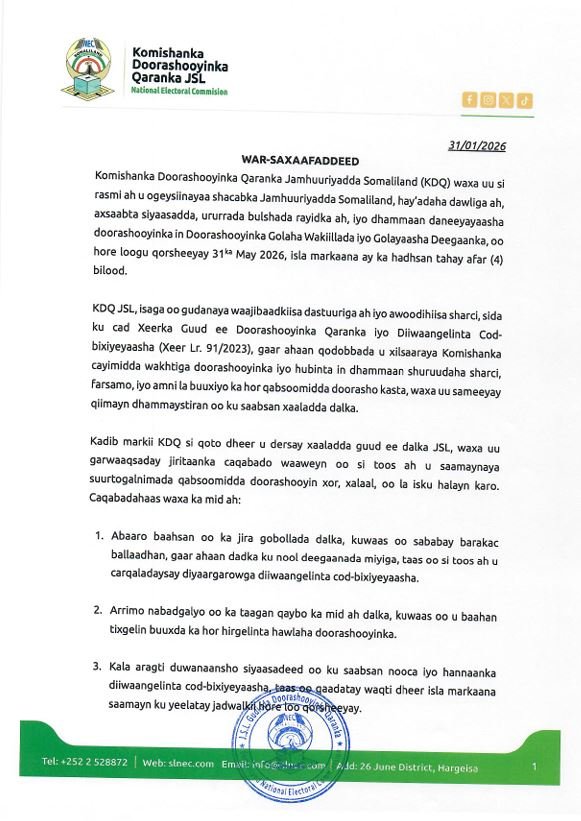
Somaliland Delays Parliamentary and Local Elections, Citing Drought, Security and Political Disputes.
The Somaliland Electoral Commission’s decision to postpone the House of Representatives and Local Government elections marks a critical moment for the country’s democratic trajectory. Scheduled for May 31, 2026, the vote has now been pushed back by ten months, a move the Commission says is driven not by political convenience but by hard constraints on the ground.
At the center of the decision is a convergence of pressures that have become increasingly difficult to manage simultaneously. Prolonged drought has disrupted large swathes of the country, affecting population movement, livelihoods and the basic logistics required for voter registration and polling. In parallel, localized security challenges have raised concerns about the Commission’s ability to guarantee safe access to polling stations and election materials in all regions.
Political disagreements have compounded those challenges. While the Commission did not specify the nature of the disputes, the reference reflects a familiar pattern in Somaliland politics: unresolved tensions over process and timing that can undermine confidence if elections proceed without broad consensus.
By invoking its constitutional mandate under the General Elections and Voter Registration Act, the Commission is attempting to anchor the postponement firmly in law. The language of the statement is deliberate. This is presented as a “special extension,” not an open-ended delay, and as a measure designed to protect the integrity of the vote rather than suspend it.
The ten-month extension creates a narrow but consequential window. During this period, the Commission says it will complete outstanding technical work on voter registration, finalize election materials, and strengthen operational readiness. In effect, it is buying time to ensure that when elections do take place, they meet both domestic constitutional standards and international expectations of credibility.
Still, the decision carries political risk. Election delays, even when legally justified, can feed public suspicion in a region where democratic processes are often under strain. For Somaliland, which has long presented itself as a relative democratic exception in the Horn of Africa, maintaining public trust is as important as managing logistics.
The Commission appears acutely aware of that balance. Its emphasis on legality, transparency and accountability is aimed at preempting accusations that the delay serves partisan interests. Whether that assurance holds will depend less on words than on visible progress during the extension period.
The next ten months will therefore function as a test. If the Commission uses the time to deliver tangible improvements in voter registration, security coordination and political dialogue, the postponement may ultimately strengthen Somaliland’s democratic institutions. If progress stalls, the delay could deepen skepticism and sharpen political competition.
For now, the message from the Electoral Commission is clear. The cost of proceeding under unfavorable conditions is judged to be higher than the cost of waiting. Somaliland is choosing caution over speed, betting that credibility is better preserved by delay than by a flawed vote.