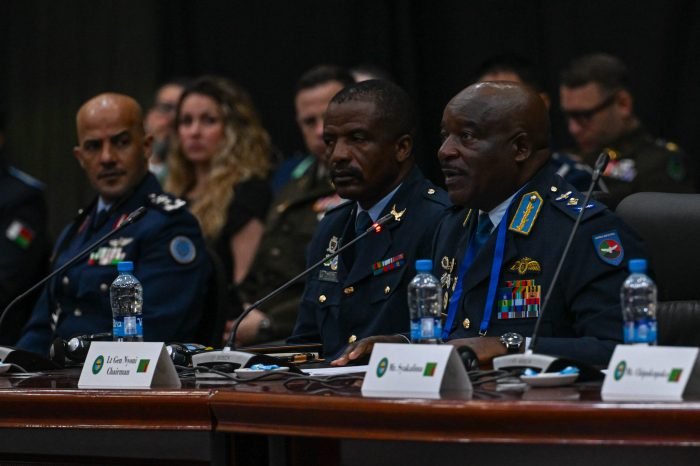
Somaliland’s high-level visit to the headquarters of US Africa Command in Stuttgart represents another important step in the gradual expansion of direct security engagement between Hargeisa and Washington.
The delegation, led by Defence Minister Mohamed Yusuf Ali and including Coast Guard Commander Admiral Ahmed Hurre Hariye, discussed maritime security, institutional capacity-building and wider stability across the Horn of Africa, according to Somaliland’s Ministry of Defence.
The significance lies less in any immediate agreement than in where the talks took place.
Somaliland officials were not meeting a regional intermediary or attending a general conference. They were received at AFRICOM’s headquarters to discuss security challenges directly affecting the Bab el-Mandeb Strait, the Red Sea and the Gulf of Aden.
Those waterways are under growing pressure from terrorism, weapons trafficking, piracy, illegal fishing and regional warfare. AFRICOM itself describes maritime-domain awareness, coordinated interdiction and stronger coastal institutions as central to protecting African waters and international commerce.
Somaliland offers several practical advantages.
It controls a long coastline facing the Gulf of Aden, maintains functioning security institutions and occupies territory close to some of the world’s most vulnerable shipping routes. Berbera also provides infrastructure that could support logistics, coast-guard development, maritime surveillance and emergency access.
For Washington, this makes Somaliland operationally relevant even while US diplomatic policy continues to recognize Somalia’s territorial integrity.
That contradiction increasingly defines the relationship.
The United States does not formally recognize Somaliland as an independent state, but its military institutions continue to assess Somaliland according to practical realities: stability, geography, local capacity and willingness to cooperate.
The Somaliland ministry said the Stuttgart meeting ended with a preliminary understanding to deepen cooperation in defence, security and institutional development.
However, there has been no publicly announced defence pact, basing agreement or joint operational framework. AFRICOM had not issued a specific public statement confirming the Somaliland meeting as of August 7. The details therefore remain based primarily on Somaliland government reporting.
That does not reduce the meeting’s strategic importance.
It shows that Hargeisa is moving beyond symbolic diplomacy and presenting itself directly to American military planners as a capable security partner in a region where reliable institutions are scarce.
WARYATV ASSESSMENT
The Stuttgart meeting should be understood as the opening of a more structured security channel—not yet a formal alliance.
Somaliland’s immediate opportunity is to convert dialogue into practical cooperation: coast-guard training, radar coverage, maritime intelligence exchange, port security and professional military education.
Washington’s challenge is political. It increasingly recognizes Somaliland’s operational value while remaining constrained by a diplomatic policy built around Somalia’s territorial claim.
The wider Red Sea crisis may eventually force that contradiction into the open.
In maritime security, geography and capability matter more than diplomatic formulas.
Somaliland possesses both.
The visit to AFRICOM headquarters shows that Washington’s military establishment is becoming increasingly willing to engage with that reality.