“Democracy Isn’t for Us”—Burkina Faso Junta Redefines Power Amid War.
On state television in Ouagadougou, the message was delivered without hesitation. Ibrahim Traoré told his country to “forget about democracy.”
It was not a slip. It was a declaration.
Speaking to the national broadcaster, Traoré dismissed democratic governance as incompatible with Burkina Faso’s current reality, arguing that elections and political competition must give way to what he framed as a more urgent priority: survival in the face of escalating insecurity.
The statement marks a turning point in a transition that was once framed as temporary. After seizing power in a 2022 coup, Traoré initially pledged a return to civilian rule by 2024. That timeline has since been extended to 2029, while political parties have been banned and opposition space sharply reduced.
By the third layer of this shift, the implications extend beyond Burkina Faso. The country has become part of a broader pattern across parts of West Africa, where military governments are redefining legitimacy—not through elections, but through claims of restoring security and sovereignty.
Traoré’s rhetoric reflects that recalibration. He has positioned himself within a lineage that includes Thomas Sankara, invoking anti-colonial themes and rejecting Western political models. For supporters, this framing resonates as a break from external influence. For critics, it signals a consolidation of power under the language of resistance.
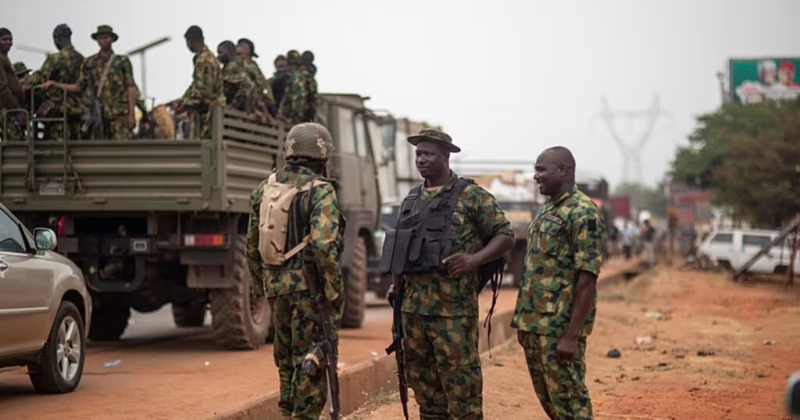
The security context is central to that argument. Burkina Faso has faced a sustained insurgency linked to jihadist groups since 2014, with violence displacing millions and destabilizing large parts of the country. The government maintains that extraordinary measures are necessary to confront an existential threat.
Yet the results remain contested.
Human rights organizations, including Human Rights Watch, report that violence has continued to escalate, with civilians caught between armed groups and state-aligned forces. Allegations of mass killings, forced displacement, and targeted attacks on ethnic communities have drawn international scrutiny—claims the government denies.
There are competing narratives at play. Authorities argue that strict control is required to restore order. Critics contend that suppressing political processes risks deepening instability by removing peaceful channels for dissent.
The tension is not new, but it is becoming more explicit.
Traoré’s rejection of democracy reframes the debate. It shifts the question from how to hold elections to whether elections are even relevant under current conditions. In doing so, it challenges assumptions that have long guided international engagement with the region.
The strategic calculation appears clear: prioritize control now, defer political transition until security improves.
The risk is that the two may become intertwined. Without political inclusion, grievances can persist. Without security, democratic processes struggle to take root. Each depends on the other—and the absence of one can undermine the other.
For Burkina Faso, the path forward is uncertain. The junta’s approach may consolidate authority in the short term, but its long-term sustainability will depend on whether it can deliver the stability it promises.
Because in the end, the debate is not only about democracy.
It is about whether any system—military or civilian—can restore order in a country where conflict has already reshaped the foundations of governance itself.