Jordan’s King Abdullah II Arrives in Jeddah for Talks with Saudi Crown Prince. At a moment of war and uncertainty, Riyadh and Amman are moving closer—fast.
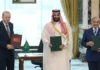
King Abdullah II arrived in Jeddah on Monday, where he was received at King Abdulaziz International Airport by Mohammed bin Salman, signaling a high-level meeting at a moment of deep regional uncertainty.
The visit underscores longstanding ties between the Jordan and Saudi Arabia, two states that have historically positioned themselves as anchors of stability in the Middle East. Officials framed the meeting as part of ongoing coordination between leaderships, reflecting what both sides describe as a shared strategic outlook.
But the timing is what gives the visit its weight.
With the region facing escalating tensions—from the ongoing Iran war to mounting pressure on energy routes and security alliances—consultations between Riyadh and Amman take on broader geopolitical significance.
Both countries have consistently aligned on core regional priorities, including support for a political resolution to the Palestinian issue, counterterrorism cooperation, and safeguarding regional stability amid external pressures.
The meeting also carries diplomatic implications beyond the region.
By presenting a unified front, Saudi Arabia and Jordan aim to reinforce the role of coordinated Arab diplomacy in shaping international responses to crises. In an environment where global powers are increasingly divided, such alignment offers a counterweight—projecting cohesion at a time of fragmentation.
Economic considerations are also expected to feature prominently.
Saudi Arabia’s Vision 2030 reform agenda, led by Crown Prince Mohammed bin Salman, has opened new avenues for regional partnerships. Jordan, navigating its own economic modernization efforts, stands to benefit from expanded cooperation in sectors such as infrastructure, renewable energy, and technology.
Existing frameworks, including bilateral coordination councils, provide a mechanism to translate political alignment into tangible investment and development.
The optics of the personal by the Crown Prince at the airport—were deliberate.
They conveyed not only diplomatic courtesy but also the depth of the relationship, reinforcing a pattern of close engagement between the two leaderships. Such gestures, while symbolic, often reflect deeper strategic coordination behind closed doors.
As the Middle East enters a period of heightened volatility, this visit is less about ceremony and more about positioning.
For Riyadh and Amman, the message is clear: coordination is no longer optional—it is essential.