
Possible Spam
WARYATV Raises Alarm Over Chrome Spam Filter Flagging Its Web Push Notifications

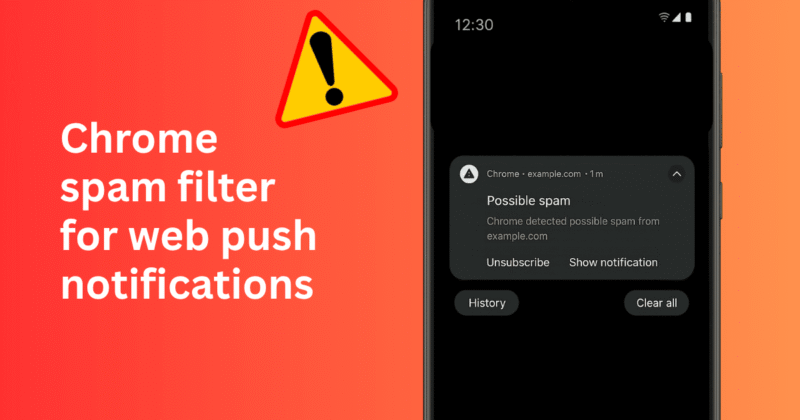
Your browser says “Possible Spam.” We say: you asked for our news. Here’s what’s happening.
WARYATV has raised concerns after Google Chrome’s new machine-learning spam filter began flagging its web push notifications as “possible spam,” prompting readers to unsubscribe.
The feature, announced on the official Chromium blog under the title “Fighting Unwanted Notifications with Machine Learning in Chrome,” is designed to detect and block what Google considers low-quality or abusive web push messages.
But publishers say the system risks penalizing legitimate outlets whose subscribers explicitly opted in to receive alerts.
Unlike email, web push notifications require users to manually grant permission through a browser prompt before any messages can be delivered. Users can also unsubscribe instantly with a single click. For that reason, digital publishers argue that web push cannot, by definition, be “unsolicited.”
Under the new system, if Chrome flags a notification, users no longer see the original message. Instead, they receive a browser-generated alert reading: “Possible spam. Chrome detected possible spam from [website].”
The notice includes two prominent buttons: “Unsubscribe” and “Show notification.” Critics say the design may nudge readers toward unsubscribing before even viewing the content.
The filter relies on machine learning models trained largely on synthetic data generated by Google’s Gemini large language model, according to Chromium documentation.
The model analyzes notification text — including headlines, descriptions and action buttons — to determine whether content resembles spam patterns.
Publishers worry the criteria are opaque. Words commonly used in journalism or marketing — such as “urgent,” “breaking,” or “free” — could potentially trigger flags.
Since the system is proprietary and its training data is not public, it is difficult for news organizations to know precisely what prompts a notification to be labeled suspicious.
Notably, Chrome does not apply the same automated spam detection system to notifications sent by native mobile apps, which typically have notifications enabled by default once installed. Web-based publishers argue this creates an uneven playing field between the open web and app ecosystems.
Web push notifications are end-to-end encrypted and function as a direct channel between publishers and subscribers. Industry advocates warn that unpredictable filtering could weaken the reliability of this communication method and affect engagement metrics.
For publishers experiencing declines in click-through rates, digital marketing experts suggest testing alternative wording and monitoring performance closely.
Google has not publicly indicated plans to reverse or modify the feature.


Lebanon War Expands a Conflict Already Spinning Out of Control

Russia and Ukraine Trade Deadly Strikes as Zelenskyy Meets Erdogan

Royal Daughters Caught in a Scandal That Won’t Fade


-

 TECH3 weeks ago
China Bets on an AI-Powered Military Future
-

 US-Israel war on Iran2 weeks ago
Waves of Mystery Drones Breach U.S. Nuclear Base Airspace
-

 Terrorism1 week ago
Egypt Uncovers Alleged Plan to Down Presidential Plane
-

 US-Israel war on Iran3 weeks ago
Saudi Arabia Warns of Military Action After Iranian Missile Strike
-

 US-Israel war on Iran2 weeks ago
Former CIA Chief Blames White House for Escalating Iran War Crisis
-

 Top stories1 week ago
Saudi Arabia Deepens Defense Ties with Ukraine
-

 US-Israel war on Iran2 weeks ago
Iran’s Guard Leadership Hit Hard in Escalating Strikes
-

 Analysis2 weeks ago
Inside the IRGC’s Quiet Rebuild of Hezbollah