Top stories
Travel Ban Widens Again: Trump Targets New Countries, Tightens U.S. Borders
The travel ban is back—broader, tougher, and politically charged. Five more countries are out, dozens face new limits, and the message from Washington is unmistakable.
The Trump administration on Tuesday moved to significantly expand its travel ban, adding five countries to the list of nations whose citizens are barred from entering the United States and imposing new restrictions on travelers from more than a dozen others.
The decision marks another escalation in the administration’s drive to tighten immigration controls and revive one of President Donald Trump’s most controversial first-term policies.
Under the new proclamation, nationals from Syria, South Sudan, Burkina Faso, Mali and Niger are now fully banned from visiting the United States. The White House also announced a complete restriction on travel by individuals using travel documents issued by the Palestinian Authority, a move likely to draw international scrutiny.
The expansion follows the recent arrest of an Afghan national accused of shooting two National Guard troops near the White House over the Thanksgiving weekend. While administration officials have not directly linked the case to the policy shift, the timing underscores how security incidents continue to shape immigration decisions.
The new measures build on a sweeping announcement Trump made in June, when he reinstated a hallmark policy from his first term by banning travelers from 12 countries and imposing partial restrictions on seven others.
That earlier list included Afghanistan, Myanmar, Chad, the Republic of Congo, Equatorial Guinea, Eritrea, Haiti, Iran, Libya, Somalia, Sudan and Yemen, with heightened restrictions placed on Burundi, Cuba, Laos, Sierra Leone, Togo, Turkmenistan and Venezuela.
Tuesday’s update goes further. In addition to the five newly banned countries, the administration added 15 more nations to the list facing partial travel restrictions: Angola, Antigua and Barbuda, Benin, Côte d’Ivoire, Dominica, Gabon, Gambia, Malawi, Mauritania, Nigeria, Senegal, Tanzania, Tonga, Zambia and Zimbabwe.
In justifying the move, the administration cited what it described as systemic problems in many of the affected countries, including widespread corruption, unreliable civil documentation and weak criminal record systems. Officials also pointed to high rates of visa overstays, refusals by some governments to accept deported nationals, and political instability that complicates U.S. vetting efforts.
“The restrictions and limitations imposed by the Proclamation are necessary to prevent the entry of foreign nationals about whom the United States lacks sufficient information to assess the risks they pose,” the White House said, framing the policy as essential to national security, counterterrorism and immigration enforcement.
The Afghan suspect in the Thanksgiving shooting has pleaded not guilty to murder and assault charges. Still, the broader policy shift suggests the administration is once again using border security as both a governing priority and a defining political signal—one with far-reaching diplomatic and humanitarian consequences.
Top stories
India and UAE Sign $3 Billion LNG Deal
India and the United Arab Emirates have just redefined the strategic geometry between South Asia and the Gulf — and they did it in two hours.
During a lightning visit by UAE President Sheikh Mohammed bin Zayed to New Delhi, both sides signed a $3 billion liquefied natural gas deal that elevates India to the UAE’s largest LNG customer and anchors Abu Dhabi as a central pillar in India’s long-term energy security. ADNOC Gas will supply 0.5 million metric tons of LNG annually to Hindustan Petroleum for a decade, pushing the total value of Emirati energy contracts with India beyond $20 billion.
But the energy deal is only half the story.
More significant is what came alongside it: a formal commitment to build a strategic defence partnership and a pledge to double bilateral trade to $200 billion within six years. In practical terms, this signals a shift from transactional cooperation to structural alignment — energy, security, trade, and geopolitics now fused into a single corridor.
The timing matters.
India’s move comes as Pakistan has already locked in a mutual defence pact with Saudi Arabia and is pursuing a trilateral framework with Turkey. In response, New Delhi is not chasing alliances out of ideology — it is constructing partnerships around resilience: diversified energy supply, maritime security, arms cooperation, and supply chain insulation.
For the UAE, this is about strategic diversification. As Abu Dhabi recalibrates its regional posture — diverging from Saudi Arabia in Yemen, clashing on oil output, and navigating multipolar pressures — India offers something rare: scale without volatility, growth without ideological entanglement.
What makes this pact particularly notable is what it avoids.
Despite defence integration, Indian officials were explicit: this partnership does not pull India into Gulf conflicts. Instead, it positions New Delhi as a stabilizing external power — economically embedded, militarily interoperable, but politically independent.
In today’s fractured global system, that model is increasingly valuable.
This deal also strengthens the emerging Indo-Arab axis that stretches from the Gulf to the Indian Ocean — one that bypasses traditional Western security architecture while remaining compatible with it. It is a quiet but decisive move toward strategic autonomy for both sides.
Energy is the entry point. Defence is the multiplier. Trade is the anchor.
Together, they form a new corridor of influence — one that will shape how power flows between Asia and the Middle East in the decade ahead.
Top stories
Iranian Interior Ministry Official Defects, Begs Trump to Strike Regime
Iran Interior Ministry Official Defects, Urges Trump to Act Amid Brutal Crackdown.
An official from Iran’s Interior Ministry has defected from the Islamic Republic’s government and joined ongoing anti-regime protests, publicly appealing to U.S. President Donald Trump to take decisive action against Tehran as demonstrations and state violence escalate across the country, according to a report by Iran International.
The official — whose identity is being withheld for security reasons — said his decision to defect was inspired by calls from opposition figures, notably exiled Crown Prince Reza Pahlavi. He told the broadcaster that he witnessed what he described as the Islamic Republic’s deliberate and ruthless use of live ammunition against unarmed protesters, saying security forces had little regard for civilian life.
“Iran’s security apparatus is ruthless and will do anything,” the official said, describing a situation he characterized as resembling de facto martial law in several provinces, with traffic restrictions, armed patrols, and attempts to suppress all public gatherings. He also warned that Iranians’ patience was wearing thin amid intensified crackdowns.
In a direct appeal to Trump, the defector stated that many Iranians are “waiting for Trump,” and warned that if U.S. leadership fails to act, a “widespread hatred” toward the U.S. could emerge among the Iranian public. He expressed belief that Trump might eventually intervene but stressed protesters’ expectations were growing amid the regime’s use of lethal force.
The defection and public appeal come amid some of the most violent unrest Iran has seen in years. Protests that began in late December 2025 over economic hardship have expanded into broader anti-government demonstrations, prompting a severe crackdown by security forces and a near-nationwide internet shutdown. Rights groups estimate thousands of deaths and tens of thousands of arrests as authorities attempt to suppress dissent.
President Trump has repeatedly said the U.S. is considering strong measures against Tehran. In mid-January, he tweeted that “help is on the way,” a phrase widely interpreted as a promise of potential intervention, although he later canceled planned strikes and said he would “watch what the process is” regarding military options.
International concern has also grown: the United Nations Human Rights Council is planning an emergency session to address alleged rights violations against protesters, and several Western governments have condemned Iran’s use of force.
The unfolding crisis — now involving defections from within the regime’s own ministries — highlights both the depth of internal dissent and the intense pressure Iran faces domestically and internationally as calls for political change continue to grow.
Top stories
EU Prepares Retaliation as Trump Threatens Tariffs Over Greenland Crisis
Europe is entering one of the most dangerous trade confrontations in a generation — not over steel, not over tech, but over Greenland.
Behind closed doors in Brussels, EU leaders are racing on two parallel tracks: diplomacy to calm President Trump, and retaliation to prepare for what many now see as an unavoidable economic clash.
At the center of the crisis is Trump’s threat to impose sweeping tariffs on six European states unless Denmark agrees to negotiations over Greenland. For European diplomats, this is not a trade dispute. It is coercion.
Their immediate hope rests on damage control.
Shuttle diplomacy is already underway. NATO Secretary General Mark Rutte is expected to confront Trump directly in Davos, selling Operation Arctic Endurance as a defensive mission — not a challenge to US ambitions. Italy and the UK are quietly pushing the same line: that Trump may be reacting to a misunderstanding, not a strategy.
But Brussels is no longer betting on goodwill.
On February 7, a dormant €93 billion counter-tariff package will automatically come back to life unless suspended again. The list is surgical: American yachts, agricultural exports, and industrial goods designed to hit politically sensitive US constituencies.
This is the easy option.
The harder — and more dangerous — one is the EU’s “trade bazooka”: the Anti-Coercion Instrument. Never used before, it allows Europe to cut market access, revoke licenses, and target entire sectors if economic blackmail is confirmed.
Senior EU officials now openly describe Trump’s move as a textbook case of coercion.
That language matters.
It signals a strategic shift. For years, Europe treated Trump’s trade threats as bargaining tools. This time, it is treating them as a test of sovereignty.
What makes this crisis explosive is not the tariffs themselves — but the precedent.
If a US president can threaten allied economies to force territorial concessions, the rules of the transatlantic order collapse.
That is why this is no longer a Greenland dispute.
It is a power struggle over whether economic force can replace diplomacy among allies.
And for the first time in decades, Europe is preparing to answer Washington not with words — but with weapons of trade.
Top stories
Libya: Secret Prison Frees 200 Migrants After Years Underground
Libya Rescues Over 200 Migrants From Underground Prison in Kufra, Including Somalis.
The rescue of more than 200 migrants from a secret underground prison in Kufra has exposed one of the darkest chapters yet in Libya’s migrant trafficking economy.
Security forces discovered an improvised detention complex buried nearly three meters beneath the desert floor — a network of hidden cells where men, women, and children from Somalia, Eritrea, and across sub-Saharan Africa were held in silence, some for as long as two years.
Officials described the site as a crime against humanity. Survivors showed signs of prolonged torture, starvation, and abuse. For many, the “prison” was not a transit point — it was a grave that simply had not been sealed yet.
Kufra’s role is not accidental. The remote desert town has become a strategic choke point on the Sahara route to the Mediterranean, where traffickers operate with near-total impunity. In the past year alone, dozens of mass graves have been uncovered in the region, turning Kufra into a burial ground for Europe’s invisible border war.
The suspected trafficker behind the prison has not been arrested.
That is the most telling detail.
This is not an isolated crime. It is part of a system that thrives on weak governance, armed militias, and international indifference. Libya’s detention economy now functions as a parallel state — financed by smuggling, protected by chaos, and fed by desperation from the Horn of Africa.
For Somali migrants in particular, the pattern is tragic and familiar: fleeing conflict, only to vanish into Libya’s underground prisons.
The rescue saved lives.
But the system that buried them is still intact.
And as long as Kufra remains a gateway to Europe with no law, no accountability, and no consequences, this will not be the last secret prison — only the latest one discovered.
Top stories
High-Speed Train Crash in Spain Kills at Least 39
Spain woke to a national tragedy after two high-speed trains collided near Adamuz, outside Córdoba, killing at least 39 people and injuring more than 70 in the country’s worst rail disaster in more than a decade.
The crash unfolded just an hour after a Málaga–Madrid Freccia 1000 derailed on a straight stretch of track and veered into an oncoming Renfe service. The impact crushed the front carriages, throwing wagons onto their sides and trapping passengers inside twisted metal.
Rescue teams described a race against time. Fire chief Francisco Carmona said bodies had to be removed to reach survivors. One passenger compared the impact to an earthquake.
What has shocked investigators is not only the scale of the tragedy, but its mystery.
“This is extremely strange,” Transport Minister Óscar Puente said, noting that experts are baffled by how a modern train on a straight track could derail without warning. The Freccia 1000 is among Europe’s most advanced high-speed trains, capable of 400 km/h.
All rail links between Madrid and Andalusia were suspended as Spain launched a full investigation, expected to take at least a month.
Prime Minister Pedro Sánchez called it “a night of deep pain.” Across Europe, leaders offered condolences.
For a country proud of the world’s second-largest high-speed rail network, the crash raises a chilling question: how did one of Europe’s safest systems fail so catastrophically?
Top stories
European Troops Land in Greenland as US Pushes Takeover
European Soldiers Deploy to Greenland as US–Denmark Talks Collapse Over Trump’s Takeover Plan.
European troops have begun arriving in Greenland, marking a rare and extraordinary moment in transatlantic relations as NATO allies quietly prepare for a scenario once considered unthinkable: strategic deterrence involving the United States itself.
France, Germany, Norway and Sweden have deployed small military contingents to the Arctic island in what officials describe as a symbolic but urgent security mission. The deployment follows failed talks in Washington between Denmark, Greenlandic officials and the Trump administration, which exposed what Danish officials called a “fundamental disagreement” over Greenland’s future.
French President Emmanuel Macron confirmed that French forces are already on the ground in Nuuk, while Berlin sent a reconnaissance unit, signaling that Europe is no longer treating President Donald Trump’s Greenland rhetoric as bluff. The mission includes planting the EU flag—an unmistakable assertion of sovereignty and political ownership.
Despite the show of unity, European officials privately concede the limits of their leverage. Danish Foreign Minister Lars Løkke Rasmussen admitted talks with Washington failed to shift Trump’s position. Greenland’s foreign minister echoed the same line: cooperation with the US does not mean submission.
The White House dismissed the deployments outright. Press Secretary Karoline Leavitt said European troops “do not impact” Trump’s goal of acquiring Greenland, reinforcing the administration’s hardline stance that the island is a US national security necessity due to alleged Russian and Chinese ambitions.
Yet the real significance lies elsewhere. For the first time in modern history, NATO allies are deploying forces not to deter Russia—but to complicate potential US action. As one analyst put it, these troops cannot stop Washington, but they raise the political and alliance cost of force.
Russia has seized on the moment, accusing the West of Arctic militarization and rejecting claims that Moscow or Beijing pose an imminent threat to Greenland. Meanwhile, Inuit communities fear they are being sidelined in a geopolitical struggle driven by minerals, power, and prestige.
The Greenland standoff reveals a deeper fracture: the collapse of unquestioned US leadership within the Western alliance. Europe is no longer just reacting to external rivals—it is bracing against uncertainty from within its own camp.
Top stories
U.S. Appoints Justin Davis as Acting Head of Embassy in Somalia
Washington Tightens Grip on Mogadishu: Veteran Diplomat Takes Charge at Critical Moment.
Washington has quietly but deliberately reshuffled its top diplomatic leadership in Mogadishu, appointing veteran diplomat Justin Davis as chargé d’affaires ad interim at one of America’s most sensitive foreign missions. The move places Davis at the helm of U.S. policy execution in Somalia at a moment of political fragility, regional realignment, and growing uncertainty across the Horn of Africa.
Officially framed as a continuity measure, the appointment comes as Somalia heads toward contentious elections, faces deepening internal divisions, and reacts defensively to Israel’s recognition of Somaliland. In practice, naming a seasoned career diplomat rather than rushing a high-profile ambassadorial pick suggests caution, control, and a desire to manage risk rather than reshape strategy.
Davis is no newcomer. With nearly two decades of experience across volatile regions and already serving as deputy chief of mission, he represents institutional memory and operational discipline. As chargé d’affaires, he now becomes Washington’s highest-ranking representative on the ground, overseeing security cooperation, counterterrorism coordination against al-Shabab, and political engagement with a federal system under strain.
The timing matters. While the Trump administration has publicly rejected Israel’s recognition of Somaliland, the U.S. abstention at the UN Security Council revealed internal balancing — avoiding open confrontation while keeping diplomatic maneuvering space. Davis steps in as that balancing act grows more complex, especially as Mogadishu’s rhetoric hardens and Somaliland consolidates its new diplomatic reality.
This appointment signals that the U.S. is not disengaging from Somalia — but neither is it escalating. Instead, Washington appears to be reinforcing day-to-day control, prioritizing stability, counterterrorism, and managed engagement over bold political bets.
In the Horn of Africa’s current climate, personnel choices are policy signals. By elevating a steady hand rather than a political heavyweight, Washington is choosing containment over transformation — at least for now.
Top stories
Inside Trump’s Plan to Invoke Military Rule in Minneapolis
The streets of Minneapolis have become the front line of a high-stakes constitutional showdown as President Trump threatens to invoke the Insurrection Act, a move that would effectively place the Minnesota state capital under martial law.
After a night of escalating violence that saw federal vehicles torched and properties looted, the President took to Truth Social to issue a chilling ultimatum: if state officials fail to suppress what he labeled “professional rioters and insurgents,” the United States military will do it for them. The threat follows a chaotic incident on Wednesday in the Hawthorne neighborhood, where a federal trooper opened fire during a confrontation with three Venezuelan nationals.
According to the Department of Homeland Security, the violence was sparked by a car chase involving Julio Cesar Sosa-Celis, a Venezuelan national with a prior conviction.
The agency reports that after the chase, Sosa-Celis and two other men—identified as Alfredo Alejandro Ajorna and Gabriel Alejandro Hernandez-Ledezma—ambushed the officer with a snowplow and a broom. In what Homeland Security Secretary Kristi Noem described as an “attempted assassination,” the trooper fired in self-defense, wounding Sosa-Celis. The fallout was instantaneous.
Protesters clashed with police late into the night, pelting officers with fireworks and ice, while the FBI has now issued a $100,000 reward for the recovery of government property stolen during the mayhem.
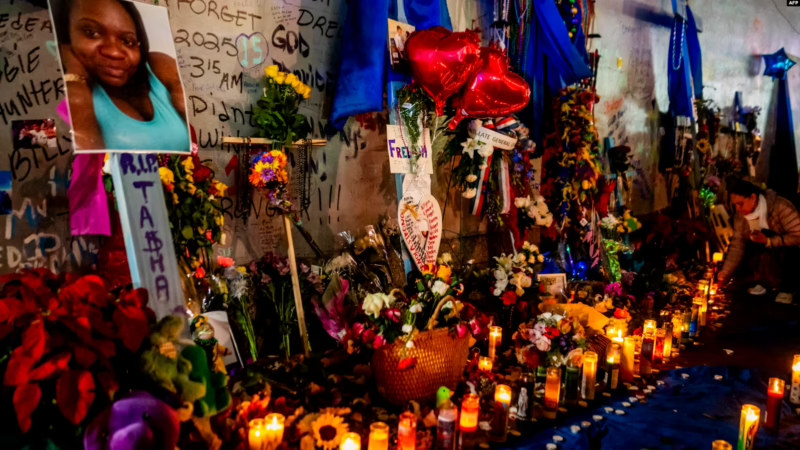
The tension in the city has been simmering since the fatal shooting of 37-year-old Renee Nicole Good by a federal trooper last week, but the introduction of the 1807 Insurrection Act has pushed the crisis into uncharted territory.
This 19th-century law grants the President the power to deploy federal troops domestically to enforce laws, bypassing local authorities entirely. Minnesota Representative Mahmoud Ahmed Noor warned that such a move would represent a complete overhaul of the American system, potentially allowing the military to operate under its own laws just as the country nears a critical election cycle. “It would have a huge impact,” Noor stated, “not just in the state, but across the entire country.”
With nearly 3,000 federal troops already stationed in Minnesota, the political divide has reached a breaking point. Governor Tim Walz, a Democrat, sent a direct appeal to the White House on Thursday to “turn the heat down,” while Minneapolis Mayor Jacob Frey—who has repeatedly demanded that ICE leave his city—described the current atmosphere as “not livable.” Despite these pleas, the administration remains undeterred.
After a federal judge denied Minnesota prosecutors a restraining order to suspend ICE operations, President Trump signaled that federal enforcement will only intensify, setting the stage for a historic confrontation between state sovereignty and federal military power.
-
Analysis11 months agoSaudi Arabia’s Billion-Dollar Bid for Eritrea’s Assab Port
-
Opinion17 years agoSomaliland Needs a Paradigm Change: Now or Never!
-
Interagency Assessment1 month agoTOP SECRET SHIFT: U.S. MILITARY ORDERED INTO SOMALILAND BY LAW
-
Somaliland3 months agoSomaliland Recognition: US, UK, Israel, and Gulf Bloc Poised for Historic Shift
-
EDITORIAL1 year agoDr. Edna Adan Champions the Evolving Partnership Between Somaliland and Ethiopia
-
Top stories2 years ago
Ireland, Norway and Spain to recognize Palestinian state
-
Russia-Ukraine War6 months agoFibre-Optic Drones Shift Ukraine’s Drone Warfare
-
ASSESSMENTS10 months agoOperation Geel Exposes the Truth: International Community’s Reluctance to Embrace Somaliland as a Strategic Ally