Senate Warns of Rising Port Threats—Somaliland Offers the Solution.
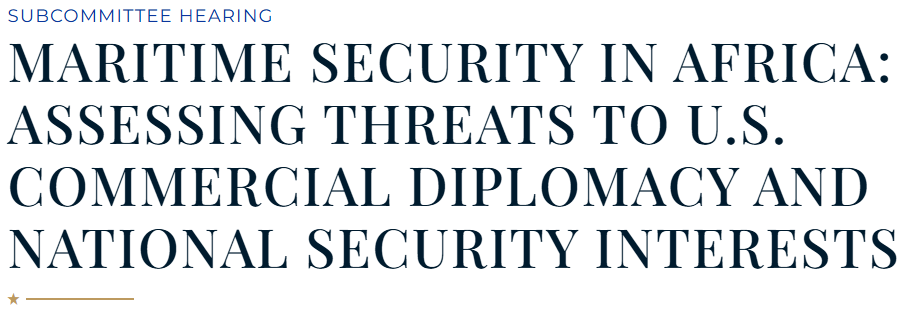
The U.S. Senate’s latest hearing on maritime security in Africa revealed a striking clarity about the risks facing American commercial diplomacy: strategic ports across the continent are becoming arenas of great-power maneuvering, and Washington urgently needs partners capable of resisting foreign influence.
As senators pressed for solutions to piracy, illicit trafficking, and the quiet expansion of Chinese and Russian port infrastructure, one fact became impossible to ignore: the most reliable maritime partner in the entire Gulf of Aden is also the one the United States has not yet recognized—Somaliland.
The Senate’s discussion underscored that maritime insecurity is not merely a regional concern but a direct threat to U.S. economic and national security.
American companies depend on predictable shipping routes; U.S. naval planners depend on friendly ports; and U.S. diplomats depend on governments capable of resisting the opaque lending and port-technology schemes used by Beijing and Moscow to secure footholds across Africa.
Testimony from State Department officials was blunt: adversaries exploit weak governance, corruptible political systems, and unmonitored port infrastructure to expand their reach.
The hearing’s message was unmistakable—Washington needs trusted, stable coastal partners able to safeguard shipping lanes and push back against malign influence without requiring constant American intervention.
Somaliland already meets that standard, and it does so with far fewer resources than the fragile states the Senate spent hours dissecting. For more than thirty years, Somaliland has maintained internal security, democratic governance, and a functioning coast guard along one of the most strategic stretches of water on earth.
Its maritime forces have routinely cooperated with international partners, helped limit piracy, and enforced territorial waters without attracting the governance crises that plague Mogadishu.
The port of Berbera, steadily expanding with private investment, stands out as the only major deep-water port in the region that is both politically stable and insulated from adversarial control.
In an era where U.S. policymakers are deeply concerned about Chinese-owned port technology and Russian access agreements, Berbera offers precisely the transparent, pro-Western alternative the Senate is calling for.
What the hearing repeatedly identified as Africa’s core vulnerability—governance breakdown—is the area where Somaliland has quietly excelled. It is not a liability requiring large-scale U.S. stabilization spending; it is a functioning democracy that has delivered peaceful transfers of power, institutional resilience, and credible local security.
Senators searching for African partners who operate above corruption, maintain predictable administration, and resist foreign military penetration are, intentionally or not, describing Somaliland.
The geopolitical logic is stark. If Washington wants a stable anchor in the Gulf of Aden to protect U.S. commercial interests, counter Chinese port expansion, and secure the Red Sea corridor, it already has a partner demonstrating those capabilities.
What it lacks is the diplomatic acknowledgment that unlocks the full potential of that partnership.
Recognition would not be symbolic; it would be strategic—a force multiplier that enhances U.S. maritime posture, empowers American companies in East Africa, and places Berbera squarely inside the U.S. sphere of influence at a moment when the Senate is warning of an aggressive global race for ports.
Somaliland has been doing, for three decades, what the Senate now insists Africa must do to protect global trade routes: govern effectively, police its territory, and resist predatory state influence. As the United States reviews its maritime strategy, the question is no longer whether Somaliland aligns with American interests.
It is why Washington continues to manage the region’s security challenges while leaving the most aligned and capable partner diplomatically stranded.
The hearing made one truth unmistakable: the strategic future of U.S. maritime security in Africa will depend not on expanding military deployments, but on recognizing the partners who have already built the stability the Senate seeks.