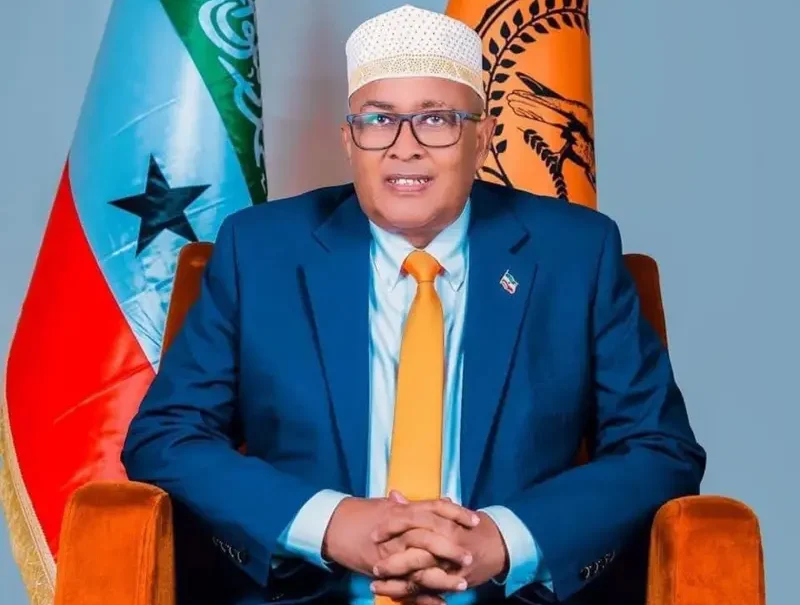
The internal power struggle inside Somaliland’s Kulmiye party has reached a decisive turning point after the Registration and Approval Committee of National Parties and Organizations intervened with a binding ruling that dismantles Chairman Mohamed Kahin Ahmed’s attempt to delay the party congress.
The move marks a rare and forceful assertion of institutional authority—and it lands squarely on the side of reform within an opposition party already under pressure to redefine itself.
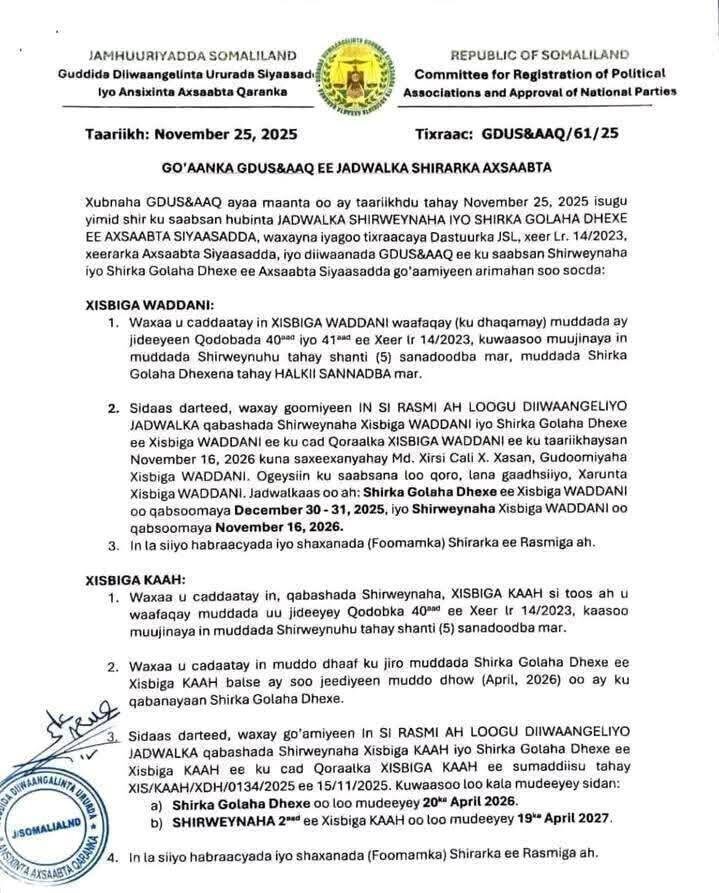
The ruling declares that Kahin’s unilateral extension of the congress—justified by claims of a “national disaster”—was illegal.
Under Somaliland’s regulations, only the Kulmiye Central Committee can request an extension, and even then under limited conditions. Kahin’s maneuver fell far outside those boundaries.
More importantly, the committee ordered Kulmiye to set a congress date within 30 days. Should the party fail to comply, the committee will take control of the entire process, from scheduling to execution.
This removes the only weapon Kahin had left: procedural delay. It also restores the internal democratic mechanism needed to resolve the leadership crisis.
For the faction aligned with former President Muse Bihi Abdi—now the dominant force inside Kulmiye’s Central Council—the ruling is a major victory. The party’s grassroots majority has long demanded a congress to elect new leadership. With the institutional blockade eliminated, a new chairman is now virtually assured.
What remains puzzling is why Mohamed Kahin chose to escalate this confrontation in the first place. As Bihi’s Interior Minister for seven years—and a political ally for decades—his decision to defy the party’s base and risk institutional intervention has left observers searching for explanations.
Several theories circulate in Hargeisa’s political corridors. One is the provocative claim that Kahin is being quietly leveraged by the ruling Waddani party, which benefits from a fractured Kulmiye heading into the 2026 electoral cycle.
Another points to sub-clan pressures that have pulled Kahin away from Bihi’s influence. A third frames his resistance as an act of legacy politics—a last stand by an aging power broker seeking to protect his long-held authority.
Regardless of motive, the institutional order has changed the landscape. The congress will happen—either under Kulmiye’s oversight or directly under the national committee. The Bihi-aligned faction’s control of the Central Council ensures they will elect a new leadership team.
That resets the party’s course at a moment when it must urgently unify and prepare itself not as a governing party, but as a credible opposition capable of challenging a ruling Waddani government that is consolidating national power.
The broader significance extends beyond party politics. Somaliland’s institutional system—often criticized for deference to political elites—has demonstrated the ability to enforce procedural integrity even against powerful actors.
For a political environment marked by shifting alliances and deep factional divides, this intervention signals that the country’s democratic architecture retains meaningful authority.
For Kulmiye, however, the work now begins. The party must repair the damage inflicted by months of paralysis, rebuild cohesion, and articulate a vision capable of competing with Waddani’s incumbency.
That effort starts with the congress—and with ending a crisis that had threatened to hollow out the opposition at the most critical moment.
Khadija Ali, Somaliland Senior politics Correspondent
The views expressed in this article are the authors’ own and do not necessarily reflect WARYATV’s editorial policy.