An Unseen Crisis: The Dangers of Fake Medicine in Somaliland.
A recent police bust in Hargeisa didn’t just uncover a racket—it exposed a system. When officers arrested four Yemeni nationals allegedly repackaging expired drugs and doctoring expiry dates, they seized about $9,000 worth of products and cartons imported from China designed to make old medicines look new. If that sounds small, it’s because it’s the tip of a much larger iceberg.
The February 18 operation showed how easy it is to recycle expired drugs back into the market. The method is simple and deadly: repackage, relabel, and resell. People buy what they believe are safe medicines; instead, they take products that may be ineffective at best and lethal at worst.
The gaps don’t end at one warehouse. Weak oversight has allowed unqualified operators to open “clinics,” sell drugs, and even obtain fake medical certificates in minutes. Diagnosis is often guesswork; prescriptions can be profit-driven. As one source put it, some centers behave “like drug dealers,” keeping customers dependent rather than getting them well. It’s no surprise many patients now travel to Ethiopia or India for care they trust.
Consider Sado Mohamud from northern Hargeisa. She’d managed high blood pressure for years. After a new prescription from an unqualified provider, she suffered a stroke the next day. Her family complained; the clinic said the staffer was fired. Dozens of women nearby have reported similar outcomes—illness, coma, even death—shortly after taking medicines from rogue clinics. Behind every “case” is a family absorbing the loss.
Somaliland relies almost entirely on imported drugs. Without a strong screening and quality-control system, counterfeit and substandard products slip through. The well-off can source trusted medicines from abroad; most people can’t. That leaves the majority exposed to a market where the incentives favor volume over safety.
The wider picture: counterfeits kill
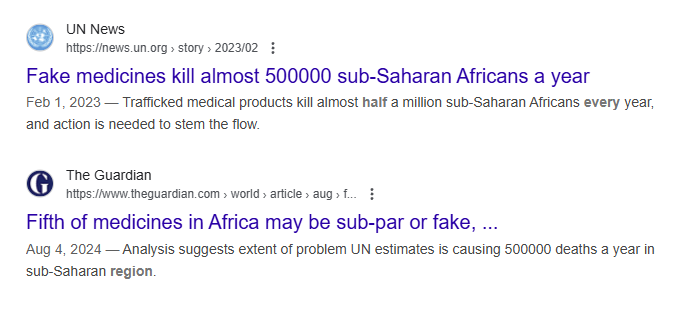
This isn’t a niche problem. Globally, estimates suggest up to a quarter of all drugs sold are fake—and in parts of Africa and Asia the share can exceed 50%. Counterfeits range from pills with no active ingredient (which fail to treat illness and fuel antibiotic resistance) to products cut with toxic substances. Past scandals—like fake versions of the cancer drug bevacizumab containing starch and salt, or a heparin contamination linked to dozens of deaths—show how quickly bad medicine becomes a mass-casualty event. Uncertain dosage and tainted injectables add infection, organ damage, and paralysis to the list of risks. The through-line is simple: counterfeits can kill and they destroy trust in the health system.
What must happen now
Somaliland doesn’t need to reinvent the wheel; it needs to enforce it.
Emergency market sweep: Conduct immediate inspections of pharmacies, depots, and clinics; seize and destroy suspect stock.
Licensing and closure powers: Freeze new licenses, audit existing ones, and shutter noncompliant outlets. Tie dispensing rights to verified credentials.
Border and import controls: Require batch-level documentation, random lab testing on arrival, and serialisation/barcoding to track products.
Criminal accountability: Fast-track prosecutions for relabeling, repackaging, or selling expired and fake drugs. Publicly name offenders to deter copycats.
Whistleblower protection and hotlines: Make it safe—and worthwhile—for insiders and patients to report bad actors.
Clinical guidance and audits: Issue clear prescribing rules, audit high-risk prescribers, and retrain or remove unqualified staff.
Public awareness: Run simple campaigns—how to check a package, verify an expiry date, and avoid red flags.
Regional cooperation: Work with Ethiopia and other neighbors on shared watchlists and cross-border intel.
Independent quality testing: Stand up (or partner for) a basic medicines quality lab and publish results.
Accountability matters
Since the Hargeisa arrests, authorities haven’t provided a public update on charges, convictions, or broader reforms. Silence breeds impunity. Regular briefings—what was seized, who was charged, what changed—are as important as raids. People need proof the system protects them, not the profiteers.
Somaliland has built a reputation for stability against the odds. That credibility is now on the line in pharmacies and clinic back rooms. Crack down hard, communicate clearly, and make safe medicine the rule—not the exception. Lives depend on it.
Somaliland’s Crackdown: Yemeni Nationals Arrested for Repackaging Expired Medicine