
Espionage
Spy Scandal: Ex-US Embassy Guard Accused of Selling Secrets to Russia and Iran


Espionage in the Arctic: Norway’s Security Breach Highlights Rising East-West Tensions
The indictment of a former U.S. Embassy security guard in Norway for allegedly spying for Russia and Iran is a stark reminder of the intensifying intelligence battles playing out far beyond traditional hotspots. This case, involving sensitive information about embassy diplomats, floor plans, and security procedures, underscores how even seemingly peripheral locations like Norway’s Arctic region have become frontlines in global espionage.
Norway’s geographical proximity to Russia—sharing a 198-kilometer border in the Arctic—positions it as a critical player in NATO’s northern flank. Since Russia’s invasion of Ukraine in 2022, the Arctic has gained strategic importance, with Norway tightening security and border controls. The arrest of this individual, who reportedly sought contact with Russian and Iranian intelligence influenced by geopolitical flashpoints such as U.S.-Israel ties and the Gaza conflict, illustrates how regional conflicts resonate globally, fueling espionage activities.
The defendant’s claim, through his defense, that the leaked information might not legally constitute “classified” data reflects common gray areas in espionage cases. It also hints at the challenges Western nations face in securing sensitive information across multiple layers of security clearance and employee access. The fact that the accused was pursuing studies in security and preparedness at Norway’s Arctic University (UiT)—an institution previously linked to another espionage case—raises questions about recruitment tactics and vulnerabilities in academic environments near strategic zones.
Moreover, the case fits into a larger pattern of Russia’s intelligence operations expanding beyond traditional battlegrounds, exploiting ideological grievances and regional conflicts. Iran’s involvement further complicates the picture, as Tehran seeks to leverage global conflicts to undermine Western alliances. This multifaceted espionage attempt is not just about state secrets but about shifting alliances, influence, and power projection in the increasingly contested Arctic and surrounding regions.
For the U.S. and its allies, this incident signals the urgent need for robust counterintelligence frameworks, particularly in vulnerable outposts. Norway’s consideration of physical border barriers against Russia reflects the broader security recalibration in response to renewed Cold War-style pressures.
The silence from official channels like the U.S. Embassy and prosecutorial offices—while typical in sensitive cases—adds an air of uncertainty that feeds speculation about the extent of damage and intelligence losses.
As geopolitical rivalries intensify, cases like this espionage scandal remind us that the Cold War never truly ended; it has simply evolved. The Arctic, long perceived as remote and tranquil, is now a chessboard for espionage, strategy, and influence—where every leak, every spy, can tip the balance in a world increasingly defined by hybrid conflicts and covert operations.











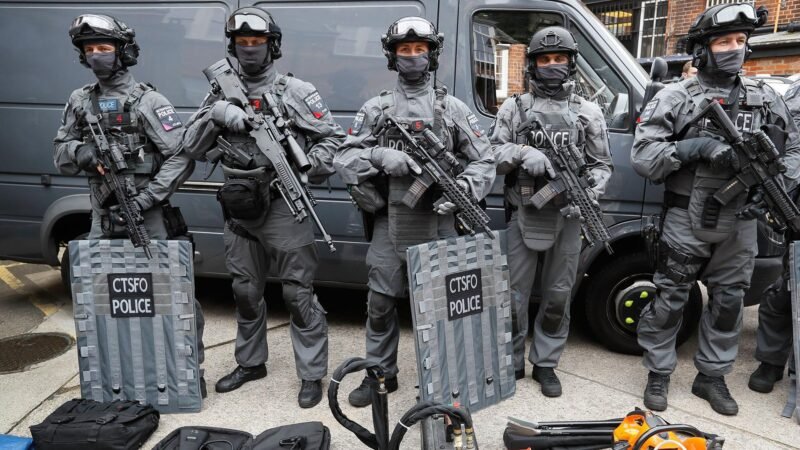
Months of covert monitoring, alleged surveillance of Jewish targets — is Iran-linked espionage expanding onto British soil?
Counter-Terror Police Probe Alleged Surveillance of Jewish Sites as Part of Long-Running Security Operation.
British counter-terrorism officers have been granted extra time to question four men arrested on suspicion of spying for Iran, as investigators examine whether alleged surveillance of Jewish locations in London was linked to potential attack planning.
The Metropolitan Police said Saturday that the suspects — one Iranian national and three dual British-Iranian nationals — can now be held in custody until 13 March under the UK’s National Security Act.
The men, aged 22, 40, 52 and 55, were detained shortly after 1 a.m. Friday during coordinated arrests at addresses in Harrow, Watford and Barnet in north London. Six other men, aged between 20 and 49, were arrested at the same Harrow address but have since been released on bail pending further investigation. One of the four primary suspects was also arrested on suspicion of assaulting a police officer.
Focus on Alleged Surveillance of Jewish Sites
Detectives are investigating reports of in-person surveillance of Jewish locations and individuals in London. Authorities are examining whether the activity was directed from overseas and whether it was linked to preparations for attacks on British soil.
The operation, involving counter-terrorism police and Britain’s domestic intelligence agency MI5, is understood to have been under way for months before the arrests.
Home Secretary Shabana Mahmood praised the security services, saying the arrests had kept “Britain safe from a potential threat.”
“The Jewish community and the wider public will understandably be concerned,” Mahmood said, adding that police and intelligence agencies have the government’s full support as they continue their investigation.
Broader Context of Iran-Linked Activity
The arrests come amid heightened scrutiny of Iranian-linked activities in the UK. In October, MI5 Director General Ken McCallum disclosed that 20 Iran-linked plots had been disrupted in Britain over the previous year, most targeting Iranian dissidents and at least one involving an Israeli-linked site.
While authorities have not publicly detailed the evidence in the current case, the extension of detention suggests investigators believe further questioning is necessary to determine the scope of the alleged operation and any external coordination.
Officials have urged patience as inquiries continue, emphasizing that no charges have yet been filed.
For now, the case underscores a growing concern among British security services: that geopolitical tensions abroad may increasingly manifest as covert operations — or worse — at home.

Jubaland’s President Ahmed Madobe claims his regional intelligence agency now surpasses Somalia’s NISA, revealing a deepening struggle for control of security power in the Horn of Africa.
Jubaland President Ahmed Mohamed Islam (Ahmed Madobe) has publicly claimed that his regional intelligence agency now outperforms Somalia’s National Intelligence and Security Agency (NISA)—a declaration that deepens the growing rift between Kismayo and Mogadishu over control of national security institutions.
Speaking at the inauguration of the new Jubaland Intelligence and Security Agency (JISA) headquarters in Kismayo on Tuesday, Madobe said his agency has become the “go-to service in the Horn of Africa” for credible intelligence operations.
“When it comes to security information in the Horn of Africa, the agency everyone turns to today is Jubaland’s Intelligence and Security Agency,” he said. “Even Somalia’s federal government comes after us.”
The remarks, delivered at a gleaming new JISA facility outfitted with advanced surveillance and communications systems, are a direct challenge to Mogadishu’s centralized security authority.
Officials close to JISA describe the new complex as a regional fusion center designed to coordinate counterterrorism, electronic intelligence, and cross-border monitoring—an investment more than a decade in the making since the agency’s founding in 2013.
According to regional sources, JISA officers have received foreign-backed technical training, including in cyber forensics and counterinsurgency tactics, specifically aimed at dismantling Al-Shabaab’s networks in southern Somalia.
Madobe’s speech, however, carried clear political undertones. It follows escalating tensions between Jubaland and the federal government of President Hassan Sheikh Mohamud, which has long sought to reassert control over Gedo and other border regions.
Lawmakers representing Jubaland recently accused Mogadishu of “weaponizing national institutions for political interference,” warning that federal overreach could “destroy the foundations of Somalia’s federal system.”
The new JISA facility is not merely a security milestone—it is a symbol of autonomy. Analysts see it as Jubaland’s attempt to signal that effective governance and intelligence leadership can exist outside Mogadishu’s reach.
Diplomatic observers note that Kenya—long an influential actor in Jubaland’s affairs—is quietly backing Madobe’s push for regional stability, seeing it as a buffer against renewed Al-Shabaab incursions along the border.
Nairobi has urged both sides to de-escalate and return to the National Consultative Council (NCC), but talks in Kismayo last month failed to yield results.
Behind the diplomatic language lies a deeper struggle: a contest for who truly commands Somalia’s security architecture. If Madobe’s claims hold true, JISA’s rise may force both Mogadishu and its international partners to rethink where real intelligence power lies—in the capital, or in Kismayo’s newly fortified nerve center.

The decade-long cyber conflict between Israel and Iran has intensified since June’s 12-day war, even as a fragile ceasefire holds, the Financial Times reported Sunday. Israeli officials say they continue to receive spear-phishing messages and other digital attacks, while Iranian-aligned hackers have targeted Israeli companies using recent Microsoft software vulnerabilities.
Iran says it faced its “most extensive” cyber campaign during the war, including over 20,000 attacks. One breach reportedly disabled Tehran’s air defenses ahead of Israel’s June 13 airstrikes, enabling intelligence gathering on senior Iranian military and nuclear officials.
Israeli-linked group Gonjeshke Darande claims it stole $90 million from Iranian crypto exchange Nobitex and crippled two major banks. Meanwhile, Iranian hackers have breached 50 Israeli firms, leaking personal data of defense-sector employees and attempting to disrupt emergency alerts.
While Israel says none of the attacks on its infrastructure caused major damage, Iranian officials have acknowledged significant setbacks and called for urgent upgrades. Analysts expect the cyber hostilities to continue, given their deniability and the absence of direct military escalation.
Espionage
British Spies Exposed: Catastrophic Afghan Data Leak Shakes MoD and Raises National Security Alarm

SAS operators, MI6 agents, MPs, and thousands of Afghan allies compromised in what insiders call the worst Ministry of Defence breach in decades.
In one of the gravest national security failures since the Cold War, British intelligence agents, special forces operatives, and senior officials have been compromised in a catastrophic data breach linked to the UK’s Afghan evacuation efforts.
The blunder, committed by a Ministry of Defence official in February 2022, leaked the personal details of more than 16,000 Afghans, alongside over 100 names of British personnel, including MI6 spies, SAS commandos, senior military brass, and government ministers.
The fallout has been so severe that it triggered an extraordinary two-year super injunction, effectively muzzling the media while the government scrambled to contain the consequences. That gag order—partially lifted this week—has left the public reeling at what is now being described as a monumental intelligence failure.
Some Afghans affected by the breach—many of whom worked closely with British forces—were already being hunted by the Taliban. They had trusted the UK with their identities in hopes of asylum; instead, their data was exposed to unknown entities, potentially putting lives directly in harm’s way.
But the real shock came when it emerged that British personnel themselves were exposed—from active-duty MI6 agents to current Members of Parliament. According to Defence Secretary John Healey, even support letters from MPs and ministers were visible in leaked files, drawing gasps from legal observers and MPs alike.
Former Armed Forces Minister James Heappey—who had long defended the Ministry’s vetting process—admitted the truth was “gut-wrenching”. He acknowledged the system for granting sanctuary to former Afghan commandos (known as “The Triples”) was deeply flawed, and confessed that senior officials had misled both ministers and Parliament.
Behind closed doors, the Intelligence and Security Committee is now demanding immediate access to the classified intelligence behind the gag order, while legal teams debate whether the government is still suppressing critical facts.
What’s perhaps most disturbing is the scale of misjudgment: The same Afghan commandos who were paid directly by British forces, trained under UK command, and fought shoulder-to-shoulder with British troops were denied protection, often on the basis of contradictory or discredited information.
For a government already haunted by its chaotic withdrawal from Kabul, this breach is a fresh and damning indictment. It represents not just a failure of policy, but a moral betrayal—one that could leave allies to die and compromise the safety of Britain’s own clandestine warriors.
And as the truth unravels in court and Parliament, one question hangs over Whitehall like a shadow: Who exactly is protecting whom?

Top-secret Ukraine war intel leaked by ex-Army officer seduced online; Pentagon reeling from betrayal inside Strategic Command.
A retired Army lieutenant colonel pleads guilty to leaking classified Russia-Ukraine war intel to a woman on a dating site. Was it romance, espionage—or treason?
The war in Ukraine just collided with America’s most humiliating espionage scandal yet—and the battlefield was a dating app. David Slater, a retired U.S. Army lieutenant colonel turned Air Force civilian analyst, admitted in court that he leaked secret military intelligence about the Russia-Ukraine war to a woman he met online who called him, disturbingly, “my secret agent love.”
Slater, who had Top Secret clearance while working at Strategic Command in Nebraska, wasn’t duped in a bar or blackmailed by foreign agents. He fell for love bombs and flattery. And in return, he handed over highly sensitive information—military targets, Russian capabilities, NATO expectations—all via a foreign dating app’s message thread.
The woman, whose true identity and allegiance remain unclear, played her role well. “Dave, I hope tomorrow NATO will prepare a very pleasant surprise for Putin,” she wrote. Slater took the bait.
Now, facing up to 10 years in prison, Slater has pleaded guilty to conspiracy to share national defense secrets. Prosecutors dropped other charges, but the implications are chilling. This wasn’t some lonely retiree rambling in a chatroom. This was a trained officer with decades of experience who sat in war briefings and still chose pillow talk over patriotism.
The Pentagon is scrambling. How did a man with such clearance pass through security filters and behave like a rogue teenager? And worse, who was behind the seductive messages? Was it Russia exploiting a love-struck fool? Or was this a Ukrainian psy-op gone too far?
Either way, the consequences are dire. In an era of hybrid warfare, the line between lover and spy is vanishing fast. America’s enemies aren’t just launching missiles—they’re sending emojis.

Sweden’s explosive investigation into a Russian Orthodox church located perilously close to strategic military infrastructure exposes a chilling dimension of modern espionage—using religion as cover for hybrid warfare operations. As Europe’s security landscape tightens following Sweden’s NATO accession, the scrutiny of Russia’s religious establishments abroad reveals a troubling pattern: Moscow leveraging its religious outposts not merely for cultural outreach, but as clandestine surveillance hubs.
In Västerås, Sweden, just 300 metres from Stockholm-Västerås Airport—a critical NATO-aligned military hub—the Church of the Kazan Icon of the Mother of God raises urgent alarm bells. Swedish intelligence (SAPO) explicitly labels this institution as a “platform for Russian intelligence gathering,” a warning underscored by the presence of Russian diplomats at the church’s inauguration, including one later exposed as a spy. Municipal authorities now contemplate an unprecedented expropriation of the church property, underscoring the gravity of the threat.
This is not an isolated event. Investigations across Europe confirm an orchestrated Russian strategy to embed intelligence capabilities in seemingly benign religious facilities. The Ukrainian intelligence firm Molfar Institute pinpointed churches near sensitive military and industrial sites, including those linked to nuclear facilities in Sweden and submarine bases in Norway, further highlighting the Kremlin’s calculated espionage tactics.
Father Pavel Makarenko, parish priest in Västerås, exemplifies the duality of these religious leaders, convicted for aggravated financial fraud involving Russian and Belarusian interests. His conviction and direct corporate connections amplify suspicions about his true mission and intentions.
Russia’s instrumentalization of its Orthodox Church poses a profound security challenge for Europe, potentially destabilizing already delicate geopolitical balances. As Bulgaria expels church leaders and Finland shuts down religious outposts, a clear European awakening emerges: Russia’s hybrid warfare through religious institutions is as subtle as it is dangerous. The question now is whether European nations will decisively counteract this insidious encroachment or remain vulnerable to infiltration cloaked in spiritual robes.
Espionage
China’s Embassy Espionage? French Intel Uncovers Beijing’s Campaign to Sink Rafale Fighter Sales

French intelligence reveals China’s covert efforts to sabotage France’s Rafale jet exports amid India-Pakistan conflict fallout.
French military intelligence exposes a Chinese disinformation and lobbying campaign to discredit Rafale jets after combat losses in South Asia, aiming to boost Chinese arms sales and weaken France’s strategic influence in Asia.
French intelligence agencies have uncovered a sophisticated Chinese campaign leveraging embassies worldwide to undermine the reputation and sales of France’s flagship Rafale fighter jets. The campaign intensified after Rafales saw combat losses during the May clashes between India and Pakistan, triggering doubts among existing and potential buyers.
China’s defense attaches reportedly engaged foreign security officials, spreading narratives casting doubt on Rafale’s performance while aggressively promoting Chinese-made aircraft. This lobbying targeted countries like Indonesia, which has already ordered Rafales and is considering additional purchases.
Complementing embassy efforts, Beijing orchestrated online disinformation campaigns featuring AI-generated imagery, manipulated videos, and thousands of fake social media accounts glorifying Chinese military tech. Though French military officials haven’t linked this online onslaught directly to Beijing’s government, the embassy-level activity suggests coordinated state efforts.
For France, the Rafale is more than a fighter jet; it symbolizes national strategic autonomy and industrial prowess. Beijing’s campaign seeks to erode not only the jet’s sales but France’s geopolitical influence, especially as it forges security partnerships in the Indo-Pacific.
Experts argue China’s strategy is clear: exploit perceived Rafale vulnerabilities from combat, magnify doubts, and position Chinese defense exports as superior alternatives—thereby weakening Western presence in Asia.
This revelation shines a spotlight on the modern battlefield: one not only fought in skies but in boardrooms, embassies, and online feeds—where global power struggles unfold through disinformation and diplomatic pressure as much as missile exchanges.
Espionage
Chinese Agent Turned NJ Chef Back in ICE Custody as Trump’s Deportation Machine Roars Back
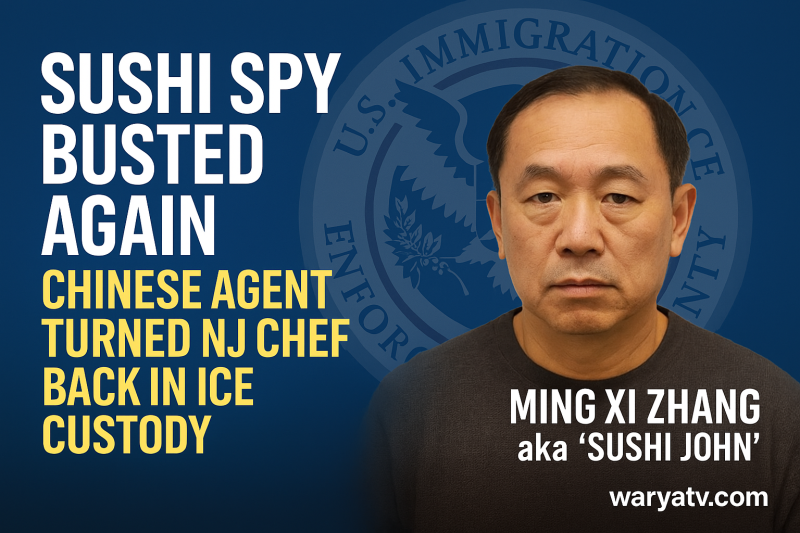
Sushi John Zhang, convicted of spying for China, now faces deportation as ICE cracks down under Trump’s hardline immigration push.
From sushi rolls to secret deals, a quiet New Jersey town is at the center of a spy scandal ripped from a Cold War thriller. Ming Xi Zhang, aka “Sushi John,” once convicted of operating as a secret agent for the Chinese government, is now back in federal custody—and may be shipped out of the country for good.
Zhang, 61, who ran Ya Ya Noodles in Montgomery Township, was sentenced in 2024 to three years’ probation after pleading guilty to acting as an unregistered foreign agent. He admitted meeting with Chinese intelligence officials in the Bahamas, handing off $35,000 to a contact in New Jersey, and twice hosting a Chinese government handler at his home in Princeton.
Though spared prison time, ICE wasn’t finished with him. Agents arrested Zhang on March 24 in Newark, citing violations of his lawful admission into the U.S. “Any illegal alien conducting activities related to espionage or sabotage is subject to deportation,” ICE’s John Tsoukaris declared.
Zhang now waits at the Elizabeth Detention Center as Trump-era deportation machinery kicks back into high gear, backed by renewed detention authority and mass removal orders targeting national security threats. Yet remarkably, his local community has rallied behind him. “He’s doing good, given the circumstances,” said a restaurant worker. “The whole town’s been really supportive.”
But national winds are shifting. The Supreme Court just re-opened questions about deportation law, while judges in other high-profile cases—like pro-Palestine student Mahmoud Khalil—are already authorizing removals.
Espionage won’t be forgiven a second time, even if it comes with miso soup and wasabi on the side.

Jamie Dimon Backs Iran War but Questions the Plan

Burkina Faso’s Military Leader Rejects Democracy

US F-15E Shot Down Over Iran as Search Underway for Missing Crew


-

 US-Israel war on Iran1 month ago
UK Refuses Iran Strike Access, Trump Fires Back
-
 Russia-Ukraine War1 month ago
Europe’s Spies Challenge Trump’s Ukraine Peace Optimism
-
 Top stories1 month ago
War Expands Across Region as Iranian Militias Join Fight
-
 Top stories1 month ago
India Turns to Brazil in Strategic Minerals Push Against China
-
 US-Israel war on Iran1 month ago
Iran Pledges ‘Never, Ever’ to Hold Bomb-Grade Material
-
 US-Israel war on Iran1 month ago
Syria Under Fire on Two Fronts
-
 Russia-Ukraine War1 month ago
Estonia Warns NATO Would Strike Deep Inside Russia if Baltics Are Invaded
-

 Top stories3 weeks ago
Meloni Breaks Ranks: Italy Warns on Iran War