As U.S. forces exit Niger, Washington turns to Abidjan to counter jihadist threats, Russian and Chinese influence, and protect strategic Sahel corridors.
With its drone wings clipped in Niger and the Sahel in freefall, the United States is recalibrating its military strategy in West Africa — and Côte d’Ivoire is now the cornerstone. The two nations are in advanced discussions to establish a U.S. drone base, marking a seismic shift in regional defense architecture amid rising threats from jihadist insurgents and geopolitical adversaries.
The potential base, likely in proximity to Mali and Burkina Faso’s porous borders, would serve as a launchpad for surveillance, counterterrorism strikes, and strategic deterrence. It also sends a blunt message: the U.S. is not surrendering West Africa to Russian mercenaries or Chinese contractors.
General Michael Langley, AFRICOM’s top brass, made the intent clear during his April 2025 visit to Côte d’Ivoire.
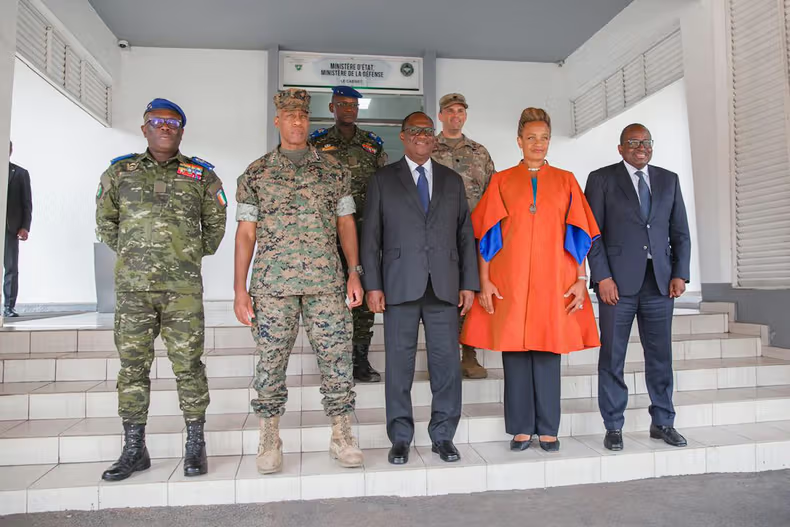
His presence at Flintlock 2025, the continent’s elite multinational war game, was more than symbolic — it was the clearest signal yet that Abidjan is Washington’s new security partner of choice.
With over 500 special forces operatives from 38 countries converging in Jacqueville, Côte d’Ivoire showcased not only its rising military sophistication but its ambition to lead the Sahel’s security reset. Unlike the fractured regimes in Bamako or Ouagadougou, Abidjan offers a stable platform and reliable governance — rare currency in today’s West Africa.
This pivot is strategic, not just tactical. As Russia tightens its grip on juntas in Mali and Burkina Faso through Wagner-linked proxies, and as China quietly dominates infrastructure and port access, the U.S. is racing to secure its own influence corridor from the Gulf of Guinea northward. A drone base is the centerpiece of that chessboard.
Discussions remain fluid. No final site has been selected, but U.S. officials have floated the idea of leveraging existing Ivorian military facilities — a cost-efficient alternative to building from scratch. Jacqueville and areas near Odienné are being eyed, especially for their proximity to jihadist flashpoints.
The stakes? Enormous.
With terrorist networks metastasizing across the Sahel and maritime piracy returning in the Gulf of Guinea, the U.S. cannot afford to be blind or absent in this region. Côte d’Ivoire, a democracy with a functioning military, is offering exactly what Washington needs: access, stability, and shared security priorities.
For now, Abidjan is emerging as America’s new eye in the sky — and possibly, its last real chance to hold ground in a rapidly shifting West African battlefield.