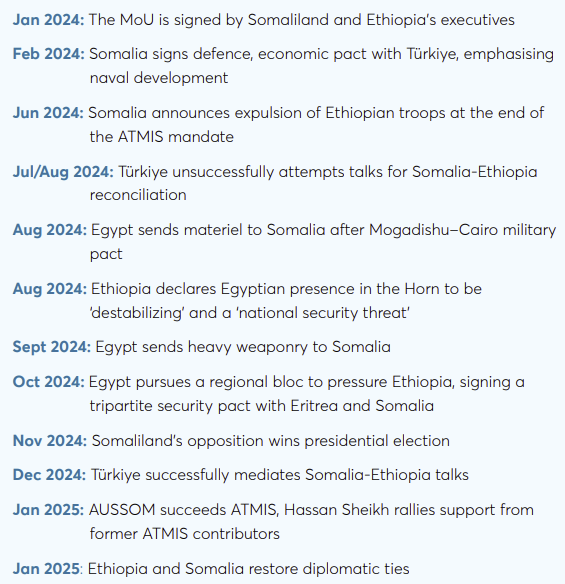
In January 2024, the Ethiopia-Somaliland memorandum of understanding (MoU) ostensibly finalized the sharing of naval bases and formal recognition of statehood between the two entities. This agreement not only represented a strategic victory for both sides but also introduced significant geopolitical and security dynamics in the Horn of Africa.
Ethiopia’s acquisition of a naval base on the Somaliland coast under the MoU significantly enhances its strategic footprint in the Red Sea, a critical artery for global trade. This move aligns with Ethiopia’s longstanding goal of accessing the sea, which it lost following Eritrea’s secession in 1993.
For Somaliland, the MoU presents a pathway to achieving international recognition, leveraging its strategic geography against Ethiopia’s need for maritime access. Despite not being internationally recognized as an independent nation, Somaliland has managed to establish a stable and democratic governance structure, distinct from Somalia’s federal government.
The MoU has heightened tensions within Somaliland and between Somaliland and Somalia. Key stakeholders, including certain clan factions within Somaliland and the Somali federal government, perceive the agreement as a threat to territorial integrity and political sovereignty.
The agreement has also influenced regional security dynamics, particularly concerning the activities of terrorist organizations such as al-Shabaab and ISIS’s Somali branch. These groups may exploit perceived or real grievances stemming from the MoU to bolster recruitment and enhance their operational capacity.
Beyond the strategic and security implications, the MoU offers substantial economic benefits for both Ethiopia and Somaliland. For Ethiopia, access to the sea through Somaliland’s ports could significantly reduce logistics costs and boost trade. For Somaliland, closer economic ties with Ethiopia provide opportunities for economic growth and development, potentially increasing its political leverage on the international stage.
However, the economic advantages envisaged by the MoU are contingent on the stable implementation of its terms amidst fluctuating regional political dynamics. Both parties must navigate internal dissent and regional rivalries, particularly with Somalia and potentially with other regional powers like Djibouti and Eritrea, who may view this agreement as a strategic encroachment.
Moving forward, both Ethiopia and Somaliland will need to engage in careful diplomatic maneuvering with regional actors to mitigate backlash and integrate the MoU into a broader strategy that promotes regional stability and economic integration.
Additionally, fostering an inclusive dialogue that addresses the concerns of all stakeholders within Somaliland and Somalia will be crucial. This approach not only helps in reducing internal conflicts but also enhances the legitimacy and sustainability of the MoU.
The role of international actors and organizations will be pivotal in supporting the implementation of the MoU. Strategic partnerships that focus on economic development, infrastructural investments, and security cooperation could reinforce the benefits of the MoU, making it a model for similar agreements in politically complex regions.
In conclusion, the Ethiopia-Somaliland MoU stands as a testament to the complex interplay of geopolitics, regional security, and economic ambitions in the Horn of Africa. Its success or failure will largely depend on the involved parties’ ability to navigate these multifaceted challenges in a rapidly evolving regional landscape.