GRU Officers Advising Iran-Backed Rebels on Red Sea Maritime Attacks
US intelligence suggests that Russian military intelligence officers, specifically from the GRU, have been operating within Houthi-controlled regions of Yemen. Their mission? To aid the Iran-backed Houthis in targeting commercial vessels in the Red Sea. This covert operation has been ongoing for several months, a senior US official disclosed under the condition of anonymity.
The precise nature of the GRU’s involvement remains shrouded in secrecy, but their advisory role is clear. The Houthis, claiming solidarity with besieged Palestinians in Gaza, have intensified their attacks on maritime targets, drawing on Russian expertise to bolster their campaign.
This development signals Russia’s deepening ties with the Houthis, a move that could reshape the balance of power in the region. Earlier this year, President Vladimir Putin contemplated arming the Houthis with advanced anti-ship cruise missiles, a plan thwarted only by Saudi Crown Prince Mohammed bin Salman’s intervention. Yet, concerns linger in Washington that Putin might still use the Houthis as leverage against US policies, especially concerning Ukraine.
Samuel Ramani, a renowned expert on Russia’s Middle Eastern policies, suggests that deploying technical advisors might be Putin’s middle ground, allowing him to deepen cooperation without overtly escalating military support. The move aligns with Russia’s broader strategy of embedding itself in regional conflicts, as seen with its mercenaries in Libya and military presence in Syria.
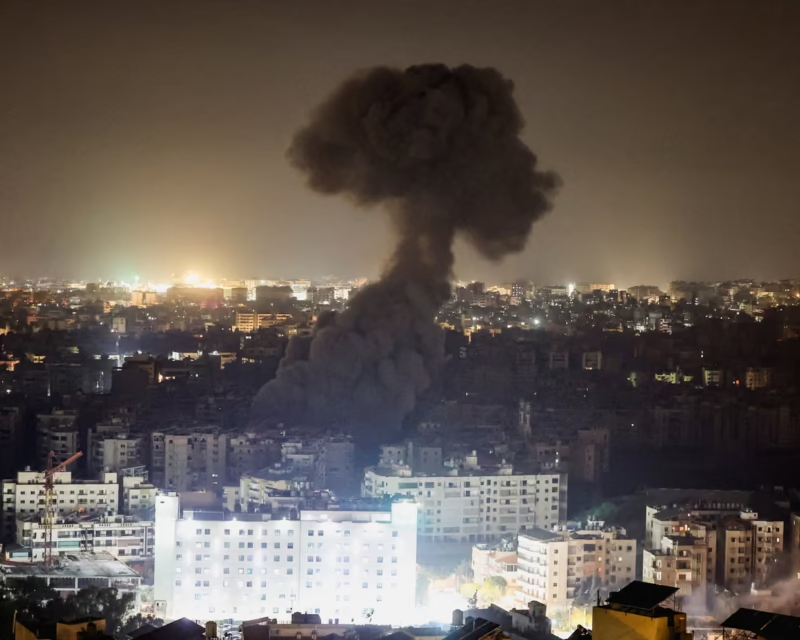
The timing of this revelation is critical. The Houthis have ramped up missile and drone attacks on commercial vessels since Hamas’ assault on Israel on October 7th. While US retaliatory strikes on the Houthis have been ineffective, the group’s attacks have been selective, sparing ships linked to Russia, Iran, and China. This selective targeting underscores the Houthis’ maritime intelligence limitations and their reliance on open-source data, further highlighting the need for GRU expertise.
Publicly, Russia’s engagement with the Houthis has become more visible. In July, Putin’s deputy foreign minister met with a Houthi delegation in Moscow, signaling a closer alliance. The US anticipates that Iran’s “axis of resistance,” which includes the Houthis, will play a pivotal role in any retaliatory actions against Israel.
Former US officials suggest that Putin might view the escalating Middle East tensions as an opportunity to pressure the US, drawing a parallel between Ukraine’s attacks on Russian vessels in the Black Sea and potential Houthi actions in the Red Sea. General Frank McKenzie, ex-commander of US Central Command, hinted that Putin could see this as a form of “Red Sea payback.”
Despite the mounting evidence, official responses from the White House and the Department of Defense remain absent. The US intelligence community, however, is on high alert, closely monitoring the situation as the geopolitical stakes in the region continue to rise.
Russia’s strategic maneuvering in Yemen is part of a broader pattern. With the Wagner Group’s activities in Libya and the Sahel, and military deployments in Syria, Russia’s footprint in the Middle East is expanding. The potential for a Russian naval base in Sudan’s Red Sea coast only adds to this intricate geopolitical web.
In this complex game of power and influence, Putin’s decision to place GRU officers in Yemen reflects a calculated move to enhance the Houthis’ operational capabilities while safeguarding Russian interests in the Red Sea. As tensions escalate, the world watches closely, bracing for the potential fallout from this clandestine collaboration.