Dahabshiil—the prominent remittance company with deep roots in Somaliland—has found itself at the center of a burgeoning controversy following its decision to remove the term ‘Somaliland’ from its website. This action, enacted to align with an order from the Somali government, has provoked outrage among the Somaliland populace and raised serious questions about the functioning of national identity in the face of economic pressures.
The Decision that Sparked Outrage
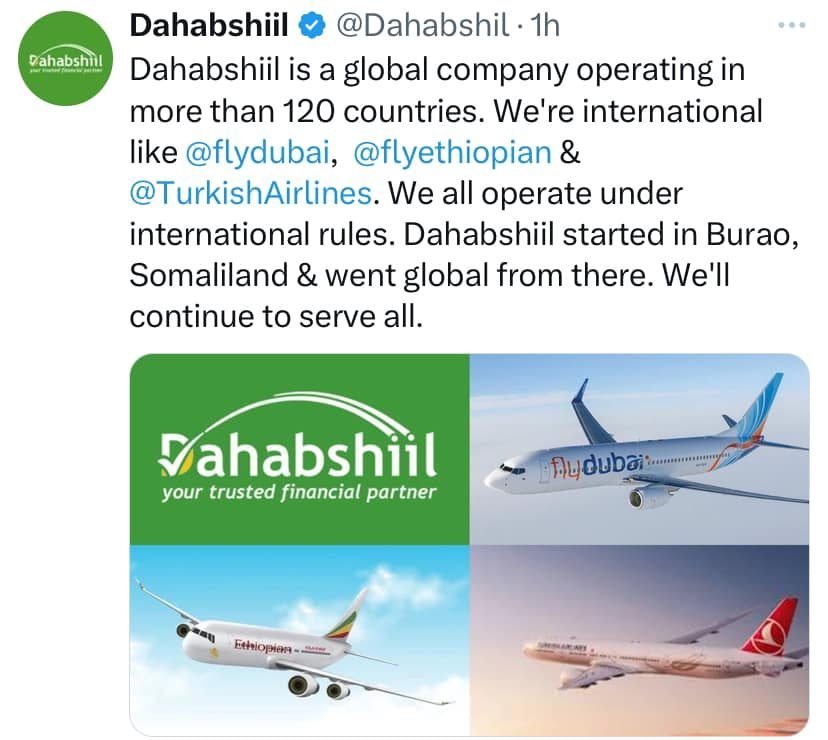
Dahabshiil’s removal of ‘Somaliland’ from its platform—an act that many perceive as a capitulation to Mogadishu’s directives—has ignited a firestorm of criticism. In a recent statement issued through the social media platform X, Dahabshiil justified its decision, emphasizing that as an international company operating in over 120 countries, it must adhere to international laws. The company framed its compliance as a necessity for its expansive operations rather than an affront to its origins.
Yet, as the Somaliland community awoke to the news, the reactions were swift and vehement. “You have chosen over your country our enemy, Somalia,” tweeted a disappointed user identified as Qodah. “I have stopped using your services.” The sentiment encapsulated a widespread feeling of betrayal among Somalilanders, who view Dahabshiil’s actions as not merely corporate maneuvering but a dilution of their national identity.
This controversy cannot be examined in isolation; it dovetails into a broader political landscape fraught with historical grievances. The Somali government’s recent edict to airlines and remittance services to cease using the name ‘Somaliland’ is a continuation of the ongoing struggle over the legitimacy of Somaliland’s sovereignty. Nearly three decades after declaring independence from Somalia in 1991, Somaliland functions its own government, currency, and institutions, yet it remains unrecognized by the international community.
The compliance of Dahabshiil with the Somali government’s directive is emblematic of the precarious position Somaliland finds itself in. While the Somali capital, Mogadishu, grapples with ongoing issues of governance, security, and legitimacy, the comparatively stable and democratic Somaliland has had to navigate the complexities of economic relationships that span the region. Dahabshiil’s cooperation with Mogadishu raises critical questions: Is the company prioritizing profit over the very identity that initially propelled it into the international market?
A Reaction to Remember
As the outrage surged on social media, experts and commentators echoed the sentiments expressed by countless numeraries. Notably, an influential user on X, bhlub, articulated a broader narrative of disappointment, stating, “For years now, we said Somaliland will not be taken seriously if its people and government don’t take it seriously.” Bhlub’s observations reflect a growing feeling among Somalilanders that their leaders may be complicit in undermining their own legitimacy.
Other reactions on X echoed this concern. “You obeyed orders from a hostile state and deliberately erased your own country,” stated one user in response to Dahabshiil’s corporate rationale. “Imagine FlyDubai removing UAE on orders from Qatar,” they continued, effectively spotlighting the absurdity of the situation. The general consensus among commentators is that Dahabshiil’s actions not only jeopardize their standing as a Somaliland-based company but also risk alienating the very customer base that built their success.
The Dangers of Economic Compliance
The underlying corporate decision reveals an unsettling trend: a prioritization of economic interests over national identity. Twitter users highlighted that several companies operate similarly, with Somaliland-related entities complying with pressures from Mogadishu at the expense of regional integrity. “Somalian banks, Somalian telecommunications… it’s an individual interest over national security,” tweeted another critical voice, underscoring ignorance or apathy from local leaders toward the larger implications of such actions.
Furthermore, the marked disparity in treatment between Somaliland and Somalia poses a significant ethical dilemma. Dahabshiil is not alone; its stance may well reflect broader corporate larger trends among businesses operating in unstable regions—where fiscal survival often overshadows the need for principled stands on identity and sovereignty.
The trajectory of Dahabshiil, and similar enterprises, raises important questions regarding national identity amid economic constraints. Somalilanders are urging their leaders not only to respond to corporate measures that undermine their autonomy but also to confront the oligarchs who continue to financially support a government that lays claim over their right to self-determination.
For Somaliland to solidify its international presence and foster sustainable growth, a reckoning with the interplay between economic necessity and national pride is essential.
As the outrage over Dahabshiil’s decision reverberates through communities and online platforms, it serves as both a warning and a catalyst for a more cohesive, self-respecting national narrative.