Top stories
Privacy Policy
WARYATV Privacy Policy
This Privacy Policy describes how WARYATV (“WARYATV,” “we,” “us,” or “our”) collects, uses, and protects the personal information of users (“you”) who visit our website, www.waryatv.com, and engage with our content, news articles, and services. We are committed to protecting your privacy and ensuring you have a positive experience on our site.
1. Information We Collect
We collect two main types of information: Personal Data and Non-Personal Data (Usage Data).
A. Personal Data
This information is provided directly by you when you interact with us. It may include:
- Contact Information: Name and email address when you subscribe to our newsletter, submit a contact form, or register an account.
- Comments and Engagement: Any information you post in the comments sections of our articles.
- Communication Data: Records of correspondence if you contact us directly.
B. Non-Personal Data (Usage Data)
This information is collected automatically as you navigate and interact with the website. It helps us understand how our site is used and includes:
- Device and Browser Information: Your device type, operating system, browser type, and language settings.
- IP Address: Your Internet Protocol (IP) address, which may be used to infer your general geographical location (e.g., country or city).
- Activity Data: Pages viewed, the time and date of your visit, the time spent on those pages, referring websites, and clickstream data.
2. How We Collect Your Information
We use several methods to collect data:
- Direct Interaction: When you fill out forms (e.g., subscriptions, contact forms, account registration).
- Cookies and Tracking Technologies: We use cookies, web beacons, and similar technologies to collect Usage Data, personalize your experience, and remember your preferences. (See Section 5).
- Third-Party Analytics: Tools like Google Analytics and Site Kit are used to monitor and analyze web traffic and user behavior on the site.
3. How We Use Your Information
We use the collected information for the following purposes:
- To Operate the Website: To present content effectively and ensure the functionality of the website.
- Communication: To send you newsletters, updates, and marketing materials (if you have opted in) and to respond to your inquiries.
- Analytics and Improvement: To analyze website traffic, measure the performance of our content, understand audience demographics, and improve the user experience and service offerings.
- Security: To detect, prevent, and address technical issues, fraud, or violations of our Terms of Service.
- Personalization: To customize the content and advertising you see based on your browsing history and interests.
4. Disclosure of Your Information
We do not sell your Personal Data. We may share your information only in the following circumstances:
- Service Providers: We share data with trusted third-party vendors who perform services on our behalf, such as website hosting, data analysis, email delivery, and marketing assistance. These parties are obligated to keep the information confidential and use it only for the purposes for which we disclose it to them.
- Legal Requirements: If required to do so by law or in the good faith belief that such action is necessary to comply with a legal obligation, protect the rights or property of WARYATV, or protect the safety of our users or the public.
- Business Transfers: In the event of a merger, sale of assets, or acquisition, your Personal Data may be transferred to the acquiring entity.
5. Cookies and Tracking Technologies
A cookie is a small file placed on your device. We use cookies to:
- Maintain your user session and settings.
- Track and target the interests of our users to enhance the experience on our site.
- Remember information so you don’t have to re-enter it during your visit.
You have the option to accept or refuse cookies. Most web browsers automatically accept cookies, but you can usually modify your browser setting to decline cookies if you prefer. However, if you choose to decline cookies, you may not be able to fully experience the interactive features of WARYATV.
6. Third-Party Links
Our website may contain links to other websites that are not operated by us (e.g., sources cited in articles or advertisements). If you click on a third-party link, you will be directed to that third party’s site. We strongly advise you to review the Privacy Policy of every site you visit. We have no control over and assume no responsibility for the content, privacy policies, or practices of any third-party sites or services.
7. Children’s Privacy
WARYATV is not directed to individuals under the age of 13. We do not knowingly collect personally identifiable information from anyone under the age of 13. If you are a parent or guardian and you are aware that your child has provided us with Personal Data, please contact us. If we become aware that we have collected Personal Data from children without verification of parental consent, we take steps to remove that information from our servers.
8. Changes to This Privacy Policy
We may update our Privacy Policy from time to time. We will notify you of any changes by posting the new Privacy Policy on this page and updating the “Effective Date” at the top of this Policy. You are advised to review this Privacy Policy periodically for any changes.
9. Contact Us
If you have any questions about this Privacy Policy, please contact us:
- By email: waryatv@waryatv.com
Middle East
Meloni Breaks Ranks: Italy Warns on Iran War
A close Trump ally. A NATO partner. Now a public warning. Has Europe’s unity on Iran begun to crack?
Italian Prime Minister Says U.S.-Israeli Strikes Reflect “Dangerous” Trend Outside International Law.
ROME — Italian Prime Minister Giorgia Meloni delivered her sharpest rebuke yet of the U.S.-Israeli war against Iran on Wednesday, describing the conflict as part of a troubling pattern of unilateral military actions “outside the scope of international law.”
Speaking before the Senate, Meloni framed the Middle East war as another symptom of what she called a broader structural crisis in the international system — one already destabilized by Russia’s 2022 invasion of Ukraine.
“It is in this context,” she said, “that we must also place the American and Israeli intervention against the Iranian regime.”
The remarks mark a notable shift in tone from Rome. Meloni, a conservative leader with close ties to U.S. President Donald Trump, has largely aligned Italy with its transatlantic allies. Her government had faced criticism from opposition lawmakers for appearing reluctant to directly question Washington’s role in the conflict.
Italy now joins Spain as one of the few European countries to publicly voice explicit concern over the legality of the campaign. Most European governments have stopped short of direct criticism, instead urging de-escalation and restraint.
Yet Meloni’s speech balanced caution with firmness toward Tehran. She reiterated that Iran must not be allowed to develop nuclear weapons, warning that such an outcome would undermine the global non-proliferation framework and expose Europe to “dramatic repercussions for global security.”
The war, now in its 12th day, has expanded beyond Israel and Iran, disrupting roughly one-fifth of global oil and gas flows and drawing in Gulf states hosting Western forces. Meloni confirmed that Italy is providing air-defense assets to Gulf partners targeted by Iranian strikes.
“This is not only because they are friendly nations and strategic partners,” she said, “but because tens of thousands of Italian citizens are in the region — and around 2,000 Italian soldiers are stationed in the Gulf.”
Her intervention highlights the increasingly delicate position of European leaders: balancing alliance commitments with growing unease over the war’s legal and geopolitical consequences. By linking the Iran conflict to the broader erosion of international norms, Meloni signaled that Rome views the crisis not as an isolated flare-up — but as part of a more dangerous global pattern.
Whether her words foreshadow a broader European reassessment remains to be seen. For now, Italy has made clear it supports deterrence against Iran’s nuclear ambitions — but not without questioning the path chosen to achieve it.
Middle East
Trump and Putin Talk War, Oil and Peace
One phone call. Three wars. And oil at the center of it all.
U.S. Weighs Easing Russian Oil Sanctions as Leaders Discuss Iran Conflict and Ukraine Ceasefire.
U.S. President Donald Trump and Russian President Vladimir Putin spoke by phone Monday about the war in Iran, prospects for peace in Ukraine and the growing strain on global energy markets, as Washington considers easing sanctions on Russian oil to stabilize prices.
The call — their first publicly confirmed conversation this year — came amid sharp volatility in oil markets triggered by the U.S.-Israeli assault on Iran and Tehran’s threats to disrupt shipping through the Strait of Hormuz, a chokepoint that carries roughly 20 percent of global crude supplies.
Speaking at his golf club in Florida, Trump described the conversation as “very good,” saying Putin expressed interest in helping reduce tensions in the Middle East. “I said you could be more helpful by getting the Ukraine-Russia war over with,” Trump told reporters, signaling that ending the Ukraine conflict remains a U.S. priority.
Earlier Monday, Putin warned that the Iran conflict risked triggering a full-scale global energy crisis. He cautioned that oil production dependent on transit through the Strait of Hormuz could grind to a halt if fighting escalates further. Russia, the world’s second-largest oil exporter, is positioned to benefit from any prolonged disruption.
Against that backdrop, the Trump administration is weighing options to ease certain oil-related sanctions on Russia, according to sources familiar with internal discussions. The aim would be to increase global supply and cool prices that have surged since the outbreak of the Iran war. Any move could include targeted exemptions for countries such as India, which rely heavily on discounted Russian crude.
Trump confirmed that his administration was reviewing “certain oil-related sanctions” to help bring prices down but did not specify which countries would benefit.
The potential shift presents a delicate balancing act. Loosening restrictions could help stabilize markets and lower fuel costs, but it risks undermining efforts to restrict Moscow’s revenue stream as the war in Ukraine drags on.
Putin, meanwhile, reiterated that Russia remains open to long-term energy cooperation with Europe if political conditions allow — a signal that Moscow sees opportunity in the current turmoil.
The call underscores a widening geopolitical realignment driven by energy. As conflict in the Middle East collides with unresolved fighting in Ukraine, oil flows — and the leverage they create — are once again shaping diplomacy at the highest level.
Top stories
Iran War’s Surprise Beneficiary: Moscow
While the Gulf burns and oil surges, is the Kremlin quietly cashing in?
Rising Oil Prices, Strained U.S. Resources and Ukraine’s Vulnerability Put Russia in a Stronger Position.
The first week of the U.S.-Israeli war against Iran has shaken energy markets, destabilized the Gulf and intensified political pressure on President Donald Trump. But amid the turmoil, one capital appears to be gaining leverage: Moscow.
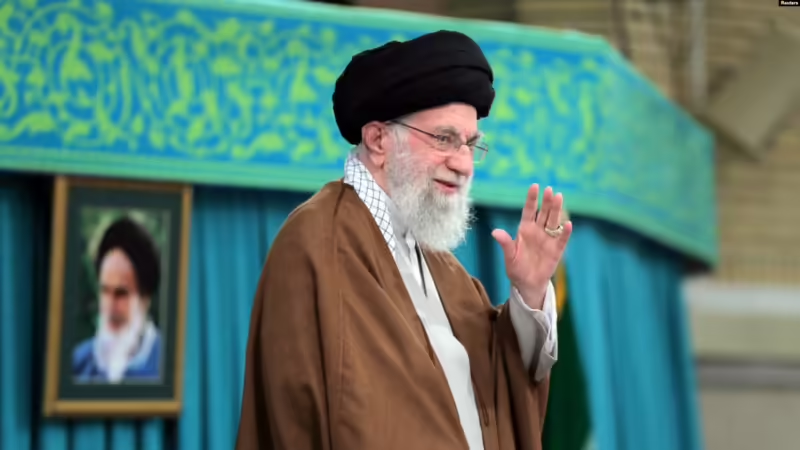
Russia condemned the February 28 strikes that killed Iran’s Supreme Leader Ali Khamenei, calling them an act of aggression. President Vladimir Putin described the killing as a “cynical murder.” Yet beyond rhetorical solidarity with Tehran, the war’s ripple effects have opened economic and strategic space for the Kremlin.
Oil Windfall
Before the conflict, Russia’s energy outlook was constrained by sanctions and discounted pricing. Oil and gas revenues had dropped significantly as Western measures targeted Moscow’s ability to finance its war in Ukraine.
Now, with Gulf supplies disrupted and the Strait of Hormuz under threat, global oil prices have surged. Russian crude, once sold at steep discounts, is reportedly trading at a premium. For a state budget heavily dependent on energy exports, the shift offers immediate relief.
Treasury Secretary Scott Bessent confirmed a temporary waiver allowing India to take delivery of Russian oil already at sea, easing short-term pressure amid rising fuel costs. While framed as a limited measure, the optics reinforce Moscow’s improved position in a tightening market.
Higher prices combined with Gulf uncertainty create favorable conditions for Russia, one of the few producers capable of quickly capitalizing.
Ukraine’s Defense Strain
The Iran war may also indirectly benefit Russia on the battlefield in Ukraine.
Ukraine relies heavily on U.S.-made Patriot air defense systems to intercept Russian missiles and drones. Those same high-cost interceptors are now being used extensively in the Middle East to counter Iranian attacks. European officials, including EU Defense Commissioner Andrius Kubilius, have warned that missile shortages are becoming acute.
Over the weekend, Russia launched one of its largest aerial assaults on Ukraine in months, underscoring Kyiv’s vulnerability as Western stockpiles stretch thinner.
Ukrainian President Volodymyr Zelenskyy has offered Gulf states expertise in countering Iranian drones — systems Russia has used extensively in Ukraine — but the broader imbalance remains.
Intelligence and Strategic Distraction
Reports from U.S. media outlets suggest Russia has shared targeting intelligence with Iran related to American military assets. The White House has not confirmed operational details but has downplayed the impact.
For Moscow, even limited involvement carries upside. Prolonged U.S. engagement in the Middle East risks draining resources, fracturing political focus and diverting attention from Ukraine. As analyst Robert Person notes, any development that “degrades America’s projection of power” shifts the geopolitical balance incrementally in Russia’s favor.
Calculated Gains
Russia may risk losing influence if Iran’s regime collapses. But in the near term, elevated oil prices, stretched U.S. arsenals and global distraction from Ukraine serve Kremlin interests.
Wars create destruction for some — and opportunity for others. In this unfolding conflict, Moscow appears positioned to absorb fewer costs while harvesting strategic dividends.
The longer the war drags on, the more those dividends may compound.
Comment
Trump Ousts Kristi Noem in Homeland Security Shake-Up
President Nominates Sen. Markwayne Mullin After Mounting Criticism Over Immigration and Disaster Response.
A Cabinet exit amid protests, lawsuits, and GOP backlash — what went wrong at Homeland Security?
President Donald Trump on Thursday fired Homeland Security Secretary Kristi Noem, ending a turbulent tenure marked by controversy over immigration enforcement, department spending, and disaster response.
Trump announced the move on social media, saying he would nominate Oklahoma Republican Sen. Markwayne Mullin as her replacement. He also said Noem would take on a new role as “Special Envoy for The Shield of the Americas,” a security initiative focused on the Western Hemisphere.
Noem’s departure makes her the first Cabinet secretary to leave during Trump’s second term.
Mounting Pressure on Capitol Hill
The dismissal follows days of pointed criticism during congressional hearings, where Noem faced unusually sharp questioning not only from Democrats but also from members of her own party.
Lawmakers scrutinized a $220 million advertising campaign launched by the Department of Homeland Security (DHS) encouraging undocumented immigrants to leave the country voluntarily. Noem told lawmakers Trump had been aware of the campaign in advance. Trump later told Reuters he had not signed off on it.
Her leadership also drew criticism after the department was partially shut down for 20 days, with many employees continuing to work without pay.
Immigration Crackdown Under Fire
Noem had overseen Trump’s hard-line immigration agenda, which triggered protests and legal challenges nationwide. Tensions escalated following the fatal shootings of two protesters in Minneapolis by immigration enforcement officers — incidents that intensified scrutiny of DHS tactics and oversight.
Republican frustration reportedly grew over the department’s execution of enforcement policy and over the pace of disaster funding through the Federal Emergency Management Agency (FEMA). Critics questioned how billions of dollars allocated by Congress had been spent and whether emergency responses had been managed effectively.
What Comes Next
Mullin’s nomination will require Senate confirmation. Under federal vacancy laws, however, he can serve as acting Homeland Security secretary while his nomination is pending.
The shake-up underscores the volatility within Trump’s second-term Cabinet and reflects the political sensitivity surrounding immigration enforcement and federal emergency management.
With immigration central to Trump’s domestic agenda, the transition at DHS signals not a retreat — but a recalibration at a department at the heart of the administration’s most contentious policies.
Top stories
Putin: Russia Could Cut EU Gas Immediately
Russian President Says Moscow May Redirect Energy Supplies to “Reliable Partners” Instead of Waiting for EU Ban.
If Brussels plans to quit Russian gas anyway, Putin asks: why wait?
Russian President Vladimir Putin said Wednesday that Moscow could halt gas supplies to the European Union preemptively rather than wait for Brussels to formally phase out Russian energy imports.
Speaking after hosting Hungarian Foreign Minister Peter Szijjarto at the Kremlin, Putin suggested Russia may be better off withdrawing from the European market now and shifting exports to what he called “reliable partners.”
“If we’re going to get shut off in a month or two, we’d be better off stopping now and moving to countries that are reliable partners,” Putin said in remarks broadcast by Russian journalist Pavel Zarubin. He added that no final decision had been made but that he would instruct the government and energy companies to examine the option.
Redirecting Energy to Emerging Markets
Putin framed the potential move as a pragmatic response to the EU’s declared goal of eliminating Russian fossil fuel imports. Moscow, he argued, should deepen ties with “emerging markets” instead of remaining in a market it expects to lose.
He also defended Russia’s long-standing energy relationship with Europe, saying Moscow “has always been and remains a reliable energy supplier,” while blaming the bloc’s energy crisis on what he described as years of “misguided policies.”
At the same time, Putin signaled that supplies to select Eastern European states would continue. He specifically mentioned Slovakia and Hungary as countries Moscow views as dependable partners.
Following the meeting, Szijjarto said Hungary had secured guarantees for continued oil and gas deliveries and would explore alternative transport routes if pipelines are disrupted. That includes possible maritime options should overland supply lines face obstacles.
Pipeline Disputes and Political Fallout
Hungary and Slovakia have recently faced interruptions in crude deliveries through the Druzhba oil pipeline, after Ukraine shut down the route in January. Kyiv said the artery had been damaged by Russian strikes, a claim Moscow denied. Budapest and Bratislava accused Ukraine of using energy transit as political leverage.
The dispute has already spilled into EU politics. Slovakia ended an emergency electricity supply scheme for Ukraine, while Hungary vetoed a proposed €90 billion EU loan for Kyiv and blocked a new sanctions package targeting Russia.
If Russia were to cut gas flows abruptly, it would mark another escalation in Europe’s long-running energy standoff with Moscow. Although EU dependence on Russian gas has fallen sharply since 2022, several member states remain exposed to supply shocks — particularly in Central and Eastern Europe.
Whether Putin’s comments amount to strategic signaling or a genuine policy shift remains unclear. But the message to Brussels was unmistakable: Moscow is prepared to move first.
Middle East
Oil Surges, Gas Soars as Gulf War Threatens Global Energy Arteries
Strait of Hormuz Tensions and LNG Shutdown in Qatar Send Shockwaves Through Markets.
Missiles in the Gulf. Tankers at anchor. Is the world on the brink of an energy shock?
Energy markets jolted sharply higher as the widening conflict between Iran, the United States and Israel began to threaten critical oil and gas infrastructure across the Gulf.
Global benchmark Brent crude briefly climbed to $82 a barrel on Monday after reports that at least three vessels were attacked near the Strait of Hormuz — the narrow waterway through which roughly 20 percent of the world’s oil and gas flows. Iran warned ships against transiting the strait, deepening fears of a supply choke point.
Natural gas markets reacted even more dramatically. Europe’s benchmark gas price surged as much as 50 percent before closing 39 percent higher after QatarEnergy halted liquefied natural gas production following drone strikes on facilities in Ras Laffan Industrial City. Qatar’s defense ministry said the damage was contained, but the suspension rattled traders.
In neighboring Saudi Arabia, Saudi Aramco temporarily shut its Ras Tanura refinery after a drone strike, further tightening concerns about regional output.
Shipping disruptions compounded the volatility. The UK Maritime Trade Operations reported multiple security incidents in the Arabian Gulf and Gulf of Oman. At least 150 tankers dropped anchor outside the Strait of Hormuz, while major operators rerouted vessels to avoid exposure. Danish shipping giant Maersk paused sailings through the Bab el-Mandeb Strait and Suez Canal, diverting around Africa’s Cape of Good Hope.
Equity markets reflected the uncertainty. London’s FTSE 100 fell 1.2 percent, led lower by airlines and banks exposed to energy-sensitive sectors. France’s CAC-40 and Germany’s DAX posted steeper declines. In the United States, the S&P 500 and Nasdaq initially fell but later recovered to close modestly higher.
Analysts cautioned that markets are not yet in crisis mode. “The market isn’t panicking,” said Saul Kavonic of MST Marquee, noting that major oil infrastructure has not been comprehensively disabled. Others warned, however, that a prolonged conflict could push crude above $100 a barrel, feeding global inflation.
Economists say sustained energy price spikes would quickly filter into food, industrial commodities and transport costs. Central banks, including the Bank of England, could be forced to delay planned interest-rate cuts if inflation pressures intensify.
For now, the Strait of Hormuz remains the focal point. As long as tankers hesitate and production remains uncertain, volatility is likely to persist — a reminder that even limited regional conflict can ripple across the global economy within hours.
Middle East
Trump Rebukes Britain as Iran War Strains ‘Special Relationship’
US President Says Historic Alliance Has Changed After UK Hesitation Over Iran Strikes.
From “special relationship” to public frustration — is the Atlantic alliance cracking?
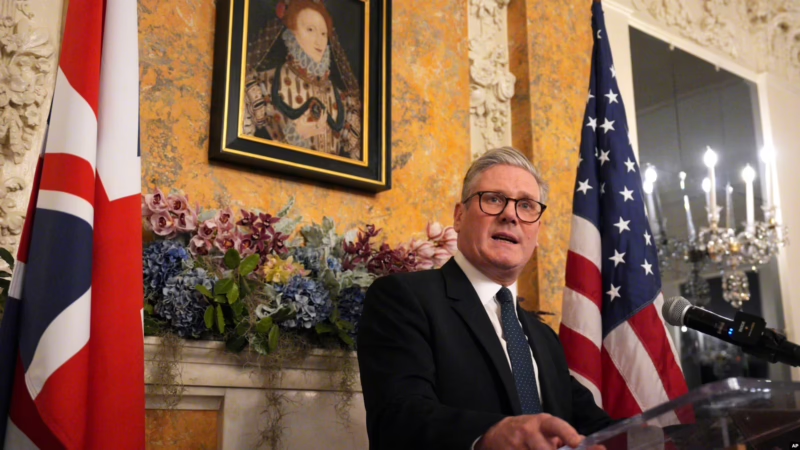
U.S. President Donald Trump said the once “most solid relationship” between Washington and London is “not like it used to be,” signaling a rare public strain in the transatlantic alliance as the Middle East conflict widens.
In an interview with The Sun, Trump criticized British Prime Minister Keir Starmer for initially refusing to allow the United States to use British military bases in operations connected to strikes on Iran.
“This was the most solid relationship of all,” Trump said. “Now we have very strong relationships with other countries in Europe,” singling out France and Germany.
He described Starmer as “not helpful” and said he never expected such hesitation from the United Kingdom. Though he later acknowledged Britain’s decision to permit limited use of bases for what London described as a specific defensive purpose, Trump argued that the approval “took far too much time.”
The disagreement touches on politically sensitive terrain in Britain. Memories of former Prime Minister Tony Blair’s support for the 2003 Iraq invasion continue to shape public and parliamentary caution over Middle East interventions.
Addressing Parliament, Starmer defended his position, saying his duty was to act in Britain’s national interest. “We all remember the mistakes of Iraq,” he said, stressing that any UK involvement must have a lawful basis and a clear strategic plan.
Downing Street confirmed that British bases, including RAF Akrotiri in Cyprus, were not being used by U.S. bombers for offensive operations. The Cypriot base was itself struck by an unmanned drone, which Starmer said had been launched prior to Britain’s policy decision.
The exchange marks one of the sharpest rhetorical breaks in U.S.-UK relations in years. While the alliance remains operationally intact — particularly within NATO — the public tone reflects deeper unease over strategy, escalation and political risk.
For Washington, speed and alignment are strategic necessities in a fast-moving conflict. For London, caution carries domestic and legal weight. The friction underscores a broader reality: even long-standing alliances can bend under the pressure of war.
Top stories
War Expands Across Region as Iranian Militias Join Fight
Embassies struck. Oil refineries targeted. Militias entering the war. The conflict is no longer confined to two countries.
The war between Israel, the United States and Iran widened sharply Monday as Iranian-backed militias joined the confrontation, missiles struck diplomatic and energy targets, and casualties mounted across multiple countries.
Iran and allied groups launched attacks on Israel and several Gulf states hosting American forces. In Kuwait City, fire and smoke were seen rising from inside the U.S. Embassy compound after reported missile or drone impacts. Kuwait’s defense ministry said several American warplanes crashed in the country, though it did not specify the cause. The U.S. military has not publicly confirmed those details.
Iranian officials said at least 555 people have been killed nationwide since the U.S.–Israeli air campaign began, with more than 130 cities reportedly struck. Israeli authorities said 11 people have been killed there in missile attacks.
In Iraq, a pro-Iranian militia claimed responsibility for drone strikes targeting U.S. forces at Baghdad’s airport and previously at Irbil. In Lebanon, Hezbollah said it fired missiles into Israel, prompting extensive Israeli retaliatory strikes that Lebanese authorities say killed at least 31 people.
Energy infrastructure has now entered the battlefield. Saudi Arabia’s Ras Tanura refinery — one of the world’s largest — was targeted by drones, which Saudi defenses said were intercepted. Kuwait and the United Arab Emirates also reported debris and damage linked to aerial interceptions.
Analysts say the strategy appears designed to impose economic pressure. “Gulf energy infrastructure is now squarely in Iran’s sights,” said Torbjorn Soltvedt of Verisk Maplecroft, warning of prolonged uncertainty for global oil markets. Roughly one-fifth of global oil trade passes through the Strait of Hormuz, where maritime tensions are rising.
Meanwhile, Iran’s envoy to the International Atomic Energy Agency accused Washington and Tel Aviv of striking safeguarded nuclear facilities, including Natanz. The United States and Israel have not publicly confirmed those claims.
President Donald Trump said U.S. combat operations would continue “until all objectives are achieved,” adding that further retaliation would be met with force. Britain, France and Germany signaled support for efforts to halt Iranian attacks but urged de-escalation.
The World Health Organization called for the protection of civilians and medical facilities as fighting spreads. With regional militias now active and oil infrastructure under threat, the conflict has entered a broader and more volatile phase — one that risks drawing in additional states and further destabilizing global markets.
-
Somaliland2 months agoF-35s Over Hargeisa: The Night Somaliland’s Sovereignty Went Supersonic
-
Somalia2 months agoAid Destroyed, Trust Shattered: Somalia Loses U.S. Support for Good
-
Terrorism1 month agoAmerica Pulls Back From Somalia but Doubles Down Next Door
-
Terrorism2 months agoForeign ISIS Pipeline Exposed: Puntland Captures Dozens of Non-Somali Fighters
-
Opinion2 months agoTurkey’s Selective Morality: From the Ruins of Gaza to the Red Sea
-
Somaliland2 months agoSomaliland at Davos: The Moment Somaliland Entered the World’s Inner Circle
-
Diplomacy2 months agoEthiopia–Israel Axis Strengthens as Regional Stakes Rise
-
Middle East2 months agoUS War Plans Against Iran Enter Advanced Stage