Total Control at Sea: How America Is Choking Iran’s Lifeline.
It’s not just ships blocking ships. It’s a full-spectrum system—watching, warning, and stopping everything that moves.
The U.S. naval blockade of Iran is not a simple line of warships cutting off traffic. It is a layered, high-tech system combining surveillance, intimidation, and precision enforcement—operating simultaneously from sea and sky.
At its core, the mission is straightforward: stop any vessel entering or leaving Iranian ports. But executing that objective across the vast waters surrounding the It’s not just ships blocking ships. It’s a full-spectrum system—watching, warning, and stopping everything that moves. requires far more than physical presence.
It requires total awareness.
A battlefield built on visibility
The backbone of the blockade is intelligence. U.S. forces must know where every ship is coming from, where it is headed, and whether it is connected to Iranian trade.
That picture is assembled in real time.
Destroyers equipped with advanced Aegis radar systems track vessels over long distances. Above them, aircraft like the P-8 Poseidon and carrier-based surveillance planes scan the sea from the air, filling in gaps that surface radar cannot cover. Drones and helicopters extend that reach even further, creating what military planners call a “maritime operating picture.”
In practical terms, this means few ships move unseen.
Interception: from warning to force
When a vessel approaches the blockade zone, the process begins with a warning—delivered by radio in precise legal language. The message is clear: comply or face force.
If a ship continues, U.S. forces escalate.
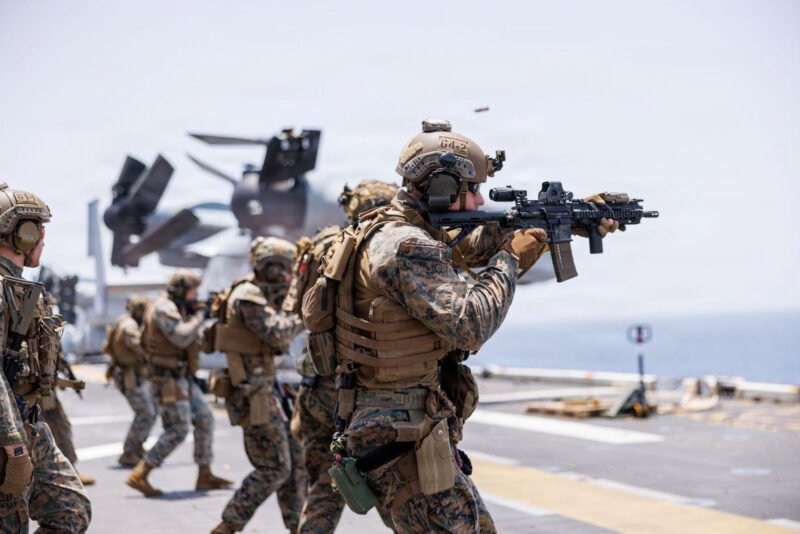
Destroyers can dispatch helicopters to visually identify the vessel. If necessary, boarding teams—often Marines or special operations forces—are deployed. These teams execute what is known as VBSS (Visit, Board, Search, and Seizure), a tightly choreographed operation designed to take control of a ship within minutes.
The method is deliberate: overwhelm quickly, secure critical areas like the bridge and engine room, and isolate the crew—all while avoiding unnecessary escalation with civilian mariners.
Control without constant confrontation
Despite its aggressive nature, the blockade is designed to minimize direct conflict. The goal is deterrence through certainty: ships turn back not because they are attacked, but because they know they will be stopped.
Early data suggests that strategy is working. Several vessels have already reversed course rather than challenge U.S. enforcement.
The air-sea fusion
What distinguishes this blockade from past efforts is the integration of air and naval power. Aircraft extend the reach of the fleet, allowing U.S. forces to monitor far beyond the immediate vicinity of warships.
This fusion reduces the chance of surprise and increases the efficiency of enforcement. As one former commander noted, the larger the area under surveillance, the harder it becomes for any vessel to slip through unnoticed.
A blockade that is also a signal
Beyond its operational mechanics, the blockade carries a strategic message.
It demonstrates that Washington is willing—and able—to control a critical artery of global trade. It also signals to Iran that its economic lifeline can be constricted without a full-scale invasion.
But that signal cuts both ways.
A blockade of this scale is not just a military tactic; it is an act of sustained pressure that risks retaliation, escalation, and long-term entanglement. It requires constant resources, coordination, and political will.
And it transforms the sea itself into an active front line.
What is unfolding in the Gulf is not simply a maritime operation. It is a test of whether control—persistent, visible, and enforced—can achieve what diplomacy has so far struggled to deliver.