
THE TURKISH PROTECTORATE
THE TURKISH PROTECTORATE: Somalia’s “Unity” Exposed as a Managed Illusion

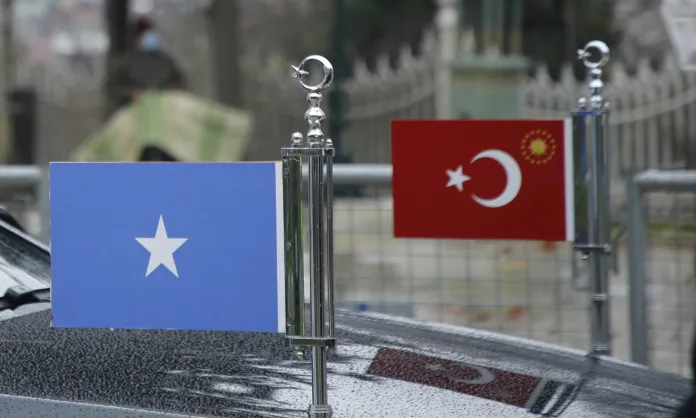
The Turkish Protectorate: How Mogadishu’s Claim to Sovereignty Became a Legal and Geopolitical Fiction.
The diplomatic standoff gripping the Horn of Africa is routinely framed as a dispute over “territorial integrity.” In practice, it is something far less noble: a collision between unresolved legal history and modern geopolitical extraction, with Mogadishu’s claim to sovereignty increasingly resembling a carefully maintained fiction.
At the heart of the matter lies a legal vacuum that has never been honestly confronted. The Somali Federal Government insists that Somaliland is a “breakaway region,” yet historical and legal records tell a different story. As research by Mo Saeed of Somaliland Legal Research makes clear, the 1960 union between Somaliland and Somalia was never lawfully completed.
The “Union of Somaliland and Somalia Law” was not ratified by the southern legislature. Even at the time, legal scholars such as Paolo Contini warned that Mogadishu’s provisional, “in principle” approval fell short of binding legality. The union, in effect, was a political gesture without a constitutional foundation.
Seen through that lens, Somaliland’s 1991 declaration was not secession. It was restoration — the reassertion of a sovereignty that had never been legally extinguished. This distinction is not semantic. It is the difference between a failed marriage and an occupation sustained by inertia.

That unresolved past helps explain the present. Turkey’s role in southern Somalia is often described in the language of brotherhood and solidarity. The balance sheet, however, tells a more transactional story. Under a 2024 maritime pact, Ankara is rebuilding Somalia’s navy in exchange for roughly 30 percent of maritime resource revenues — a staggering concession for a state that claims full sovereignty. Turkish firms manage Mogadishu’s ports, Turkish Airlines holds strategic stakes in national aviation, and Turkish-built infrastructure dominates the capital’s skyline.
This is not partnership in the abstract. It is leverage embedded in steel, contracts, and revenue streams.
The contrast is hard to ignore. While billion-dollar airports rise in Mogadishu, nearly half of Somalia’s children under five suffer acute malnutrition. The “unity” being defended does not translate into human security; it guarantees access — for external actors — to ports, airspace, and resources within a chronically weakened state.
For the international community, the choice is becoming unavoidable. Continue to uphold a narrative of unity that masks legal failure and facilitates external capture, or acknowledge the uncomfortable legal truth of 1960 and its consequences. Ignoring that history may be politically convenient, but it is not neutral. It is a decision — one that favors expediency over law, and dependency over stability.
Somaliland’s status is not a geopolitical anomaly. It is the unresolved bill of a union that never legally existed.
By Mo Saeed
Somaliland legal research (SLR)
















2,000 Ships Held Hostage—Iran Turns Global Oil Route Into a Controlled Gate

UK Leads 35-Nation Push to Reopen Strait of Hormuz

Trump Considers Replacing Attorney General Pam Bondi


-

 US-Israel war on Iran1 month ago
UK Refuses Iran Strike Access, Trump Fires Back
-
 Russia-Ukraine War1 month ago
Europe’s Spies Challenge Trump’s Ukraine Peace Optimism
-
 Top stories1 month ago
India Turns to Brazil in Strategic Minerals Push Against China
-

 Top stories1 month ago
War Expands Across Region as Iranian Militias Join Fight
-
 US-Israel war on Iran1 month ago
Iran Pledges ‘Never, Ever’ to Hold Bomb-Grade Material
-
 US-Israel war on Iran1 month ago
Syria Under Fire on Two Fronts
-
 Russia-Ukraine War1 month ago
Estonia Warns NATO Would Strike Deep Inside Russia if Baltics Are Invaded
-

 Top stories3 weeks ago
Meloni Breaks Ranks: Italy Warns on Iran War