Trump wants Greenland. Greenland says no—clearly, publicly, and decisively.
Greenland has delivered its sharpest rejection yet of U.S. annexation ambitions, pushing back forcefully after President Donald Trump named Louisiana Governor Jeff Landry as a special envoy tasked with advancing American interests on the Arctic island.
“Our future is decided by ourselves,” Greenland’s Prime Minister Jens-Frederik Nielsen wrote in a public statement. “Greenland is our country.” The message was unambiguous—and widely echoed across the island’s political spectrum.
Trump has openly pursued control of Greenland since his first term, framing the territory as essential to U.S. national security.
Landry made the administration’s intent explicit, stating that his role is to help “make Greenland a part of the U.S.” Trump himself has gone further, telling reporters the United States would acquire Greenland “one way or another,” and previously refusing to rule out the use of force.
Greenland, however, remains a self-governing territory within the Kingdom of Denmark, with full authority over its internal affairs and the legal right to choose independence.
Public opinion is overwhelmingly opposed to U.S. control. Recent polling shows roughly 85% of Greenlanders reject joining the United States, with nearly half describing Trump’s interest as a direct threat.
In a joint response, Prime Minister Nielsen and Danish Prime Minister Mette Frederiksen stressed that sovereignty and borders are protected under international law. “You cannot annex other countries,” they said.
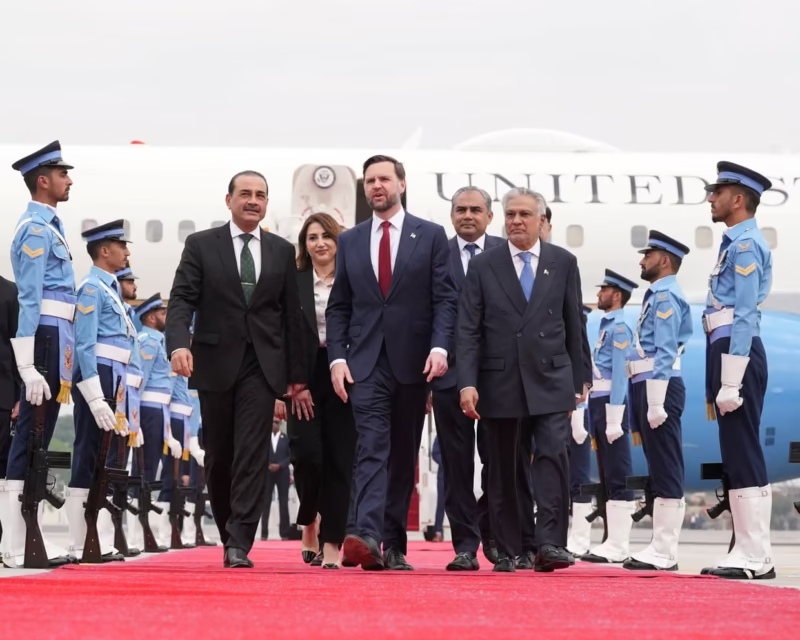
The renewed tension follows a series of high-profile U.S. moves, including a visit earlier this year by Vice President JD Vance, who accused Denmark of underinvesting in Greenland.
While Trump briefly acknowledged Greenlanders’ right to self-determination in a speech to Congress, he immediately undercut it by predicting U.S. acquisition regardless of consent.
The strategic stakes are undeniable. Greenland is the world’s largest island, sits astride critical Arctic shipping routes, hosts a key U.S. missile defense base, and occupies a central position in emerging competition with Russia and China as polar ice melts.
Beneath its receding ice lie rare earth minerals vital to modern technology—resources Washington is eager to secure as it seeks to reduce dependence on China.
But geography and minerals alone do not translate into legitimacy. Greenlanders are clear: strategic value does not override sovereignty.
As climate change accelerates Arctic competition, the island’s leaders are signaling that their future will not be decided in Washington—or bought through diplomatic pressure.
For now, the message from Nuuk is firm and final: Greenland belongs to Greenlanders.
Denmark Summons U.S. Ambassador After Trump Names Special Envoy to Greenland
Denmark Pushes Back After Trump Names U.S. Envoy to Greenland