
Munich Security Conference
Rubio Tells Europe Alliance Endures — But Policies Must Shift

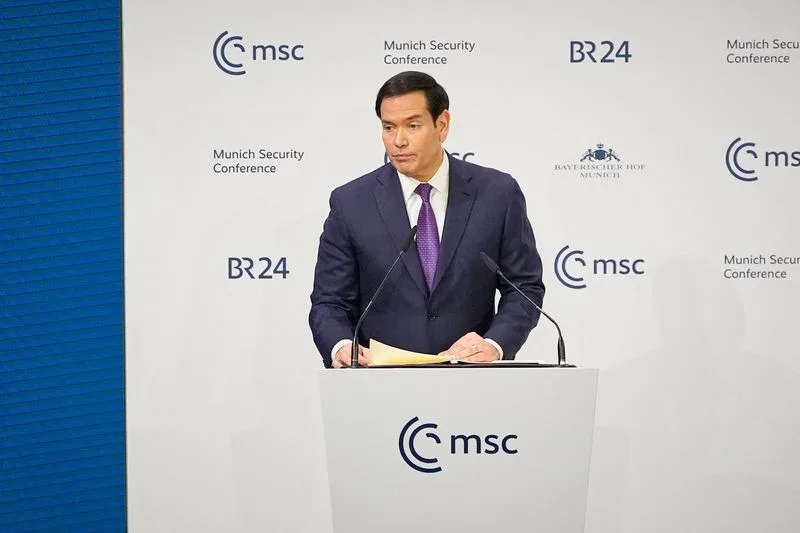
“We belong together,” Rubio says in Munich — even as he presses Europe on migration, climate and cultural identity.
U.S. Secretary of State Marco Rubio struck a conciliatory tone at the Munich Security Conference on Saturday, assuring European leaders that Washington remains committed to the transatlantic alliance — while also repeating criticisms that have unsettled allies in recent years.
“In a time of headlines heralding the end of the transatlantic era, let it be known and clear to all that this is neither our goal nor our wish,” Rubio told diplomats and security officials gathered in Munich. “For the United States and Europe, we belong together.”
His remarks sought to ease concerns that President Donald Trump’s “America First” agenda signals retreat from Europe. Rubio emphasized shared heritage and long-standing cooperation, framing the alliance as foundational rather than optional.
Yet beneath the rhetoric of unity, Rubio reiterated familiar grievances. He criticized European leaders over mass migration, climate policy and what he suggested was a drift away from cultural confidence. While the speech avoided the sharper confrontational tone that Vice President JD Vance delivered at last year’s conference, it echoed similar themes.
Notably, Rubio did not mention Russia — Europe’s primary security concern — nor did he explicitly reference NATO during his address. The omission drew quiet scrutiny among some attendees, given the ongoing war in Ukraine and rising geopolitical tensions.
European officials described the speech as reassuring in tone but light on specifics. One senior diplomat said Rubio’s emphasis on emotional and historical bonds signaled that cooperation remains possible, albeit “in a different formula.”
Others were less convinced. Democratic Senator Andy Kim said Rubio missed an opportunity to address pressing global security challenges, including Ukraine and China.
The address came as European leaders increasingly discuss strengthening their own defense capabilities. German Chancellor Friedrich Merz has acknowledged talks with France on European nuclear deterrence, while French President Emmanuel Macron has urged greater strategic autonomy.
Rubio’s message was clear: the alliance endures, but Washington expects Europe to adjust. Whether that recalibration strengthens or strains transatlantic ties remains an open question.













There’s no UK security without European security.” Starmer signals a decisive pivot toward Europe as transatlantic tensions simmer.
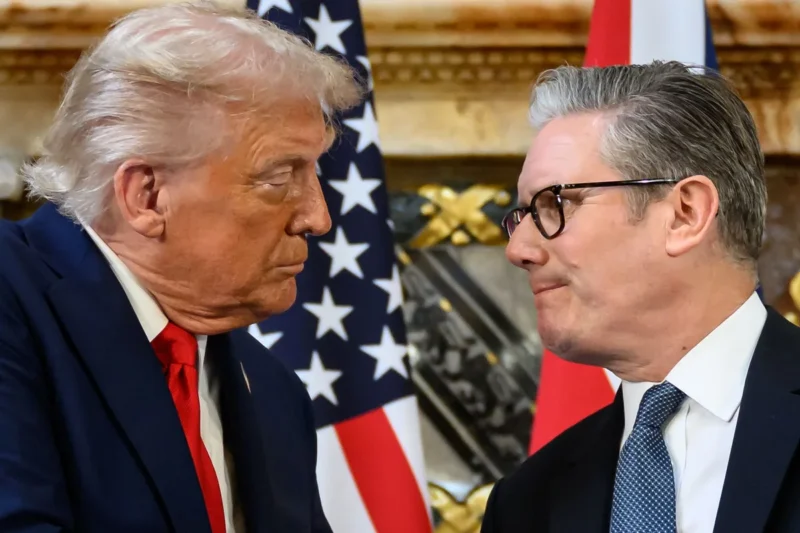
British Prime Minister Keir Starmer will declare that Britain’s “Brexit years” are over as he urges deeper security cooperation with Europe and calls for reduced reliance on the United States.
Speaking at the Munich Security Conference, Starmer is expected to argue that Europe must assume greater responsibility for its own defense amid rising geopolitical uncertainty. His remarks come against a backdrop of strained transatlantic ties under Donald Trump, whose repeated comments about Greenland and criticism of NATO allies have unsettled European leaders.
Starmer will describe Europe as a “sleeping giant,” highlighting that its combined economic output far exceeds Russia’s and that it possesses substantial military capabilities. However, he is also expected to acknowledge fragmentation and duplication in Europe’s defense infrastructure, calling for closer cooperation between the United Kingdom and the European Union to strengthen industrial capacity and defense production.
“There’s no UK security without European security. There’s no European security without UK security,” Starmer said during trilateral talks in Munich with German Chancellor Friedrich Merz and French President Emmanuel Macron.
While advocating greater European autonomy, Starmer will emphasize that this does not signal a break with Washington, describing the United States as a key ally. Instead, he will frame his vision as one of burden-sharing rather than separation.
His speech follows renewed debate over Britain’s role in European defense initiatives, including earlier talks on joining the EU’s €150 billion Security Action for Europe rearmament fund.
Starmer is also expected to criticize domestic political opponents, arguing that isolationism or softness toward Russia would weaken Europe at a time of mounting threats.
The address signals a strategic recalibration in London’s foreign policy — one that seeks to anchor Britain firmly within Europe’s security framework while maintaining, but not depending entirely on, the transatlantic alliance.
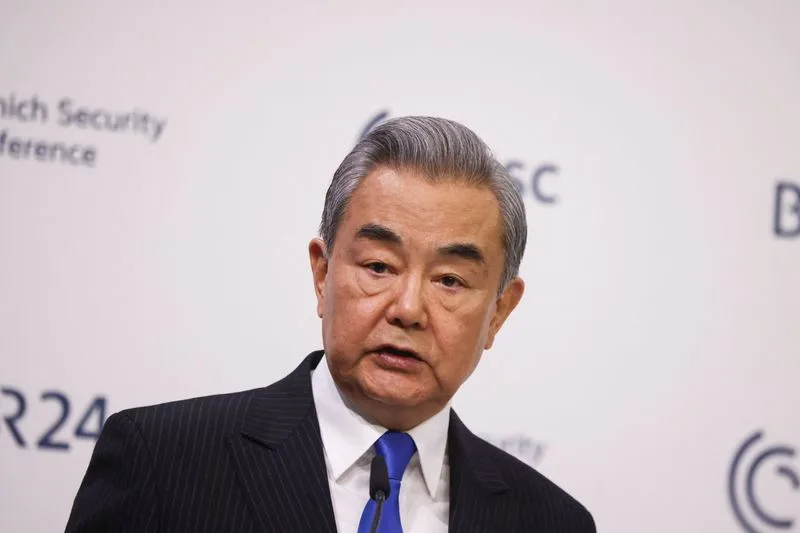
Cooperation or confrontation? China’s top diplomat says Washington faces a choice — and warns against crossing “red lines” on Taiwan.
China’s top diplomat, Wang Yi, cautioned Saturday against what he described as “knee-jerk” calls in the United States to sever economic ties with Beijing, urging Washington to adopt a more “positive and pragmatic” approach.
Speaking at the Munich Security Conference, Wang said cooperation remains the best path forward for the world’s two largest economies, even as tensions over trade, technology and security persist.
His remarks came a day after he met U.S. Secretary of State Marco Rubio in what a U.S. official described as a constructive exchange. The two sides also discussed a planned April visit to Beijing by President Donald Trump, signaling potential efforts to stabilize relations after a year marked by tariff disputes and policy friction.
Wang said Beijing had been encouraged by recent White House statements expressing respect for Chinese President Xi Jinping and the Chinese people. Still, he warned that certain voices in Washington were undermining the bilateral relationship.
He outlined what he described as two possible futures: one in which the United States views China “reasonably and objectively” and pursues cooperation, and another driven by emotional reactions aimed at decoupling supply chains and opposing China “on everything.”
Western governments have increasingly voiced concern about reliance on China for critical raw materials and key manufacturing components, prompting calls to diversify supply chains. Wang argued that attempts to fully sever economic ties would be counterproductive and destabilizing.
He also warned that moves to support Taiwan independence would cross Beijing’s “red lines” and could push the two countries toward conflict.
“China wants to see the first prospect,” Wang said, referring to cooperation. “But China is well prepared to address all kinds of risks.”
His message underscored Beijing’s effort to portray itself as open to engagement — while making clear that certain issues remain non-negotiable.
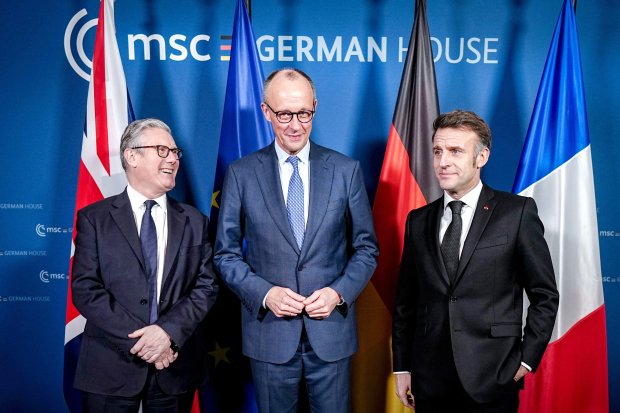
A turning point in European defense? Macron says the continent must redefine its security — with a new, “holistic” nuclear strategy.
French President Emmanuel Macron said Friday that Europe must redefine its security architecture independently, arguing that the continent can no longer rely solely on existing frameworks as it confronts an assertive Russia.
Speaking at the Munich Security Conference, Macron said Europeans must prepare for a future in which they negotiate their own security arrangements, rather than leaving such decisions to outside powers. “We have to be the ones to negotiate this new architecture of security for Europe,” he said, noting that geography ensures Europe will continue to coexist with Russia.
Macron suggested that redefining Europe’s defense posture could include a more “holistic” approach to nuclear deterrence — an area traditionally guarded as a strictly national prerogative. France, the European Union’s only nuclear-armed state, has begun what Macron described as a “new strategic dialogue” with German Chancellor Friedrich Merz and other European leaders.
The talks aim to explore how France’s national nuclear doctrine could align more closely with broader European security interests. Macron said the dialogue seeks to create strategic convergence, particularly between France and Germany.
Merz confirmed that confidential discussions on deterrence are underway but stressed that Germany remains bound by its commitments under NATO’s nuclear-sharing framework. He said Berlin would not support the emergence of “zones of differing security” across Europe.
Macron’s remarks reflect growing debate within Europe over long-term reliance on the U.S. security umbrella. While he did not call for replacing NATO, his comments signal that European leaders are increasingly weighing options for greater strategic autonomy.
Beyond defense policy, Macron also defended Europe against criticism that it is overregulated, economically stagnant or socially restrictive. He urged Europeans to adopt a more confident posture, arguing that the continent’s strengths are often overshadowed by negative narratives.
Macron said he would provide further details on his security proposals in the coming weeks, as Europe continues to reassess its strategic footing amid heightened geopolitical tensions.

Gulf Unity Emerges: Stop the War Before It Spreads

Italy Blocks US Use of Sicily Air Base

Inside Iran’s War Tactic: Turning Civilian Spaces into Battle Zones


-
 US-Israel war on Iran1 month ago
UK Refuses Iran Strike Access, Trump Fires Back
-
 Russia-Ukraine War1 month ago
Europe’s Spies Challenge Trump’s Ukraine Peace Optimism
-

 Top stories4 weeks ago
War Expands Across Region as Iranian Militias Join Fight
-
 US-Israel war on Iran1 month ago
Iran Pledges ‘Never, Ever’ to Hold Bomb-Grade Material
-
 US-Israel war on Iran1 month ago
Syria Under Fire on Two Fronts
-
 Top stories1 month ago
India Turns to Brazil in Strategic Minerals Push Against China
-
 Russia-Ukraine War1 month ago
Estonia Warns NATO Would Strike Deep Inside Russia if Baltics Are Invaded
-
 Terrorism4 weeks ago
Regional Army Moves Against Expanding Armed Groups