Comment
Somalia: Elections, Insurgency, and the Gathering Storm Over Mogadishu
December 25 is no longer an election date. It is a trigger.
The Republic of Somalia is standing at a historic precipice. What was once a fragile federal experiment has hardened into a perfect storm of fragmentation, insurgency, and overcentralization—one that now threatens outright state collapse. Intelligence indicators increasingly warn that the December 25 electoral deadline has ceased to be a political milestone and has instead become a potential ignition point for widespread bloodshed in Mogadishu.
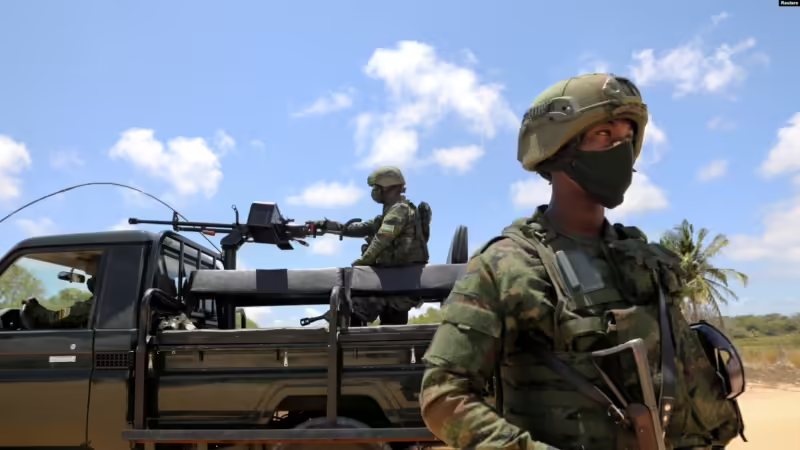
The administration of Hassan Sheikh Mohamud is no longer perceived as a federal arbiter balancing regional interests. It is seen, both domestically and by regional actors, as a besieged executive authority confined to a shrinking capital city. Al-Shabaab now operates within roughly fifty kilometers of Mogadishu and has demonstrated its reach by breaching the headquarters of the National Intelligence and Security Agency. The once-symbolic green zone around Villa Somalia is more isolated—and more exposed—than at any point in the past decade.
The collapse of the 2017 London Security Pact and the subsequent hollowing out of the Somali National Army have left a vacuum that foreign partners have tried to fill through bilateral arrangements. But deals with Turkey and China cannot compensate for internal disintegration. They merely delay its consequences.
Former President Mohamed Abdullahi Farmaajo and the newly formed Somali Future Council have sounded a blunt warning: Somalia’s military is demoralized, underfunded, and exhausted. Estimates suggest as many as 15,000 casualties in three years.
With the African Union mission facing looming bankruptcy, the defense of Mogadishu is no longer a question of strategy—it is a countdown. The risk is no longer theoretical: a jihadist-ruled capital is now within the realm of plausible outcomes.
Politically, the rupture is just as severe. Relations between Mogadishu and federal member states such as Puntland and Jubaland have crossed from dispute into constitutional breakdown.
The Kismayo communiqué—signed by former presidents, prime ministers, and regional leaders—represents a rare ideological convergence against what they describe as a blunt-instrument presidency. By declaring unilateral constitutional amendments null and void, the opposition has effectively withdrawn recognition of federal authority.
Their January 20, 2026 ultimatum is a final warning: without a consensus-based electoral framework, Somalia will slide into parallel governance, splitting authority between rival administrations—and leaving space for Al-Shabaab to advance under the black flag.
Beneath the military and political crises lies a deeper ideological shift. Somalia is drifting toward an illiberal Islamist order, driven not only by violence but by capture. While the government remains consumed by power struggles, Al-Shabaab and the Salafi al-I’tisaam network are competing for control of the state’s soul.
One advances through bombs and assassinations; the other through quiet domination of the Ulema Council, education, and banking. Both paths abandon the democratic federal bargain envisioned in 2012.
If that bargain is not repaired within weeks, the most plausible scenario is collapse and containment: Mogadishu falls, remaining federal members retreat to a provisional capital, and the Indian Ocean coast is left to a Taliban-style theocracy.
The result is financial autonomy for federal member states—and growing irrelevance for Mogadishu. Indicators suggest UAE-backed regions are now more stable and better resourced than the capital itself. If Mogadishu falls, the UAE is positioned to recognize a provisional authority elsewhere, containing jihadist control to Banadir.
By contrast, Turkey and China have doubled down on the center. Turkey’s control of Mogadishu’s port and airport provides the federal government’s primary revenue stream, while the TURKSOM base functions as Villa Somalia’s ultimate insurance policy.
Yet reliance on elite units such as Gorgor and Haram’ad has produced a Praetorian Guard—strong inside the capital, weak beyond its perimeter. China’s support, tied to Belt and Road maritime interests, risks alienating the very regional states that control the coastline.
The Africa Center for Strategic Studies underscores the imbalance: Mogadishu’s port generates between $100 million and $400 million annually, of which the federal government captures roughly 85 percent while providing minimal security to the regions. Puntland and Jubaland’s suspension of cooperation is a direct response.
If December 25 passes without consensus, a revenue embargo is likely—bankrupting Villa Somalia and forcing total reliance on Turkish and Chinese lifelines, further inflaming nationalist and Islamist narratives of occupation.
The strategic trajectory is clear. Somalia is drifting toward a permanent split: an illiberal, centralized Mogadishu backed by Turkey and China, versus a decentralized, port-driven federation backed by the UAE and regional neighbors.
The greatest danger is that amid this geopolitical chess match, Al-Shabaab exploits the cracks to seize the ultimate prize—the Mogadishu port itself. If that happens, Somalia’s collapse will no longer be debated. It will be confirmed.
Comment
Arab League Mobilizes Against Somaliland
Arab Parliament Aligns With Somalia Against Somaliland in Post-Recognition Diplomatic Escalation.
The Arab Parliament’s declaration in Cairo rejecting Somaliland and pledging political action in support of Somalia marks a familiar reflex in Arab League diplomacy: preserve inherited borders first, question governance later.
Issued during the opening of its second general assembly session, the statement framed Somaliland’s emergence — and Israel’s recognition — as violations of “sovereignty” and “territorial integrity,” invoking non-interference while simultaneously endorsing active political mobilization against a self-governing state that has existed for more than three decades.
This contradiction is not accidental. It reveals the enduring preference within Arab institutions for juridical continuity over political reality — even when that continuity rests on a state apparatus that remains fractured, militarily dependent, and diplomatically reactive.
The timing matters. Israel’s recognition of Somaliland punctured a long-standing taboo in regional diplomacy: that the Horn of Africa must be filtered exclusively through Mogadishu. The Arab Parliament’s response is less about Somaliland itself than about containing the precedent. If one external actor can legitimize Somaliland, others may follow. Cairo’s message, therefore, is not aimed at Hargeisa alone — it is directed at every capital contemplating engagement beyond Somalia’s federal framework.
Yet this mobilization exposes more weakness than strength.
Somalia’s push for Arab backing arrives as the global narrative around failed governance is shifting. At Davos, U.S. President Donald Trump’s rhetoric reclassified chronic state failure not as a humanitarian dilemma but as a strategic liability. In that reframing, Somalia ceases to be a symbol of victimhood and becomes a case study in unmanaged sovereignty.
That shift matters deeply for Somaliland.
As Western policymakers harden their stance against exporting instability through migration and aid dependency, space opens for alternative African narratives — those rooted in territorial control, security provision, and institutional continuity. Somaliland fits that model. Somalia does not.
Mogadishu presents the Arab Parliament’s statement as a diplomatic victory. In reality, it highlights the fragility of its claim. The need to summon collective denunciations is itself evidence of declining unilateral authority. Sovereignty that requires constant reaffirmation is sovereignty under question.
Meanwhile, Somalia’s strategic alignment is narrowing. Its deepening reliance on Turkey and Saudi Arabia, combined with the breakdown of its partnership with the UAE, signals a retreat into patronage-based diplomacy rather than diversified engagement. Abu Dhabi’s recalibration is instructive: maritime security, energy corridors, and Red Sea stability demand partners who control territory and honor agreements. Somaliland does both.
Claims over Berbera, Bosaso, and Kismayo increasingly ring hollow in a diplomatic system that measures legitimacy through performance, not paperwork. Somaliland has held elections, maintained internal peace, and governed its territory continuously since 1991 — achievements few conflict-region states can match.
The Arab Parliament’s statement, then, is less a blockade against Somaliland’s future than a mirror reflecting the limits of Somalia’s present.
In the evolving Horn of Africa, recognition will not be granted by declarations alone — but by those who can demonstrate that sovereignty is something exercised, not merely asserted.
Comment
Starmer Rebukes Trump Over Afghanistan Comments
When Words Become Wounds: Trump, Starmer, and the Fracturing of the Atlantic Alliance.
Words, in diplomacy, are rarely just words. When U.S. President Donald Trump casually dismissed NATO allies’ role in Afghanistan as having stayed “a little back” from the frontlines, he did more than provoke outrage — he reopened one of the deepest emotional fault lines in the Western alliance.
British Prime Minister Keir Starmer’s response was unusually blunt. Calling Trump’s remarks “insulting and frankly appalling,” Starmer accused the American president of diminishing the sacrifice of British soldiers who fought and died alongside U.S. forces over two decades of war. It was not merely a political rebuke; it was a moral one.
The numbers alone refute Trump’s narrative. Of the 3,486 NATO troops killed in Afghanistan, 457 were British — second only to the United States. These were not rear-line casualties. British soldiers fought in some of the war’s most brutal theatres, including Helmand Province, where casualty rates rivalled those of U.S. Marines. Canada lost 165, many of them civilians and frontline troops embedded in the same battle zones.
Starmer’s intervention marks a rare moment where London has chosen confrontation over quiet correction. That choice reflects more than wounded pride. It signals rising alarm in European capitals over Trump’s increasingly transactional approach to alliances — one that prizes leverage over loyalty and spectacle over solidarity.
The timing makes the rupture more serious. This clash follows Trump’s recent criticism of Britain over the Chagos Islands deal and comes amid a broader pattern of disruptive diplomacy: threats to annex Greenland, tariff brinkmanship with Europe, and renewed unilateral posturing toward Iran. In this context, Trump’s remarks about Afghanistan were not an isolated misstep but part of a worldview that recasts alliance contributions through a narrow lens of American primacy.
For Britain, the issue is existential to its military identity. The Afghan war remains one of the defining sacrifices of a generation. To suggest British troops were marginal is to erase years of joint command, shared casualties, and battlefield interdependence. It also revives uncomfortable scrutiny of Trump’s own avoidance of military service during Vietnam — a contrast not lost on veterans’ families.
Starmer’s call for an apology may seem futile — Trump rarely apologizes — but the demand itself is strategic. It draws a line: respect for allied sacrifice is not optional currency in the Atlantic alliance.
Yet the deeper concern lies beneath the rhetoric. When leaders begin questioning not just policies but the legitimacy of past shared bloodshed, alliances shift from strategic partnerships into fragile contracts. That is a dangerous evolution at a time when NATO faces its most complex security environment since the Cold War.
In the end, this is not merely about Afghanistan. It is about whether the transatlantic relationship remains rooted in shared memory and mutual respect — or whether it is being reduced to a balance sheet of who “paid” and who “led.”
For now, Starmer has made Britain’s position clear: alliances are built not only on power, but on honor.
Comment
When Pressure Comes, Putin Lets Iran Burn Alone
Putin’s Calculated Distance from Iran Exposes the Limits of Russia’s Alliances.
Alliances built on convenience rarely survive real pressure. The current standoff between Washington and Tehran has laid bare a quiet but telling shift: Vladimir Putin, long portrayed as Iran’s strategic patron, is now carefully stepping aside as the Islamic Republic faces one of its gravest moments in decades.
As President Donald Trump warns that a U.S. naval armada is moving toward the Gulf and openly hints that strikes on Iran remain an option, Moscow’s response has been conspicuously restrained. Russia’s foreign ministry has advised its citizens against traveling to Iran. Russian officials have offered mediation rather than protection. And the Kremlin has made no move suggesting it would place itself between Tehran and Washington.
This is not accidental. It is strategic abandonment.
For over a decade, Russia and Iran forged a partnership built on opposition to Western power. That relationship deepened after Moscow’s invasion of Ukraine, when Iran supplied Russia with Shahed kamikaze drones that helped sustain the Kremlin’s campaign against Ukrainian cities. In return, Tehran expected unprecedented military cooperation, including advanced aircraft and air defense systems.
Yet the partnership was always transactional, never existential.
Russia localized drone production by 2023, reducing its dependence on Iranian supply. China and North Korea now matter far more to Moscow’s war effort. And the collapse of the Assad regime in Syria in late 2024 — a regime jointly propped up by Russia and Iran — dealt a severe blow to their shared regional architecture.
Even their much-vaunted “comprehensive strategic partnership treaty” signed in early 2025 stopped short of any mutual defense obligation. That omission now looks deliberate. Russia wants flexibility, not entanglement.
The moment of truth came last summer when Israel and later the United States systematically dismantled Iran’s air defenses and struck its nuclear infrastructure — humiliating Tehran in full view of the world. Iranian envoys rushed to Moscow. They returned empty-handed.
Now, as protests sweep Iran and the regime faces mounting internal and external pressure, Putin has again chosen distance over loyalty. His priority is not Tehran’s survival. It is staying in Trump’s good graces as negotiations over Ukraine intensify. By letting the foreign ministry issue ritual condemnations while avoiding concrete commitments, Putin shields himself from consequences while signaling to Washington that Iran is expendable.
Even the limited Russian support visible — a handful of military cargo flights and vague arms assistance — falls far short of what would meaningfully alter Iran’s fate. Moscow cannot spare systems from Ukraine, and it will not risk escalation for a partner whose core survival is not tied to Russia’s own.
This moment exposes a deeper truth about Putin’s world: Russia’s partnerships are designed to be reversible. Loyalty flows upward, never reciprocally.
For Washington, this is an opportunity. Not merely to isolate Iran, but to demonstrate to Russia’s other partners that when pressure arrives, the Kremlin’s friendship has a sharp expiration date.
Putin’s silence today may echo far beyond Tehran.
Comment
Ethiopia Quietly Repositions Toward Scandinavia
Ethiopia and Norway have agreed to deepen bilateral cooperation following talks between Ethiopia’s State Minister of Foreign Affairs, Ambassador Hadera Abera, and Norwegian Deputy Foreign Minister Andreas Kravik, held today in Addis Ababa.
According to Ethiopia’s Ministry of Foreign Affairs, the discussions focused on expanding collaboration in areas of mutual interest, including climate action, trade, and investment.
Ambassador Hadera highlighted the long-standing relationship between the two countries and reaffirmed Ethiopia’s commitment to strengthening ties, particularly through its Climate-Resilient Green Economy (CRGE) Strategy and the Green Legacy Initiative. He emphasized Norway’s expertise in afforestation and environmental management as a key area for enhanced cooperation.
The state minister also briefed his Norwegian counterpart on Ethiopia’s ongoing economic liberalization efforts and encouraged Norwegian companies to explore investment opportunities in the country.
Deputy Minister Kravik welcomed Ethiopia’s reform agenda and stressed the importance of boosting trade and investment cooperation as part of a broader effort to strengthen bilateral relations.
Both sides also exchanged views on regional peace and security and agreed to work closely in bilateral and multilateral forums on issues of shared interest.
The talks signal Ethiopia’s growing engagement with European partners as it seeks to diversify its diplomatic and economic partnerships while advancing its green development and investment strategies.
Comment
Trump Put Somalia on Trial at Davos
Trump Uses Davos to Spotlight Somalia, Immigration, and the Collapse of Mogadishu’s Image on the Global Stage.
In Davos, where the world’s elite typically trade in coded language about “collective action” and “shared responsibility,” Donald Trump chose confrontation over consensus.
Standing before political leaders, corporate titans, and global media at the World Economic Forum, the U.S. president delivered a blunt and unmistakable message: America will no longer absorb the political and institutional failures of other states through unchecked migration and welfare dependency. And in doing so, Trump placed Somalia — specifically its image, governance failures, and diaspora-linked scandals — squarely on the world stage.
At the center of his remarks was the sprawling Minnesota fraud case involving dozens of Somali residents accused of siphoning tens of millions of dollars from public nutrition programs. For Trump, the scandal was not an isolated criminal episode but evidence of a deeper failure — both in U.S. immigration screening and in the exporting of dysfunction from fragile states into Western institutions.
Trump framed the issue not in legal technicalities but in strategic terms: the United States, he argued, cannot function as a financial safety net for the governance failures of other nations. In his telling, welfare abuse is not merely criminal misconduct — it is a national security vulnerability.
The White House quickly reinforced that framing. In a statement following the speech, the administration argued that immigration must be tied to contribution, assimilation, and respect for the host nation’s laws, not merely humanitarian sentiment. In effect, Trump used Davos to internationalize what has long been a domestic debate — linking migration policy directly to state failure abroad.
What made the moment particularly striking was its venue. Davos is traditionally a sanctuary for diplomatic restraint and multilateral language. Trump transformed it into a platform for unilateral clarity, redefining what “dialogue” looks like under his presidency: not consensus-seeking, but agenda-setting.
Critics dismissed the remarks as inflammatory. Yet the policy sequence surrounding the speech tells a different story. The Davos intervention coincided with tangible shifts in U.S. immigration strategy:
A freeze on visa processing from dozens of countries deemed high-risk under “public charge” standards
Expanded DHS enforcement operations across multiple U.S. cities
A recalibration of immigration preference toward applicants with high economic or cultural alignment
This was not rhetorical theater. It was strategic signaling.
Beyond domestic politics, Trump’s Davos remarks also reshaped international perception. By associating Somalia’s global image with fraud, instability, and institutional failure, he inadvertently accelerated the collapse of Mogadishu-centric legitimacy on the world stage. In doing so, he exposed a diplomatic vacuum — one that stable, democratic actors in the Horn of Africa are now positioned to fill.
In global politics, reputation is currency. Trump effectively devalued Somalia’s brand in a room where reputations determine access, partnerships, and capital flows.
And here lies the deeper geopolitical consequence.
As the United States hardens its stance against exporting instability through migration, it simultaneously creates space for alternative African narratives — those rooted in governance, security, and economic discipline rather than perpetual crisis diplomacy. The era in which “Somalia” functioned as the default Horn of Africa identity in Western policymaking is visibly eroding.
Trump’s Davos moment, then, was not merely an attack on a community or a scandal. It was a recalibration of how failed states are treated in global forums — no longer as passive victims, but as accountable political entities whose internal failures carry international consequences.
Whether one agrees with his tone or not, the message delivered in Davos was unmistakable:
The age of moral abstraction in migration policy is ending.
The age of transactional sovereignty has begun.
And Somalia — or more precisely, the political model represented by Mogadishu — found itself publicly weighed, measured, and found wanting on the world’s most elite stage.
Comment
Europe Trapped Between Putin’s War and Trump’s Greenland Gambit
Europe’s Strategic Dilemma: Defending Ukraine from Putin While Confronting Trump Over Greenland.
When allies start sounding like adversaries, the foundations of global security begin to crack.
For four years, Europe has spoken with remarkable discipline about one principle: sovereignty matters. From emergency summits to midnight phone calls, European leaders have rallied behind Ukraine’s right to exist within its internationally recognized borders, resisting Russia’s war of aggression with sanctions, weapons, and unyielding rhetoric.
This weekend, that script broke — and in a way few in Brussels ever imagined.
European capitals were once again issuing joint statements, convening crisis calls, and invoking the language of territorial integrity. But this time, the threat was not coming from Moscow. It was coming from Washington.
After U.S. President Donald Trump renewed threats to pressure Denmark into relinquishing Greenland — including the possibility of punitive tariffs — Europe found itself defending the sovereignty of a NATO member against its own principal security guarantor. The reversal was jarring.
European Commission President Ursula von der Leyen responded with words that could have been lifted directly from her speeches on Kyiv. Europe, she said, would stand firm in defending Greenland and Denmark, protect its strategic interests, and face the challenge with unity and resolve. Only the target had changed.
The implications are profound. A NATO power openly threatening economic coercion to acquire another country’s territory strikes at the core principle that has underpinned the transatlantic alliance since 1945. Even if the threat is never carried out, its mere articulation corrodes trust — the most valuable currency in collective defense.
For Europe, the timing could not be worse.
At the very moment Trump escalated rhetoric over Greenland, Washington and European capitals were deep into negotiations over post-war security guarantees for Ukraine. Those talks — involving ceasefire monitoring, multinational deployments, and binding defense commitments — depend on a single assumption: that the United States remains a credible partner in defending sovereignty against aggression.
That assumption is now under strain.
French President Emmanuel Macron drew the connection bluntly. Europe, he said, would not bow to intimidation — whether in Ukraine, Greenland, or anywhere else. Spanish Prime Minister Pedro Sánchez went further, warning that any U.S. move against Greenland would hand Russian President Vladimir Putin a strategic gift.
The logic is stark. If borders can be rewritten by force or coercion — even by allies — the moral case against Russia’s invasion of Ukraine collapses. The message to Moscow would be unmistakable: power, not law, decides.
This is the impossible puzzle Europe now faces. Can it credibly defend Ukraine’s sovereignty alongside a partner that appears willing to undermine Denmark’s? Can it sit at the same table designing security guarantees for Kyiv while questioning whether those guarantees would hold if inconvenient?
For NATO, the stakes are existential. Collective defense depends not on hardware alone, but on the belief that allies will not turn coercive against one another. Once that belief erodes, deterrence weakens — not just against Russia, but everywhere.
Europe is discovering that its greatest security challenge may no longer be choosing between Washington and Moscow, but reconciling a world in which its closest ally speaks the language of revisionism.
Ukraine remains the front line. Greenland has become the warning shot.
Comment
A Muslim NATO Emerges as Somaliland Draws a Red Line
Turkey’s Defense Pivot: Turkey in Advanced Talks to Join Saudi–Pakistan Mutual Defense Pact Amid Horn of Africa Tensions.
Turkey’s reported move to join the Saudi–Pakistan Strategic Mutual Defence Agreement (SMDA) marks a quiet but profound shift in the security architecture of the Muslim world — and it lands at a moment of extreme sensitivity in the Horn of Africa.
Unlike past military cooperation, this is not ad hoc coordination. It is formalization. The SMDA, signed in Riyadh in September 2025, includes a collective defense clause explicitly stating that an attack on one member is an attack on all. If Ankara accedes, the pact would evolve from a bilateral guarantee into a tri-power security bloc spanning the Middle East, South Asia, and the Red Sea corridor — what analysts increasingly describe as a de facto “Muslim NATO.”
Each member brings a distinct pillar of power. Saudi Arabia supplies capital, energy leverage, and diplomatic weight. Pakistan contributes strategic depth, missile capacity, and nuclear deterrence. Turkey adds conventional military strength, expeditionary experience, and a fast-growing defense industry. Together, they would form a coordinated security mechanism capable of projecting power far beyond their borders.
But the timing matters — and so does geography.
As talks advance, Somaliland has issued its most direct warning yet, accusing Turkey and Somalia’s federal leadership of preparing a military escalation in Las Anod following Israel’s recognition of Somaliland. President Abdirahman Mohamed Abdullahi Irro has framed Turkish troop movements, airlift activity, and high-level visits as destabilizing interference rather than neutral partnership.
From Hargeisa’s perspective, the pattern is unmistakable: diplomatic pressure failed, symbolic politics followed, and now militarization appears to be the next instrument. Somaliland’s message is blunt — sovereignty will be defended, and those enabling force will share responsibility for the consequences.
This is where Turkey’s broader ambitions collide with new realities. Ankara is already deeply embedded in Somalia: its largest overseas military base, long-term naval patrol mandates, energy exploration, and now plans for a dual-use spaceport capable of missile testing. Add accession to a collective defense pact, and Turkey’s footprint shifts from partner to power broker.
The move also complicates Ankara’s NATO posture. While not a treaty violation, joining a parallel mutual defense bloc underscores Turkey’s accelerating strategic autonomy — and deepens friction with Western allies already wary of its regional trajectory.
What emerges is a sharper geopolitical divide. As Turkey anchors itself in new defense frameworks and Somalia, Somaliland is doing the opposite: consolidating recognition, locking in pragmatic alliances, and asserting what it calls the Hargeisa Doctrine — sovereignty exercised, not negotiated.
If finalized, Turkey’s entry into the SMDA will reshape regional security. But in the Horn of Africa, it may also test a hard limit: Somaliland has made clear that its future will not be decided by pacts signed elsewhere.
Comment
Trump Declares Trade War on Europe Over Greenland
NATO Crisis Goes Economic: Trump Threatens Tariffs on European Allies to Force Greenland Deal as Protests Erupt.
President Donald Trump has pushed the Greenland confrontation into dangerous new territory, threatening sweeping tariffs on key European allies unless they agree to negotiations over the Arctic island’s transfer to U.S. control. The move marks an unprecedented escalation: using economic coercion against NATO partners to force a geopolitical outcome.
Trump announced a 10% tariff on all goods from Denmark, Norway, Sweden, France, Germany, the UK, the Netherlands and Finland starting February 1, rising to 25% by June if no “deal” is reached. His justification blended grievance and brinkmanship, framing Greenland as a centuries-old U.S. interest now essential for missile defense and global security.
European leaders reacted with shock and open defiance. Danish Foreign Minister Lars Løkke Rasmussen said the threat contradicted recent “constructive” talks with Washington, while French President Emmanuel Macron called the tariffs unacceptable and warned of a coordinated EU response. EU officials are now openly discussing freezing the EU–US trade deal reached last year, signaling a rapid deterioration in transatlantic trust.
The crisis comes as European troops deploy to Greenland in a symbolic show of support for Danish sovereignty—an act Trump labeled “dangerous for the survival of our planet.” For Europe, the deployments are defensive and transparent. For Trump, they are a provocation.
Public resistance has also surged. Thousands protested in Copenhagen and Nuuk, chanting “Greenland is not for sale” and rejecting any notion of annexation. With Greenland’s population barely 56,000, the demonstrations represent a rare, unified stand by Inuit communities against great-power bargaining over their land.
Legally, Trump’s tariff threat rests on shaky ground, likely invoking emergency economic powers that the Supreme Court is already scrutinizing. Politically, the strategy is even riskier: polls show three-quarters of Americans oppose taking Greenland, and bipartisan lawmakers are moving to block the tariffs.
The deeper rupture is strategic. NATO was built on collective defense, not economic blackmail. By tying tariffs to territorial demands, Trump has crossed from alliance pressure into coercion—forcing Europe to prepare not just for rivalry with Russia or China, but for instability driven from within the Western camp itself.
-
Analysis11 months agoSaudi Arabia’s Billion-Dollar Bid for Eritrea’s Assab Port
-
Opinion17 years agoSomaliland Needs a Paradigm Change: Now or Never!
-
Interagency Assessment1 month agoTOP SECRET SHIFT: U.S. MILITARY ORDERED INTO SOMALILAND BY LAW
-
Somaliland3 months agoSomaliland Recognition: US, UK, Israel, and Gulf Bloc Poised for Historic Shift
-
EDITORIAL1 year agoDr. Edna Adan Champions the Evolving Partnership Between Somaliland and Ethiopia
-
Top stories2 years ago
Ireland, Norway and Spain to recognize Palestinian state
-
Russia-Ukraine War6 months agoFibre-Optic Drones Shift Ukraine’s Drone Warfare
-
ASSESSMENTS10 months agoOperation Geel Exposes the Truth: International Community’s Reluctance to Embrace Somaliland as a Strategic Ally